World Airport Passenger Traffic: Atlanta Takes a Fifth Year, Shanghai Pudong Breaks Into the Top Five
- airport rankings
- passenger traffic
- Shanghai Pudong Airport
- Atlanta airport
- Guangzhou Baiyun Airport
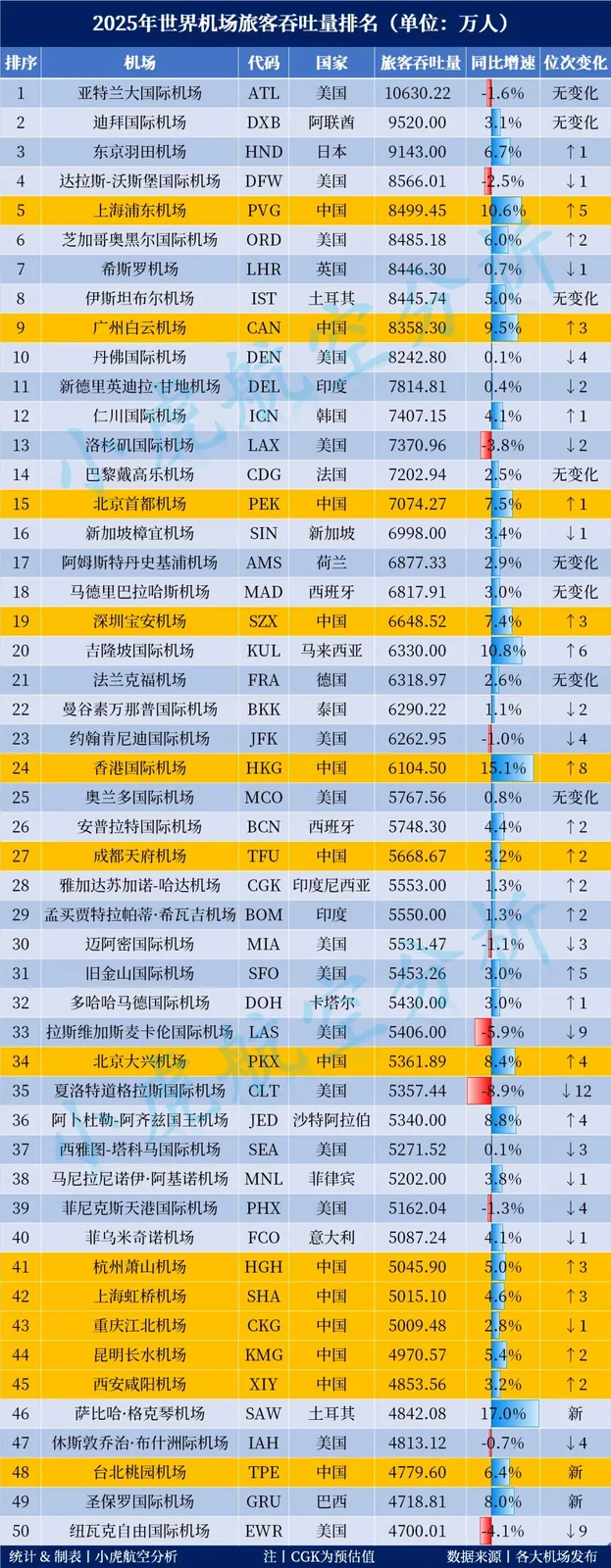
In March 2026, Xiaohu Aviation Analysis published its ranking of world airport passenger traffic for 2025. The top of the table barely moved, but three things are worth remembering: Atlanta led for a fifth consecutive year while falling for the first time; Shanghai Pudong entered the global top five with 84.99 million passengers; and Guangzhou Baiyun returned to ninth.
Passenger traffic counts everyone who boards or lands at an airport over the year, and a connecting passenger is normally counted at both ends, which is why hub airports tend to dominate this kind of table. It tells you how many people an airport moved in twelve months. It does not tell you where they came from, or how long they waited in the terminal.
1. A fifth win for Atlanta, and its first decline in four years
Hartsfield–Jackson Atlanta International Airport (ATL) handled 106.3 million passengers and finished first for a fifth straight year. Year on year, traffic fell 1.6 per cent — the first decline after four consecutive years of growth. Atlanta was also the only airport in the world above 100 million passengers in 2025, and that single hundred-million figure was shrinking.
Dubai (DXB) followed with 95.2 million, up 3.1 per cent, and Tokyo Haneda (HND) with 91.43 million, up 6.7 per cent. Below them the field bunched up: from Dallas/Fort Worth at 85.66 million to Denver at 82.43 million, seven airports were separated by just 3.2 million passengers. Heathrow (84.46 million) and Istanbul (84.46 million) stood 5,600 passengers apart — roughly half a day's traffic at that scale, and hardly evidence of a difference in strength.
The 2025 top ten, as listed in the ranking table (passengers in millions):
| Rank | Airport | Code | Country | Passengers (million) | Change | Rank move |
|---|---|---|---|---|---|---|
| 1 | Atlanta | ATL | United States | 106.30 | −1.6% | no change |
| 2 | Dubai | DXB | United Arab Emirates | 95.20 | +3.1% | no change |
| 3 | Tokyo Haneda | HND | Japan | 91.43 | +6.7% | up 1 |
| 4 | Dallas/Fort Worth | DFW | United States | 85.66 | +2.5% | down 1 |
| 5 | Shanghai Pudong | PVG | China | 84.99 | +10.6% | up 5 |
| 6 | Chicago O'Hare | ORD | United States | 84.85 | +6.0% | up 2 |
| 7 | London Heathrow | LHR | United Kingdom | 84.46 | +0.7% | down 1 |
| 8 | Istanbul | IST | Türkiye | 84.46 | +5.0% | no change |
| 9 | Guangzhou Baiyun | CAN | China | 83.58 | +9.5% | up 3 |
| 10 | Denver | DEN | United States | 82.43 | +0.1% | down 4 |
2. Pudong enters the top five, Baiyun returns to ninth
Shanghai Pudong International Airport (PVG) climbed from tenth in 2024 to fifth, crossing five places in a year and setting its highest rank on record. Guangzhou Baiyun International Airport (CAN) returned to ninth with 83.58 million passengers, up three places and 9.5 per cent. The two are built differently: Baiyun carries a higher share of domestic trunk routes, with dense waves and quick connections, while Pudong leans more on international and regional services, and its recovery has tracked the reopening of those routes. For travellers the difference is practical — Baiyun is usually the smoother of the two for a domestic connection, Pudong the richer choice for a long-haul departure.
3. Thirteen Chinese airports in the top 50, twelve of them climbing
Widen the view to the top 50 and 13 Chinese airports appear: Pudong (5), Baiyun (9), Beijing Capital (15), Shenzhen Bao'an (19), Hong Kong (24), Chengdu Tianfu (27), Beijing Daxing (34), Hangzhou Xiaoshan (41), Shanghai Hongqiao (42), Chongqing Jiangbei (43), Kunming Changshui (44), Xi'an Xianyang (45) and Taipei Taoyuan (48). Four are in the top 20 and six in the top 30.
Twelve of the 13 improved on 2024; the exception was Chongqing Jiangbei, which slipped one place. Hong Kong International Airport (HKG) was the standout, rising eight places to 24th with 61.05 million passengers and returning to the top 30.
Between 41st and 45th sits the densest cluster of them all: Hangzhou 50.46 million, Shanghai Hongqiao 50.15 million, Chongqing Jiangbei 50.09 million, Kunming Changshui 49.71 million and Xi'an Xianyang 48.54 million, five airports within two million passengers of each other. Any one of them can be overtaken by a neighbour within a few months.
On growth, the fastest climber in the top 50 was Istanbul Sabiha Gökçen (SAW) at 17.0 per cent, with 48.42 million passengers in 46th place — a new entry this year. Hong Kong followed at 15.1 per cent, Kuala Lumpur (KUL) at 10.8 per cent and Shanghai Pudong at 10.6 per cent, four airports in double digits. Among the ten fastest-growing airports in the table, six are Chinese: Hong Kong, Pudong, Baiyun (9.5), Daxing (8.4), Beijing Capital (7.5) and Shenzhen Bao'an (7.4).
4. Asia gains, North America slips, the Middle East is the wildcard
Growth in 2025 was clearly concentrated in Asia. In North America most airports handled less traffic than the year before, with Chicago O'Hare (up 6.0 per cent) a rare exception. Delhi's Indira Gandhi International Airport (DEL) managed 78.15 million passengers, up just 0.4 per cent, and fell out of the top ten to 11th, leaving the group without a South Asian representative.
The Middle East is the biggest variable in the table. Dubai held second place with 95.2 million, its crossroads position between Asia, Africa and Europe still working strongly; but the region's frequent upheavals can hit a hub that lives on connecting traffic very quickly.
5. How to read the table
Passenger traffic measures scale, not experience. Atlanta stays on top because Delta treats it as its largest connecting hub, pushing waves of passengers in and out several times a day; Pudong, Baiyun and Hong Kong depend more on the density of international routes and the demand of their hinterlands. The table is useful for reading a trend — Hong Kong up eight places in a year, Pudong into the top five — because it shows where flights are multiplying and connections widening. What decides whether a journey goes smoothly is still the schedule, the connection time and the fare.
Into 2026, several of those lines will keep moving. Pudong has to defend fifth place on further recovery in international routes. Hong Kong's next step depends on transfer demand from the Greater Bay Area. Dubai will stay near the top but is more exposed to regional politics than any airport here. Atlanta, meanwhile, suggests the US domestic market has little left to give: it holds first place not because it is growing, but because nobody else grew either.
6. August 2026: Incheon takes the international crown
In August 2026 China Daily reported that Incheon had overtaken Heathrow by international passenger volume to become the world's busiest international airport. That does not contradict this annual table: total traffic includes huge domestic networks, which is why Atlanta stays first; count only international passengers and Incheon, Dubai and Heathrow are the real contenders.
For travellers, the practical reading is simple: if you care about international connections, Incheon's wave structure and transfer facilities are already in the global first rank; if you care about total traffic, Atlanta's domestic network remains a category of its own.
Related links
- On this site: Atlanta (ATL), Shanghai Pudong (PVG), Guangzhou Baiyun (CAN), Hong Kong (HKG), Dubai (DXB), Tokyo Haneda (HND), Kuala Lumpur (KUL), China (CN)
- Wikipedia: Shanghai Pudong International Airport, Guangzhou Baiyun International Airport, Hong Kong International Airport, Hartsfield–Jackson Atlanta International Airport
- Baidu Baike: Shanghai Pudong International Airport, Guangzhou Baiyun International Airport, Hong Kong International Airport
Image and data source: Xiaohu Aviation Analysis, "2025 world airport passenger traffic ranking". Figures follow that table and may differ slightly from other agencies' counting rules; traffic shifts with the season, so check the airport's and the airline's own sites before you travel.
More articlesTravel notes

Adelaide Airport Wins Two Skytrax Awards for Staff and Regional Service
Adelaide Airport has been named Best Airport Staff in Australia/Pacific for the first time and Best Regional Airport in Australia/Pacific for the fourth time in five years at the Skytrax World Airport Awards in London. Passenger numbers passed nine million in 2025, international traffic grew more than 20%, and a A$600 million expansion called Project Flight is under way.4 min read
Buying Whisky at Airport Duty-Free: A Global Shelf Guide by Flight Time
From Taoyuan and Changi to Heathrow and Sydney, airport duty-free is where whisky's travel-retail exclusives live: single casks, cask strength and no local duty. A region-by-region survey of what stood on the shelves around Chinese New Year 2020, plus how to choose by age, cask, bottle size and the liquid rules on connections.7 min read