
Tokyo Haneda Airport Terminal Map
 Tokyo · Japan· Tokyo Haneda Airport
Tokyo Haneda Airport (IATA: HND, ICAO RJTT) is a large airport serving Tokyo, Japan, with 3 terminals and 71 gates, about 14 km from central Tokyo.
Tokyo Haneda Airport (HND) serves Tokyo, Japan. It has 3 terminals with 71 gates in total and handles about 88 million passengers a year. The airport is about 14 km from the city centre. Ground transport into the city: rail, bus and taxi.
Download Airport MapsDownloads
Airport time information — HND current timeAirport Time
Current time at HND (Asia/Tokyo) compared with your local time.
Tokyo Haneda Airport route map — direct destinationsRoute Map
73 direct destinations: map, operating airlines and distances.
Airport information & detailsAirport Details
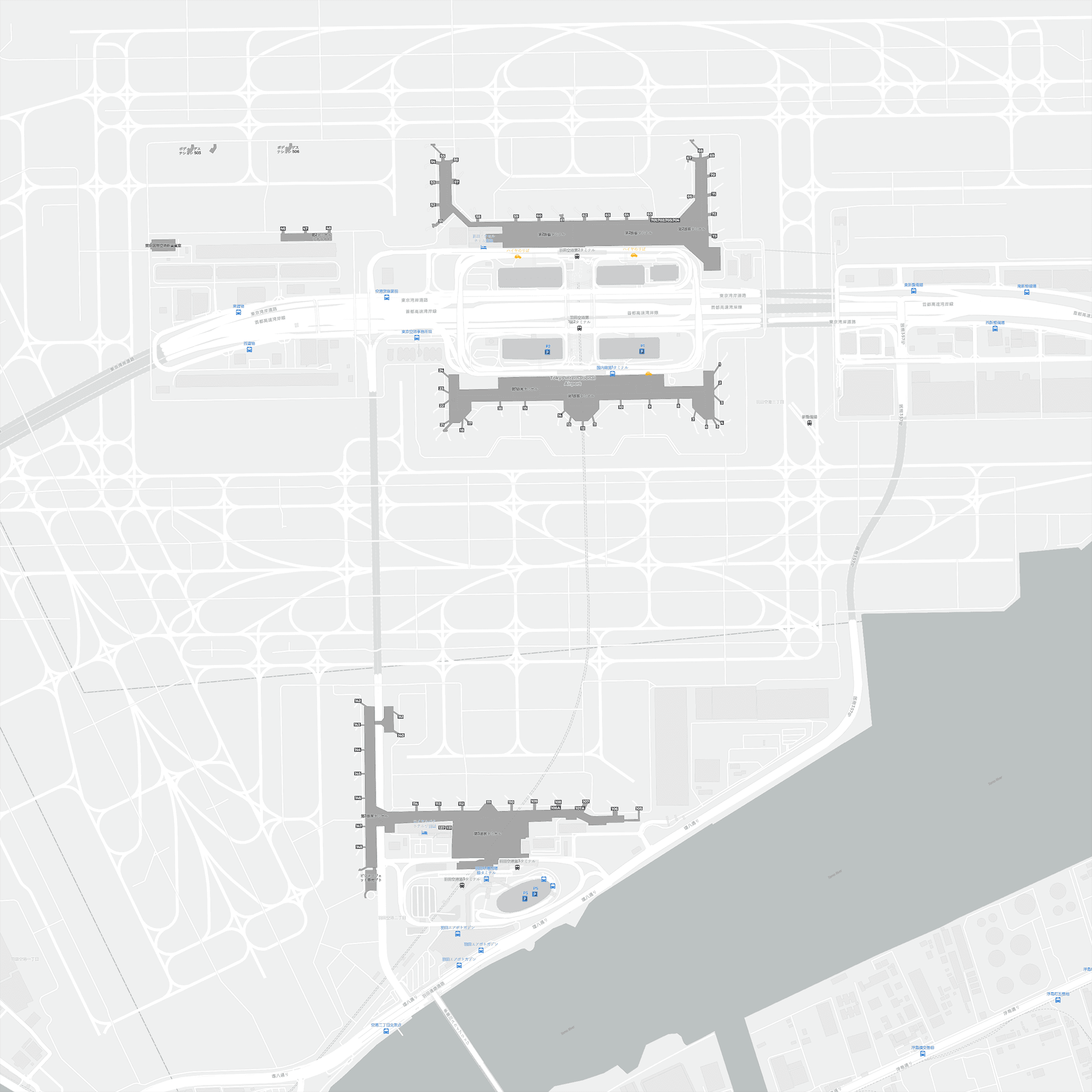
Interactive map — Tokyo Haneda Airport locationInteractive Map
View this airport on other map services:
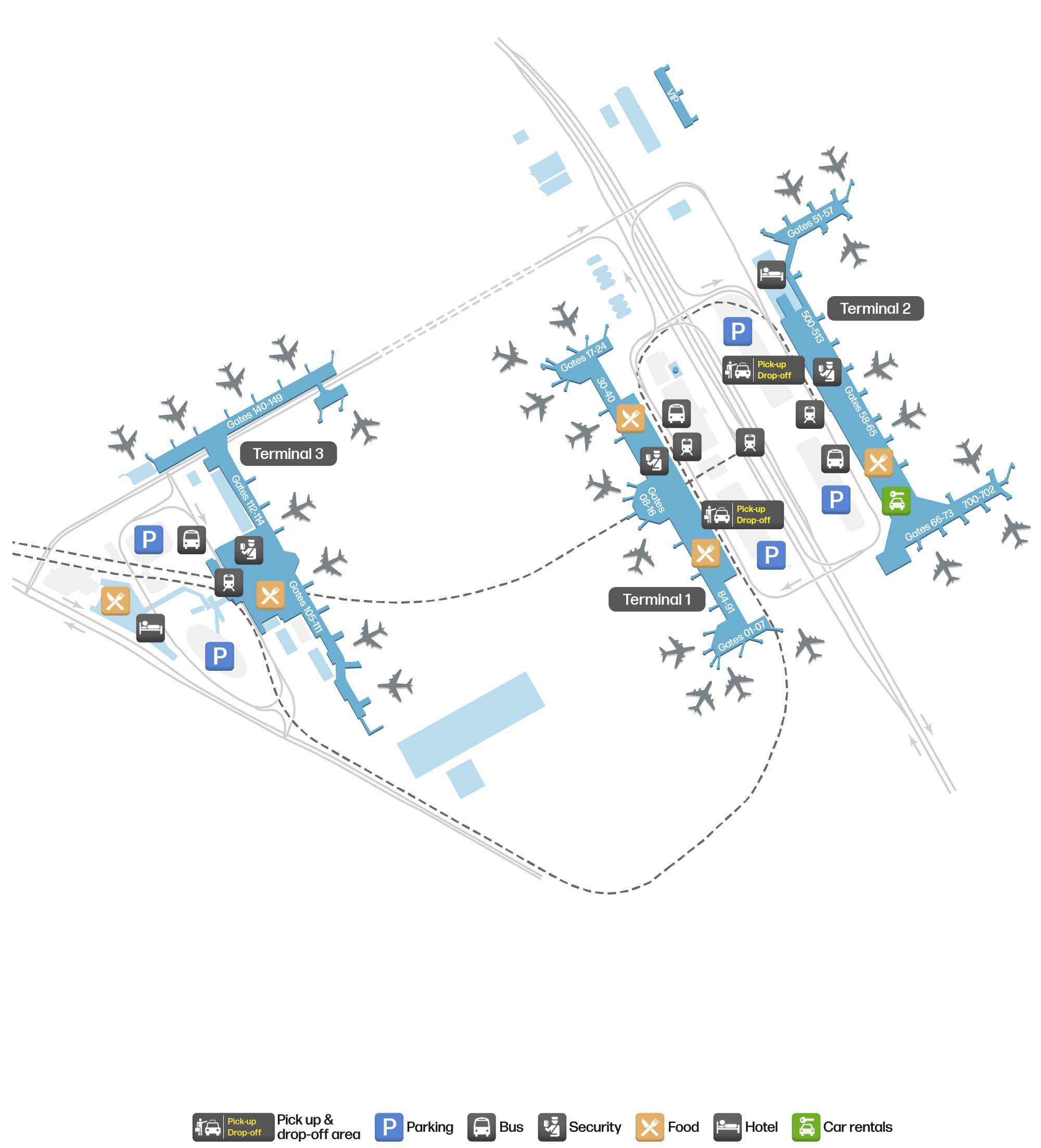
Tokyo Haneda International Airport terminal guideAirport Guide
Haneda sits on the shore of Tokyo Bay, about 15 km from central Tokyo, and handles around 91.7 million passengers a year (2025). It is the international airport closest to Tokyo — the counterpart to Narita, some 60 km away. Its layout splits by carrier and by domestic or international: Japan Airlines group domestic flights are in T1, ANA group domestic flights in T2, and international flights are concentrated in T3.
The three terminals
| Code | Name | Main carriers | Role |
|---|---|---|---|
| T1 | Terminal 1 | Japan Airlines group | Domestic flights |
| T2 | Terminal 2 | ANA group | Mostly domestic flights |
| T3 | Terminal 3 | International carriers | International flights, plus a few domestic charters |
How to tell where you are: start from the operating carrier — JAL group domestic flights use T1, ANA group T2, and any international flight uses T3. When you are unsure, go by your boarding pass.
Our diagram lays the three buildings out along the bay shore as separate blocks precisely to remind you that mixing up the terminal numbers means a long loop right around the bay.
Getting between the terminals
- Free shuttle bus — runs a loop between the three buildings, and T1 and T2 are also linked by a walking connection.
- Domestic to international (T1/T2 to T3) is the most common connection, so build the shuttle's interval into your timing.
Routes and flights
| Aspect | Details |
|---|---|
| Routes | 91.68 million passengers in 2025 (+6.7%), ranked 3rd worldwide; the densest domestic network in Japan, with T3 international traffic expanded in recent years to serve Beijing, Shanghai, Hong Kong, Bangkok, Singapore, London, Paris, Los Angeles and New York |
| Flights | 91.68 million passengers in 2025, among the busiest airports in the world |
| Aircraft | Japan Airlines (JAL) and All Nippon Airways (ANA) are the twin bases; JAL domestic concentrates in T1 and ANA in T2, and both fly Boeing 737 / 767 / 777 / 787 and Airbus A350 |
Getting into the city
- Tokyo Monorail — about 15 minutes direct to Hamamatsucho, where you change to the JR Yamanote Line; trains are frequent.
- Keikyu Line — about 13 minutes direct to Shinagawa, with some trains running through onto the Toei Asakusa Line; handier for points south of Tokyo Station.
- Limousine bus — direct to the main city hotels, suited to heavy luggage or a late-night arrival.
- Taxi — close as the airport is, a peak-hour run can still take more than 40 minutes, and it is not cheap.
Practical tips
- For a flight to Tokyo, the ground transfer from Haneda and from Narita (NRT) differs by close to two hours, so check whether the three-letter code is HND or NRT when you book.
- The fifth floor of T3 recreates an Edo-period street scene; worth a look if you have time on a connection or before departure, and you do not need to pass through immigration.
- Haneda has plenty of late-night and early-morning international flights, but the trains stop around midnight, so have a taxi or the airport bus as your fallback if you land on a red-eye.
Terminal guideTerminal Guide
Gate ranges, main airlines and facilities for each terminal at Tokyo Haneda Airport.