
Aeroporto Internacional Ninoy Aquino — mapa do terminal
 Manila · Filipinas· Ninoy Aquino International Airport
O Aeroporto Internacional Ninoy Aquino (IATA: MNL, ICAO RPLL) é um aeroporto grande que atende Manila, Filipinas, com 4 terminais e 70 portões, a cerca de 7 km do centro de Manila.
Ninoy Aquino International Airport (MNL) serves Manila, Philippines. It has 4 terminals with 70 gates in total and handles about 48 million passengers a year. The airport is about 7 km from the city centre. Ground transport into the city: bus, taxi and car.
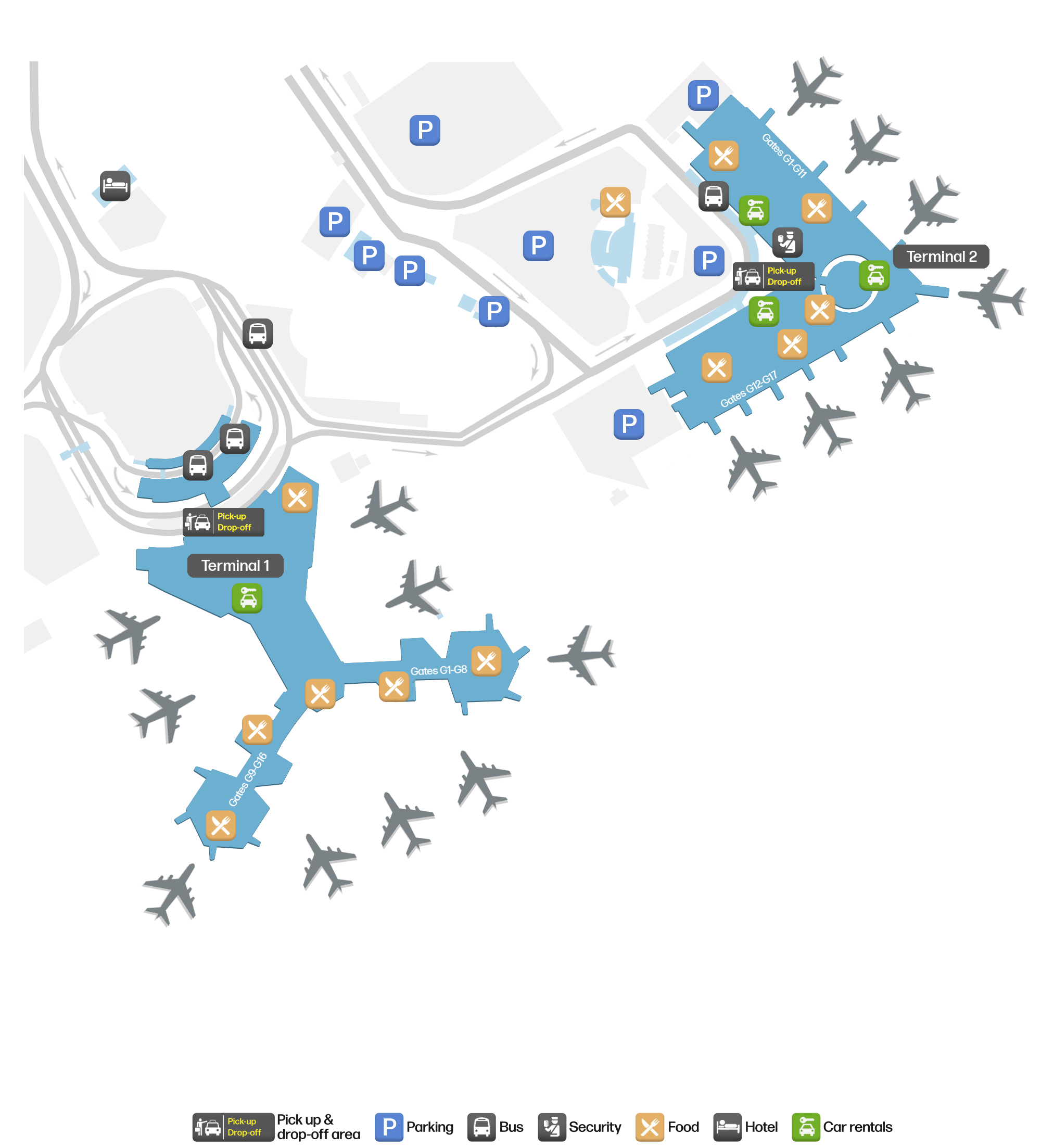
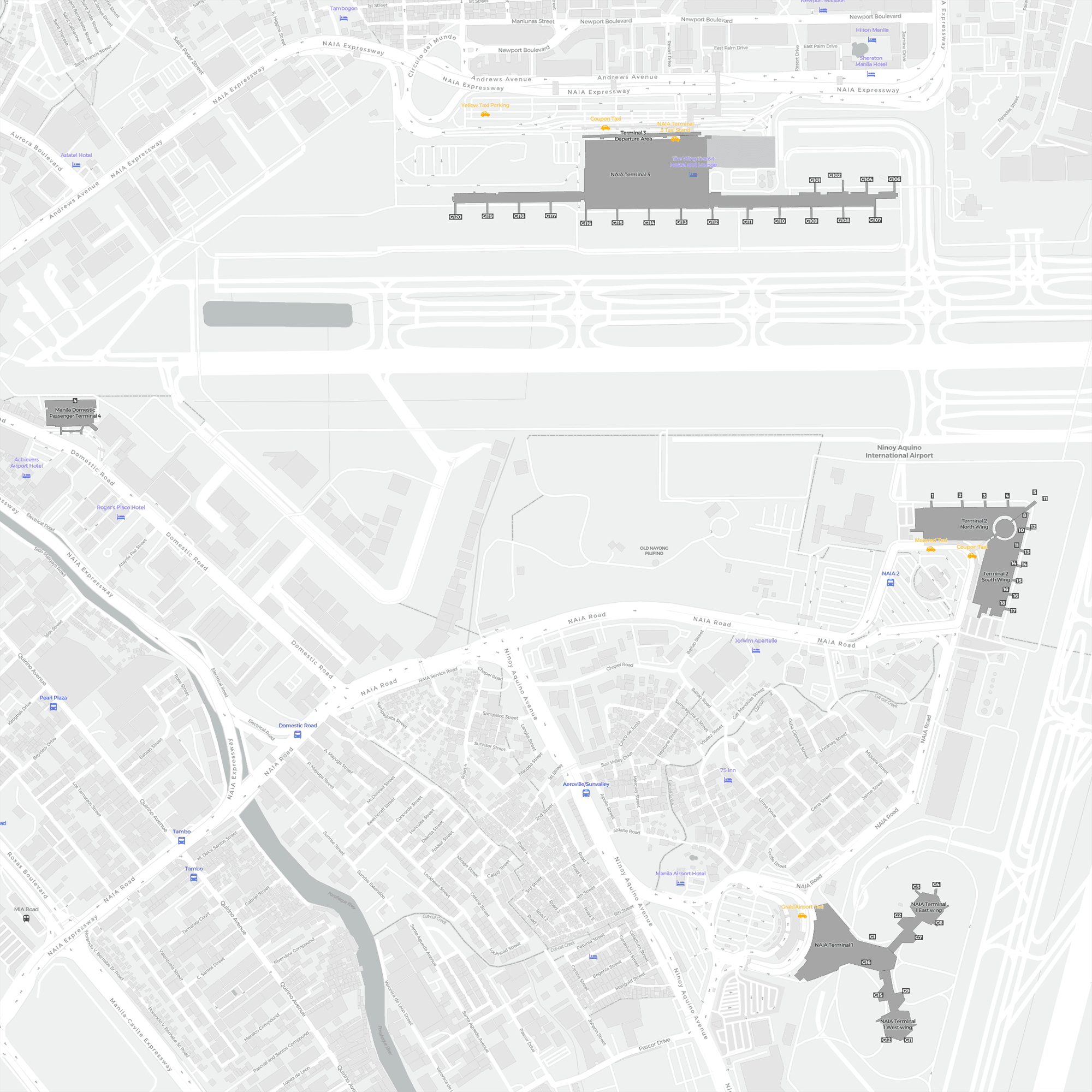
Baixar mapas do aeroportoDownloads
Fotos do aeroportoFotos do aeroporto
Fotos reais deste aeroporto, cada uma creditada à página pública da web onde foi encontrada; os direitos autorais continuam com os fotógrafos originais. Clique em uma foto para ampliar ou em uma linha de crédito para abrir a página de origem.
Na imagem de satélite, os terminais, o pátio e as pistas do Aeroporto Internacional Ninoy Aquino (MNL) são claramente visíveis.
Horário do aeroporto — horário atual em MNLHorário do aeroporto
Horário atual em MNL (Asia/Manila) comparado ao seu horário local.
Aeroporto Internacional Ninoy Aquino: mapa de rotas — destinos diretosMapa de rotas
76 destinos diretos: mapa, companhias aéreas em operação e distâncias.
Aeroporto Internacional Ninoy Aquino: voos — partidas e chegadasPainel de voos
1.823 números de voo de 67 companhias aéreas para 87 destinos, separados por direção. Números de codeshare estão incluídos.
| Voo | Companhia aérea | Destino | País/região |
|---|---|---|---|
| 5J14 | Cebu Pacific | Aeroporto Internacional de Dubai | Emirados Árabes Unidos |
| 5J18 | Cebu Pacific | Aeroporto Internacional de Dubai | Emirados Árabes Unidos |
| 5J39 | Cebu Pacific | Aeroporto Kingsford Smith de Sydney | Austrália |
| 5J49 | Cebu Pacific | Melbourne Airport | Austrália |
| 5J110 | Cebu Pacific | Aeroporto Internacional de Hong Kong | China |
| 5J112 | Cebu Pacific | Aeroporto Internacional de Hong Kong | China |
| 5J114 | Cebu Pacific | Aeroporto Internacional de Hong Kong | China |
| 5J142 | Cebu Pacific | Aeroporto Internacional de Hong Kong | China |
| 5J186 | Cebu Pacific | Aeroporto Internacional de Incheon | Coreia do Sul |
| 5J188 | Cebu Pacific | Aeroporto Internacional de Incheon | Coreia do Sul |
| 5J192 | Cebu Pacific | Cauayan City (CYZ) Cauayan Airport | Filipinas |
| 5J196 | Cebu Pacific | Cauayan City (CYZ) Cauayan Airport | Filipinas |
| 5J268 | Cebu Pacific | Xiamen Gaoqi International Airport | China |
| 5J272 | Cebu Pacific | Aeroporto Internacional de Hong Kong | China |
| 5J279 | Cebu Pacific | Denpasar I Gusti Ngurah Rai International Airport | Indonésia |
| 5J281 | Cebu Pacific | Denpasar I Gusti Ngurah Rai International Airport | Indonésia |
| 5J286 | Cebu Pacific | Aeroporto Internacional de Cantão-Baiyun | China |
| 5J288 | Cebu Pacific | Aeroporto Internacional de Cantão-Baiyun | China |
| 5J310 | Cebu Pacific | Taiwan Taoyuan International Airport | Taiwan |
| 5J312 | Cebu Pacific | Taiwan Taoyuan International Airport | Taiwan |
Números de voo e rotas do índice de voos da aviability.com (instantâneo de 26 de outubro de 2026); números de codeshare estão incluídos e nenhum horário de partida é exibido. Fonte: aviability.com ↗
Informações e detalhes do aeroportoDetalhes do aeroporto
Mapa interativo — localização do Aeroporto Internacional Ninoy AquinoMapa interativo
Veja este aeroporto em outros serviços de mapas:
Manila Ninoy Aquino International Airport terminal guideGuia do aeroporto
Ninoy Aquino International Airport sits right beside Manila, about 7 km from the city centre, and handles around 52 million passengers a year (2025). It has four terminals with no walkways and no rail link between them, only road shuttles — which makes it one of the airports in Southeast Asia where you most need to leave generous time.
Satellite view
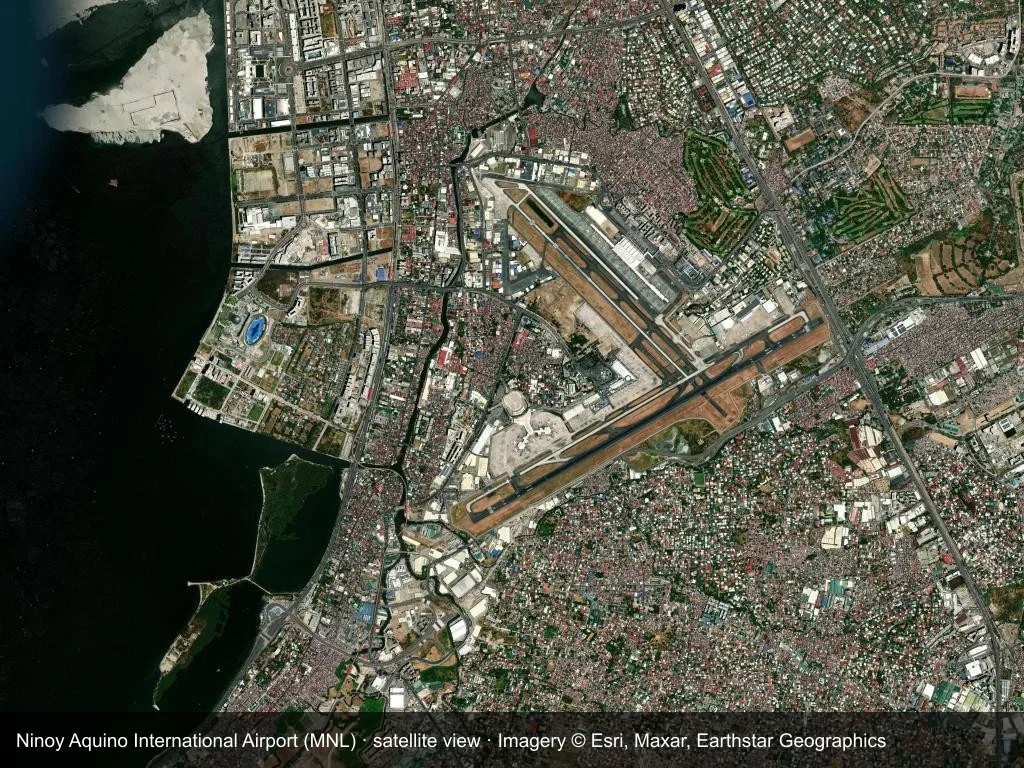
In the satellite image, the terminals, apron and runways at Ninoy Aquino International Airport (MNL) are clearly visible.
The satellite image comes from Esri World Imagery (© Esri, Maxar, Earthstar Geographics); the field and attribution are labelled in the image. This is a satellite view, not a ground-level photograph.
The four terminals
| Code | Name | Main flights | Main carriers |
|---|---|---|---|
| T1 | Terminal 1 | Mostly international | Several foreign carriers; AirAsia Philippines international flights also use it |
| T2 | Terminal 2 | Domestic + international | Philippine Airlines only, split into domestic and international zones |
| T3 | Terminal 3 | International + domestic | The largest and newest; Cebu Pacific, JAL, ANA and others |
| T4 | Terminal 4 | Domestic | Small low-cost carriers and turboprop flights |
How to tell where you are:
- For Philippine Airlines, look to T2; for Cebu Pacific and most international carriers, T3; AirAsia Philippines flies its international routes from T1 and its domestic routes from T2 (changed from March 2026).
- T1 / T2 / T3 are linked by a free inter-terminal shuttle (running 24 hours, boarding pass required), which uses public roads and is exposed to traffic.
- T4 is the furthest from the others, and the drive can take 30–40 minutes.
Our diagram draws the four buildings as separate structures precisely to make the point that every terminal change here is a road journey.
Transfers and connections
- Manila has no airside inter-terminal transit — changing buildings means leaving the terminal, collecting your bags and checking in and clearing security again.
- Official and airline advice: 2 hours for international-to-international in the same building, 3–4 hours for international-to-international across buildings, and 3.5–4 hours for international-to-domestic.
- The early morning (05:00–09:00) and the evening (16:00–20:00) are the congestion peaks, so always budget a cross-terminal connection against peak conditions.
Routes and flights
- Routes — around 30-plus airlines flying to about 60 destinations; long-haul points include Tokyo, Osaka, Seoul, Beijing, Shanghai, Hong Kong, Singapore, Dubai, Sydney, Los Angeles and San Francisco.
- Flights — about 52.02 million passengers in 2025, an all-time record for the airport.
- Aircraft — main bases are Philippine Airlines (T2) and Cebu Pacific (T3), followed by AirAsia Philippines and PAL Express; the fleet is the A320/A321 family, with A330 and A350 on long-haul.
Getting into Manila
- Taxi / rideshare (Grab) — about 7 km, but Manila's congestion can stretch that to an hour, so allow for it.
- Airport buses — linking the main districts of the city with the terminals.
- Light rail / metro — you must first take road transport out of the airport area to reach it, which is not convenient for travellers with heavy luggage.
Practical tips
- Manila is one of the Asian hubs that demands the most patience when connecting: budget 4 hours rather than expecting 2 to cover a cross-terminal transfer.
- In the holiday seasons (Holy Week, All Souls' Day, Christmas and New Year) the crowds stack up, and queues for the inter-terminal shuttle get noticeably longer.
- The city is only a street away from the airport but the congestion is severe, so when you have a flight to catch, plan the ground journey for the worst case.
References
Guia dos terminaisGuia dos terminais
Faixas de portões, principais companhias aéreas e instalações de cada terminal do Aeroporto Internacional Ninoy Aquino.
Comentários dos leitoresDiscussão
Perguntas, relatos de viagem e correções são bem-vindos. Os comentários são públicos.
Carregando…
Carregando comentários…