
Ninoy Aquino International Airport Terminal Map
 Manila · Philippines· Ninoy Aquino International Airport
Ninoy Aquino International Airport (IATA: MNL, ICAO RPLL) is a large airport serving Manila, Philippines, with 4 terminals and 70 gates, about 7 km from central Manila.
Ninoy Aquino International Airport (MNL) serves Manila, Philippines. It has 4 terminals with 70 gates in total and handles about 48 million passengers a year. The airport is about 7 km from the city centre. Ground transport into the city: bus, taxi and car.
Download Airport MapsDownloads
Airport time information — MNL current timeAirport Time
Current time at MNL (Asia/Manila) compared with your local time.
Ninoy Aquino International Airport route map — direct destinationsRoute Map
76 direct destinations: map, operating airlines and distances.
Airport information & detailsAirport Details
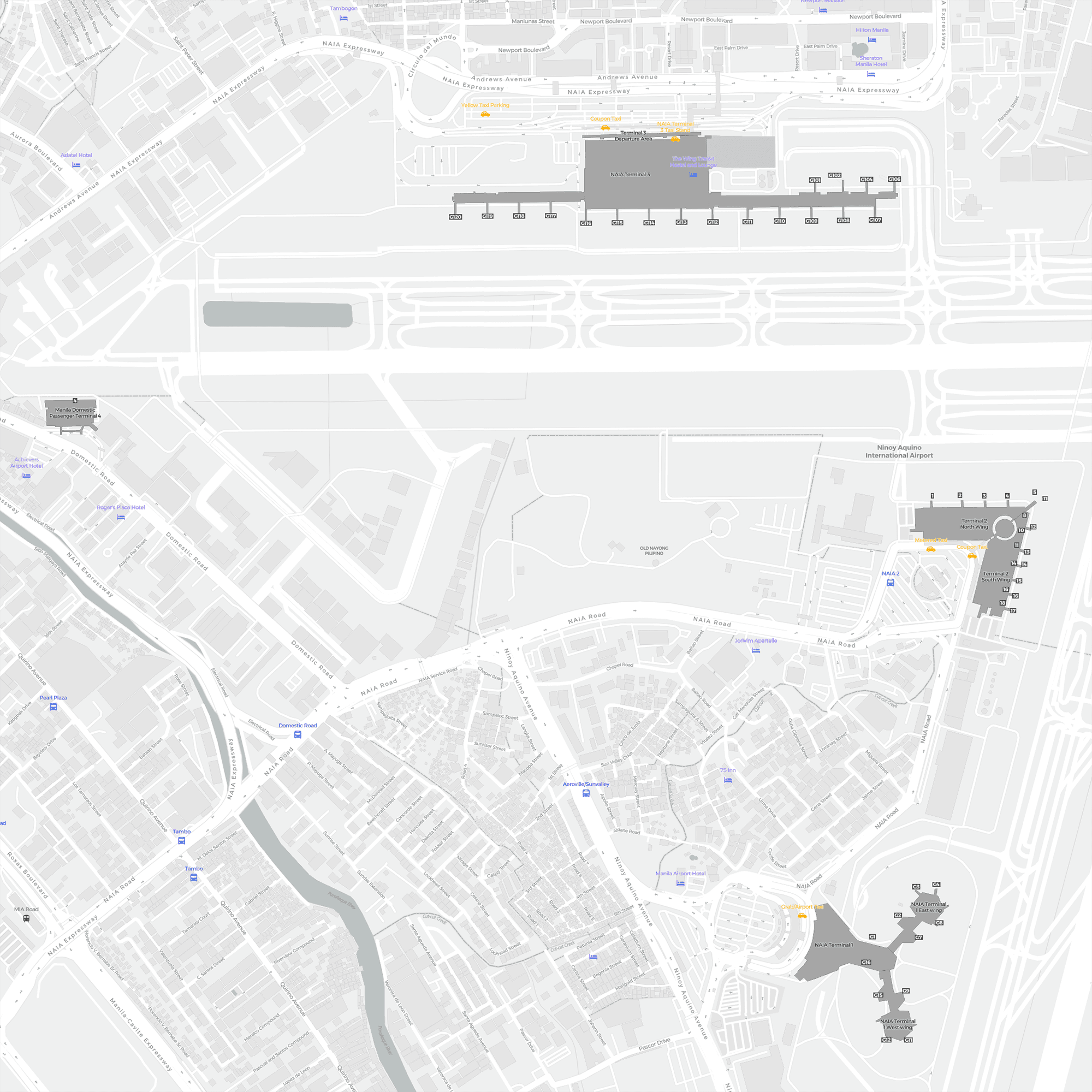
Interactive map — Ninoy Aquino International Airport locationInteractive Map
View this airport on other map services:
Manila Ninoy Aquino International Airport terminal guideAirport Guide
Ninoy Aquino International Airport sits right beside Manila, about 7 km from the city centre, and handles around 52 million passengers a year (2025). It has four terminals with no walkways and no rail link between them, only road shuttles — which makes it one of the airports in Southeast Asia where you most need to leave generous time.
The four terminals
| Code | Name | Main flights | Main carriers |
|---|---|---|---|
| T1 | Terminal 1 | Mostly international | Several foreign carriers; AirAsia Philippines international flights also use it |
| T2 | Terminal 2 | Domestic + international | Philippine Airlines only, split into domestic and international zones |
| T3 | Terminal 3 | International + domestic | The largest and newest; Cebu Pacific, JAL, ANA and others |
| T4 | Terminal 4 | Domestic | Small low-cost carriers and turboprop flights |
How to tell where you are:
- For Philippine Airlines, look to T2; for Cebu Pacific and most international carriers, T3; AirAsia Philippines flies its international routes from T1 and its domestic routes from T2 (changed from March 2026).
- T1 / T2 / T3 are linked by a free inter-terminal shuttle (running 24 hours, boarding pass required), which uses public roads and is exposed to traffic.
- T4 is the furthest from the others, and the drive can take 30–40 minutes.
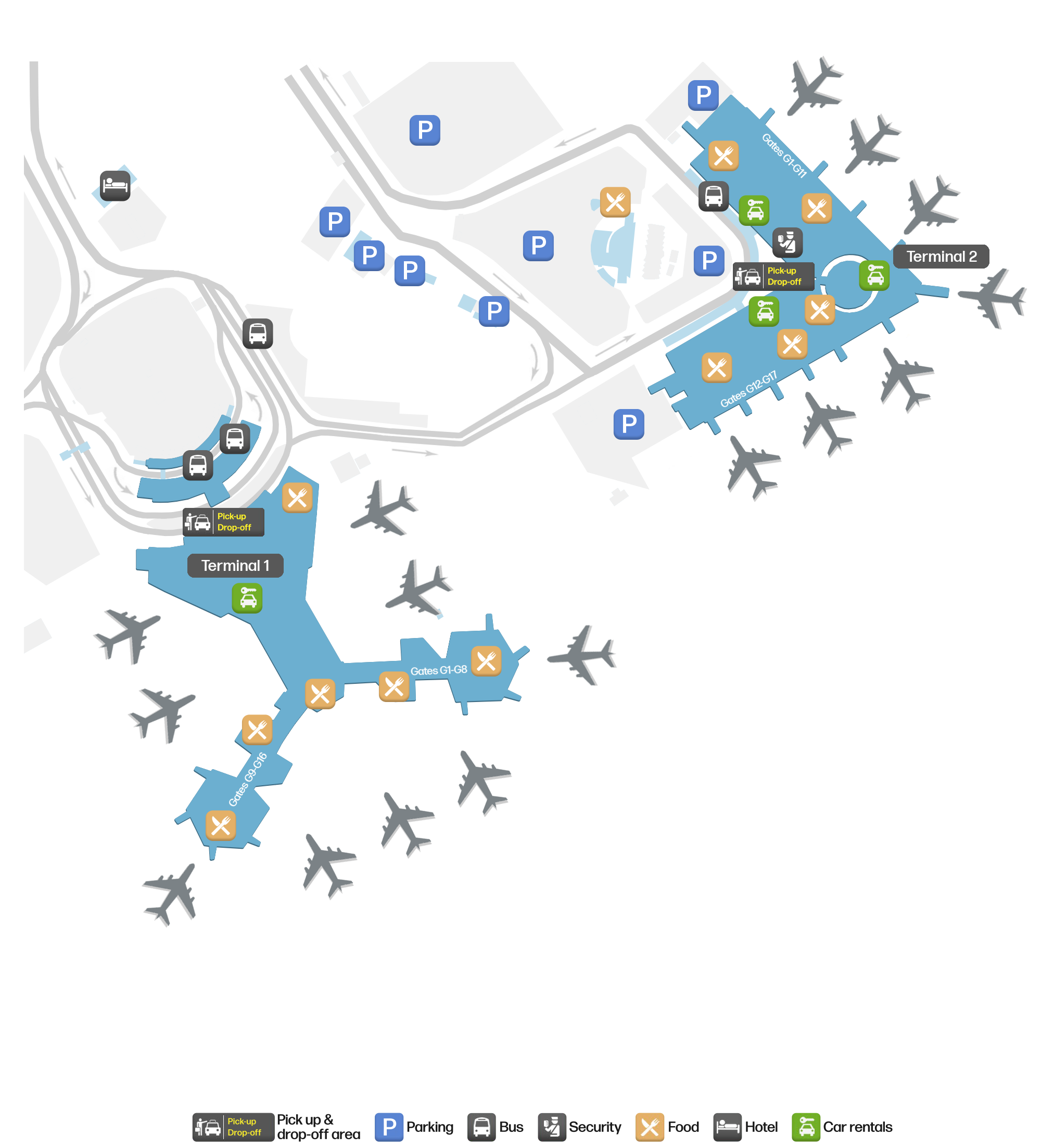
Our diagram draws the four buildings as separate structures precisely to make the point that every terminal change here is a road journey.
Transfers and connections
- Manila has no airside inter-terminal transit — changing buildings means leaving the terminal, collecting your bags and checking in and clearing security again.
- Official and airline advice: 2 hours for international-to-international in the same building, 3–4 hours for international-to-international across buildings, and 3.5–4 hours for international-to-domestic.
- The early morning (05:00–09:00) and the evening (16:00–20:00) are the congestion peaks, so always budget a cross-terminal connection against peak conditions.
Routes and flights
- Routes — around 30-plus airlines flying to about 60 destinations; long-haul points include Tokyo, Osaka, Seoul, Beijing, Shanghai, Hong Kong, Singapore, Dubai, Sydney, Los Angeles and San Francisco.
- Flights — about 52.02 million passengers in 2025, an all-time record for the airport.
- Aircraft — main bases are Philippine Airlines (T2) and Cebu Pacific (T3), followed by AirAsia Philippines and PAL Express; the fleet is the A320/A321 family, with A330 and A350 on long-haul.
Getting into Manila
- Taxi / rideshare (Grab) — about 7 km, but Manila's congestion can stretch that to an hour, so allow for it.
- Airport buses — linking the main districts of the city with the terminals.
- Light rail / metro — you must first take road transport out of the airport area to reach it, which is not convenient for travellers with heavy luggage.
Practical tips
- Manila is one of the Asian hubs that demands the most patience when connecting: budget 4 hours rather than expecting 2 to cover a cross-terminal transfer.
- In the holiday seasons (Holy Week, All Souls' Day, Christmas and New Year) the crowds stack up, and queues for the inter-terminal shuttle get noticeably longer.
- The city is only a street away from the airport but the congestion is severe, so when you have a flight to catch, plan the ground journey for the worst case.
Terminal guideTerminal Guide
Gate ranges, main airlines and facilities for each terminal at Ninoy Aquino International Airport.