
Aeroporto Internacional da Cidade do México — mapa do terminal
 Cidade do México · México· Mexico City International Airport
O Aeroporto Internacional da Cidade do México (IATA: MEX, ICAO MMMX) é um aeroporto grande que atende Cidade do México, México, com 2 terminais e 60 portões, a cerca de 6 km do centro de Cidade do México.
Mexico City International Airport (MEX) serves Mexico City, Mexico. It has 2 terminals with 60 gates in total and handles about 50 million passengers a year. The airport is about 6 km from the city centre. Ground transport into the city: rail, bus and taxi.
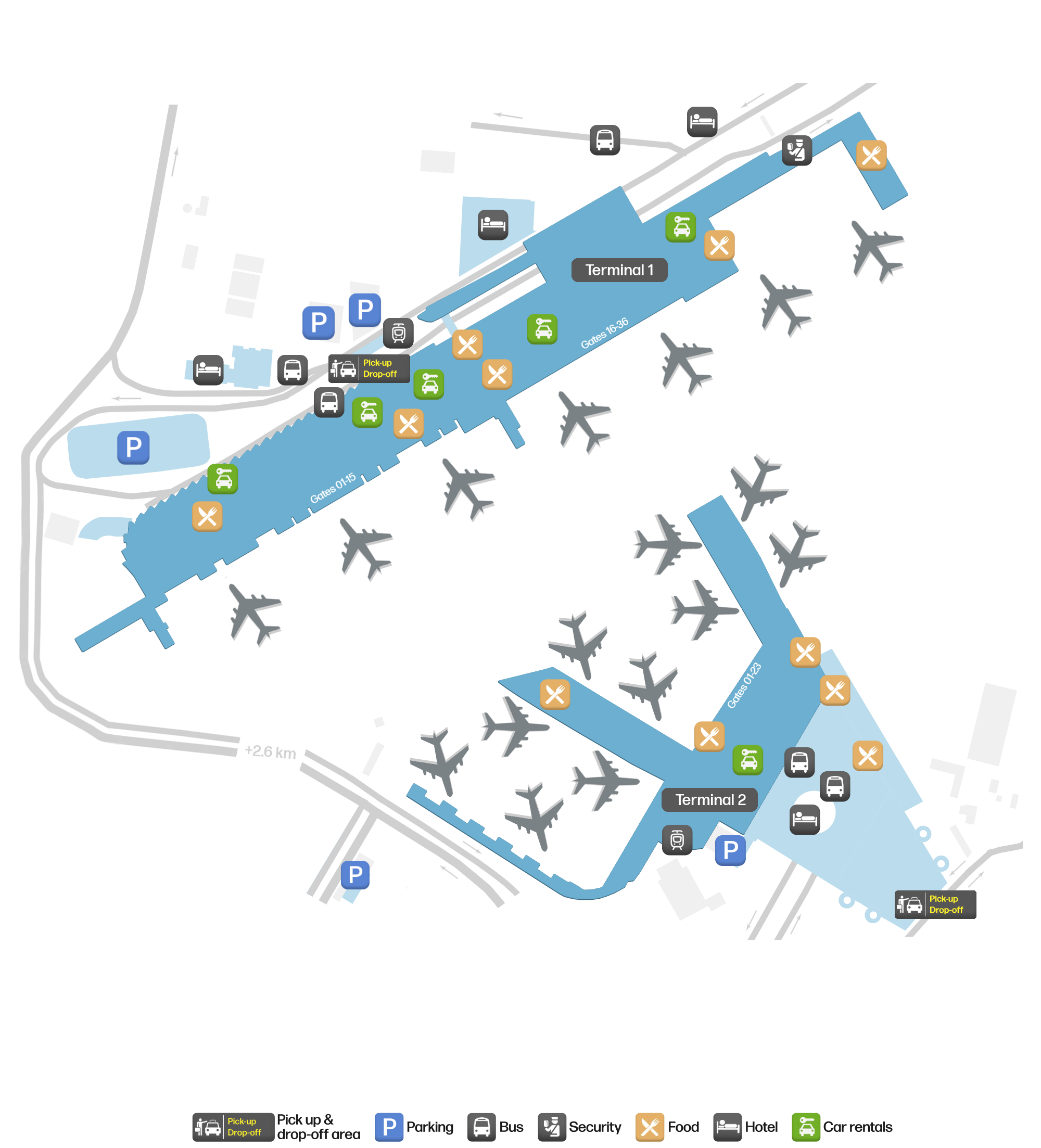
Baixar mapas do aeroportoDownloads
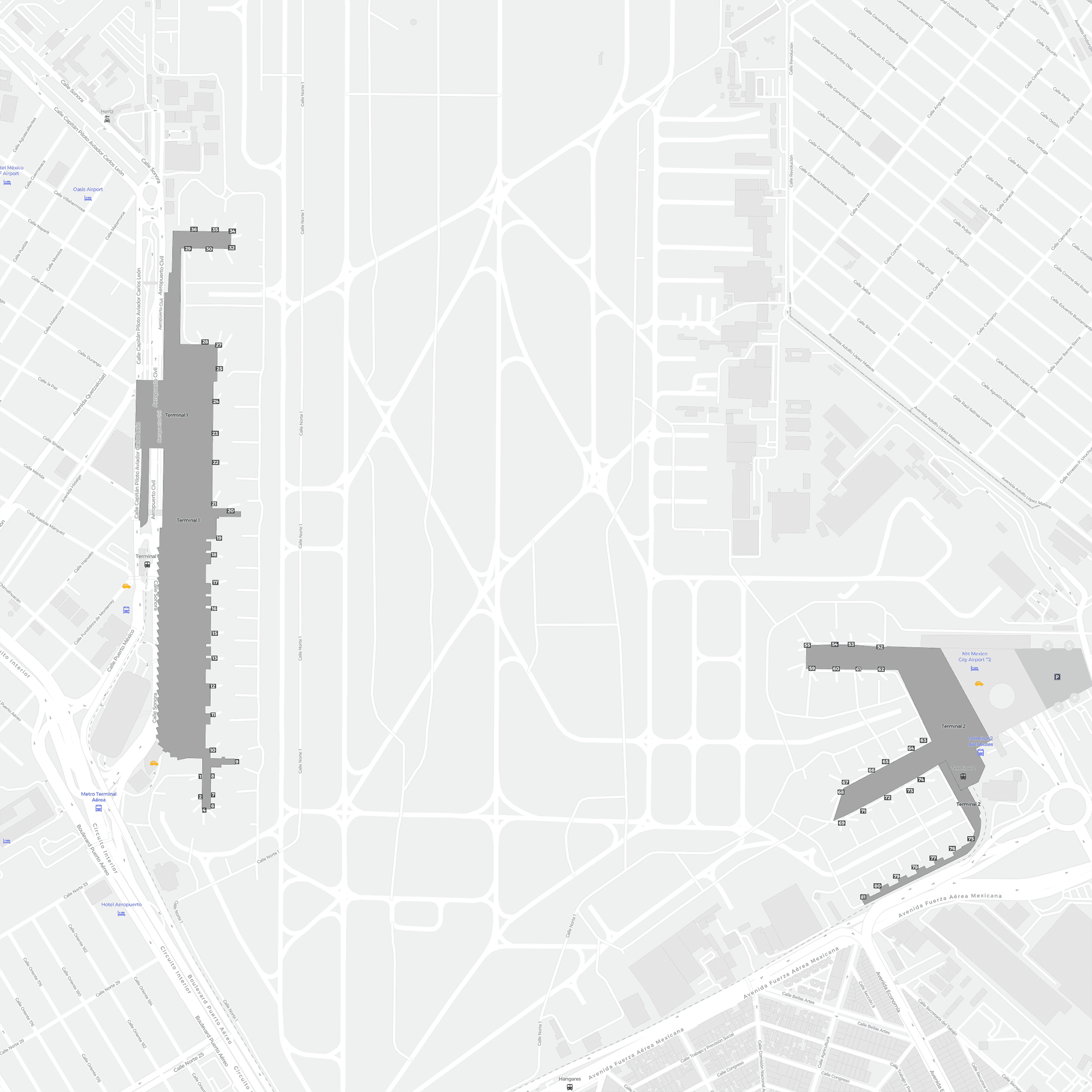
Fotos do aeroportoFotos do aeroporto
Fotos reais deste aeroporto, cada uma creditada à página pública da web onde foi encontrada; os direitos autorais continuam com os fotógrafos originais. Clique em uma foto para ampliar ou em uma linha de crédito para abrir a página de origem.
Vista de satélite: o Aeroporto Internacional da Cidade do México (MEX) é emoldurado por cidade, costa ou relevo, com a pista cruzando a cena.
Horário do aeroporto — horário atual em MEXHorário do aeroporto
Horário atual em MEX (America/Mexico_City) comparado ao seu horário local.
Aeroporto Internacional da Cidade do México: mapa de rotas — destinos diretosMapa de rotas
91 destinos diretos: mapa, companhias aéreas em operação e distâncias.
Aeroporto Internacional da Cidade do México: voos — partidas e chegadasPainel de voos
6.805 números de voo de 44 companhias aéreas para 109 destinos, separados por direção. Números de codeshare estão incluídos.
| Voo | Companhia aérea | Destino | País/região |
|---|---|---|---|
| AA250 | American Airlines | Aeroporto Internacional O'Hare | Estados Unidos |
| AA264 | American Airlines | Aeroporto Internacional de Miami | Estados Unidos |
| AA390 | American Airlines | Dallas Fort Worth International Airport | Estados Unidos |
| AA394 | American Airlines | Dallas Fort Worth International Airport | Estados Unidos |
| AA502 | American Airlines | Phoenix Sky Harbor International Airport | Estados Unidos |
| AA505 | American Airlines | Aeroporto Internacional de Miami | Estados Unidos |
| AA530 | American Airlines | Aeroporto Internacional de Miami | Estados Unidos |
| AA629 | American Airlines | Dallas Fort Worth International Airport | Estados Unidos |
| AA826 | American Airlines | Charlotte Douglas International Airport | Estados Unidos |
| AA828 | American Airlines | Charlotte Douglas International Airport | Estados Unidos |
| AA1066 | American Airlines | Dallas Fort Worth International Airport | Estados Unidos |
| AA1374 | American Airlines | Dallas Fort Worth International Airport | Estados Unidos |
| AA1498 | American Airlines | Aeroporto Internacional de Miami | Estados Unidos |
| AA1944 | American Airlines | Charlotte Douglas International Airport | Estados Unidos |
| AA2006 | American Airlines | Dallas Fort Worth International Airport | Estados Unidos |
| AA2351 | American Airlines | Dallas Fort Worth International Airport | Estados Unidos |
| AA2547 | American Airlines | Aeroporto Internacional de Los Angeles | Estados Unidos |
| AA2996 | American Airlines | Aeroporto Internacional John F. Kennedy | Estados Unidos |
| AC990 | Air Canada | Aeroporto Internacional Toronto-Pearson | Canadá |
| AC1886 | Air Canada | Aeroporto Internacional Toronto-Pearson | Canadá |
Números de voo e rotas do índice de voos da aviability.com (instantâneo de 26 de outubro de 2026); números de codeshare estão incluídos e nenhum horário de partida é exibido. Fonte: aviability.com ↗
Informações e detalhes do aeroportoDetalhes do aeroporto
Mapa interativo — localização do Aeroporto Internacional da Cidade do MéxicoMapa interativo
Veja este aeroporto em outros serviços de mapas:
Mexico City Benito Juárez International Airport terminal guideGuia do aeroporto
Mexico City's airport lies about 13 km from the city centre and handles around 44.6 million passengers a year (2025), making it one of the busiest in Latin America. It has two terminals, 2–3 km apart, linked by a free monorail shuttle (Aerotrén) — but one thing matters more than that: Mexico City now has two airports, so whenever you see "Mexico City" on a booking, check the three-letter code.
Satellite view
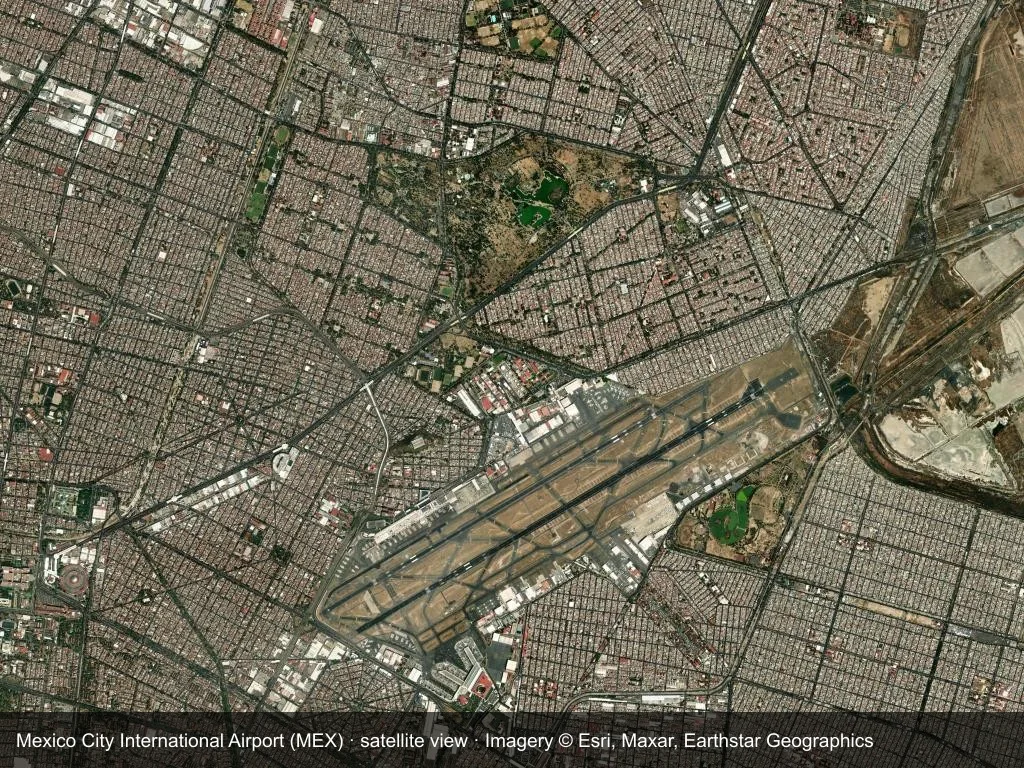
Satellite view: Mexico City International Airport (MEX) is framed by city, coast or terrain, with the runway crossing the scene.
The satellite image comes from Esri World Imagery (© Esri, Maxar, Earthstar Geographics); the field and attribution are labelled in the image. This is a satellite view, not a ground-level photograph.
The two terminals
| Code | Name | Main carriers | Notes |
|---|---|---|---|
| T1 | Terminal 1 | Most international carriers, along with domestic and foreign airlines | Built earlier and the largest; Metro Line 5 has a station here |
| T2 | Terminal 2 | Aeroméxico (hub) and SkyTeam | Newer, with long-haul and connecting flights concentrated here |
How to tell where you are:
- The Aeroméxico group is in T2; almost all other carriers are in T1 — start with the airline, then check your boarding pass.
- T1 ↔ T2 has two links: the airside Aerotrén monorail, which is free (boarding pass required, roughly 05:00–23:00), or the landside shuttle bus, free or low-cost (24 hours).
- For a cross-terminal connection allow 45–60 minutes.
Our diagram draws the two buildings as separate structures joined by a single monorail line precisely to show the distance between them.
Transfers and connections
- A connection inside T1 or inside T2 is quickest; for a cross-terminal connection allow more than 1.5 hours.
- The airside cross-terminal link depends on the Aerotrén and on your boarding pass, and it stops running late at night, leaving only the landside shuttle.
- Mexico City sits at about 2,200 metres, and a long-haul flight takes more out of you here, so err on the generous side with connection time.
Routes and flights
- Routes — around 20-plus airlines flying to about 100 destinations; long-haul points include Madrid, Barcelona, Paris, Amsterdam, London, Tokyo, São Paulo and Buenos Aires.
- Flights — 44.61 million passengers in 2025 (27.12 million domestic, 17.48 million international), down about 1.7% as some services have shifted to NLU.
- Aircraft — main base is Aeroméxico (T2) and SkyTeam, followed by Viva Aerobús and Volaris; the fleet is 737 and A320 family narrowbodies, with Aeroméxico using 787 and 777 on long-haul.
Getting into Mexico City
- Metro Line 5 — has a station on the T1 side and costs very little; the main way to dodge the traffic, but T2 has no direct metro, so you must shuttle to T1 first.
- The Metro Line 1 extension — connects parts of the network to the area around the airport.
- Airport buses — cover the main hubs and hotel districts of the city.
- Taxi / rideshare — authorised taxis must be paid for at a counter inside the terminal; rideshare pick-ups are from set points.
Practical tips
- The biggest trap is confusing the airports: Mexico City now has Benito Juárez (MEX) and Felipe Ángeles (NLU), with NLU 35–50 km north of the city and used mainly by low-cost carriers. Check the three-letter code before booking or arranging a pick-up.
- Travellers heading for NLU can take the suburban railway that opened in April 2026 (direct from Buenavista station in the north of the city) instead of relying on a long coach ride.
- Traffic in Mexico City is severe, so when you have a flight to catch, budget for peak road conditions — rail is the only predictable option.
References
Guia dos terminaisGuia dos terminais
Faixas de portões, principais companhias aéreas e instalações de cada terminal do Aeroporto Internacional da Cidade do México.
Comentários dos leitoresDiscussão
Perguntas, relatos de viagem e correções são bem-vindos. Os comentários são públicos.
Carregando…
Carregando comentários…