
Mexico City International Airport Terminal Map
 Mexico City · Mexico· Mexico City International Airport
Mexico City International Airport (IATA: MEX, ICAO MMMX) is a large airport serving Mexico City, Mexico, with 2 terminals and 60 gates, about 6 km from central Mexico City.
Mexico City International Airport (MEX) serves Mexico City, Mexico. It has 2 terminals with 60 gates in total and handles about 50 million passengers a year. The airport is about 6 km from the city centre. Ground transport into the city: rail, bus and taxi.
Download Airport MapsDownloads
Airport time information — MEX current timeAirport Time
Current time at MEX (America/Mexico_City) compared with your local time.
Mexico City International Airport route map — direct destinationsRoute Map
91 direct destinations: map, operating airlines and distances.
Airport information & detailsAirport Details
Interactive map — Mexico City International Airport locationInteractive Map
View this airport on other map services:
Mexico City Benito Juárez International Airport terminal guideAirport Guide
Mexico City's airport lies about 13 km from the city centre and handles around 44.6 million passengers a year (2025), making it one of the busiest in Latin America. It has two terminals, 2–3 km apart, linked by a free monorail shuttle (Aerotrén) — but one thing matters more than that: Mexico City now has two airports, so whenever you see "Mexico City" on a booking, check the three-letter code.
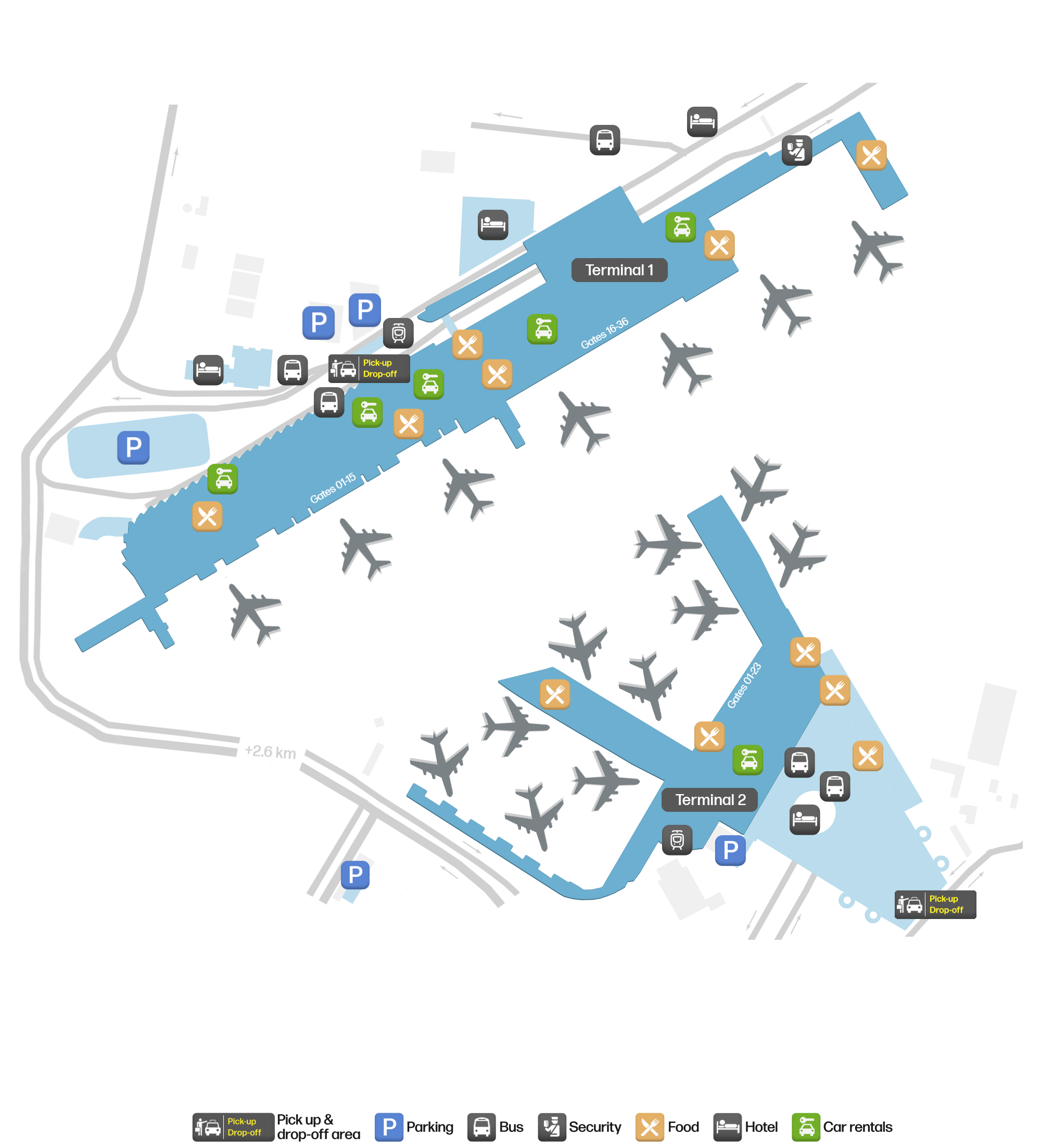
The two terminals
| Code | Name | Main carriers | Notes |
|---|---|---|---|
| T1 | Terminal 1 | Most international carriers, along with domestic and foreign airlines | Built earlier and the largest; Metro Line 5 has a station here |
| T2 | Terminal 2 | Aeroméxico (hub) and SkyTeam | Newer, with long-haul and connecting flights concentrated here |
How to tell where you are:
- The Aeroméxico group is in T2; almost all other carriers are in T1 — start with the airline, then check your boarding pass.
- T1 ↔ T2 has two links: the airside Aerotrén monorail, which is free (boarding pass required, roughly 05:00–23:00), or the landside shuttle bus, free or low-cost (24 hours).
- For a cross-terminal connection allow 45–60 minutes.
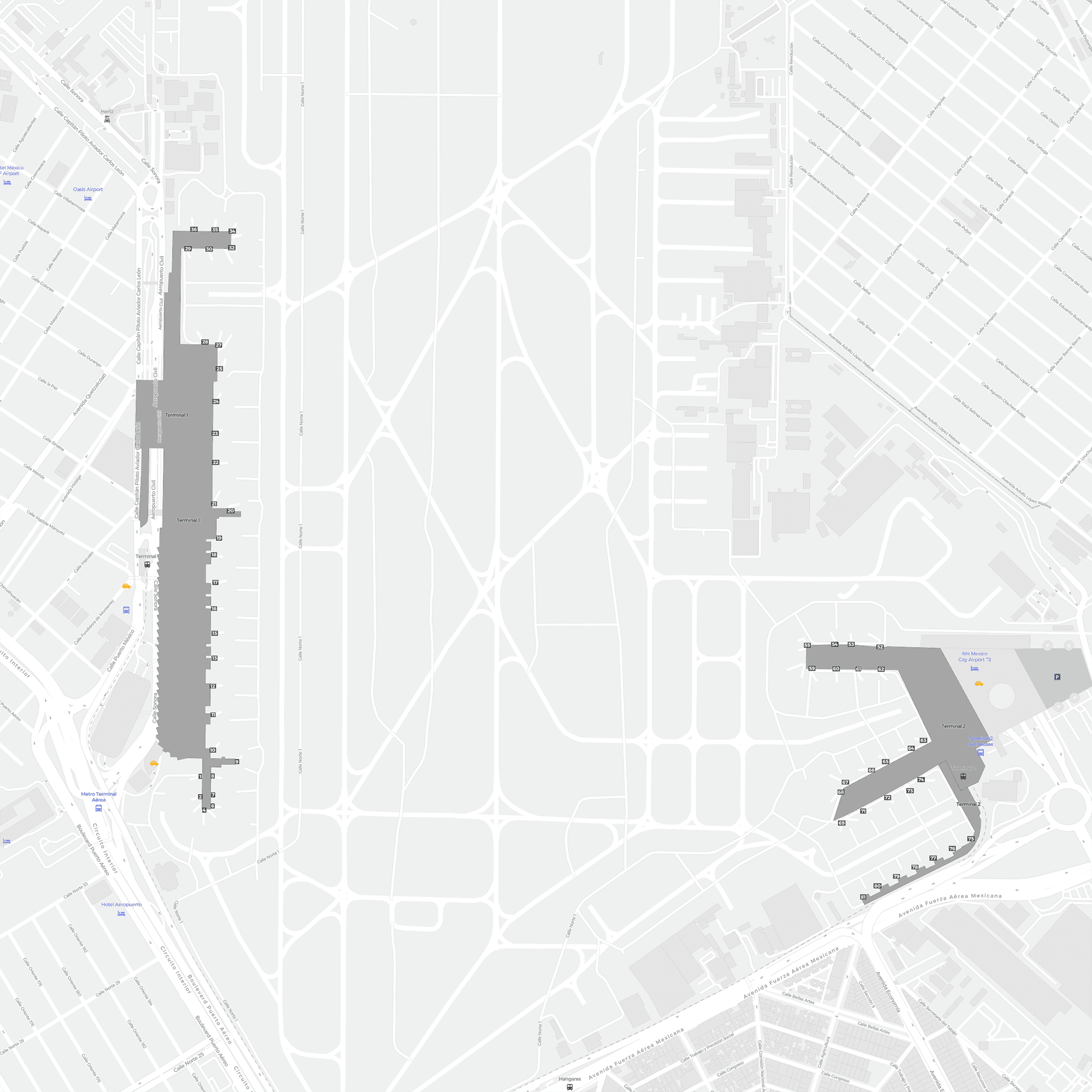
Our diagram draws the two buildings as separate structures joined by a single monorail line precisely to show the distance between them.
Transfers and connections
- A connection inside T1 or inside T2 is quickest; for a cross-terminal connection allow more than 1.5 hours.
- The airside cross-terminal link depends on the Aerotrén and on your boarding pass, and it stops running late at night, leaving only the landside shuttle.
- Mexico City sits at about 2,200 metres, and a long-haul flight takes more out of you here, so err on the generous side with connection time.
Routes and flights
- Routes — around 20-plus airlines flying to about 100 destinations; long-haul points include Madrid, Barcelona, Paris, Amsterdam, London, Tokyo, São Paulo and Buenos Aires.
- Flights — 44.61 million passengers in 2025 (27.12 million domestic, 17.48 million international), down about 1.7% as some services have shifted to NLU.
- Aircraft — main base is Aeroméxico (T2) and SkyTeam, followed by Viva Aerobús and Volaris; the fleet is 737 and A320 family narrowbodies, with Aeroméxico using 787 and 777 on long-haul.
Getting into Mexico City
- Metro Line 5 — has a station on the T1 side and costs very little; the main way to dodge the traffic, but T2 has no direct metro, so you must shuttle to T1 first.
- The Metro Line 1 extension — connects parts of the network to the area around the airport.
- Airport buses — cover the main hubs and hotel districts of the city.
- Taxi / rideshare — authorised taxis must be paid for at a counter inside the terminal; rideshare pick-ups are from set points.
Practical tips
- The biggest trap is confusing the airports: Mexico City now has Benito Juárez (MEX) and Felipe Ángeles (NLU), with NLU 35–50 km north of the city and used mainly by low-cost carriers. Check the three-letter code before booking or arranging a pick-up.
- Travellers heading for NLU can take the suburban railway that opened in April 2026 (direct from Buenavista station in the north of the city) instead of relying on a long coach ride.
- Traffic in Mexico City is severe, so when you have a flight to catch, budget for peak road conditions — rail is the only predictable option.
Terminal guideTerminal Guide
Gate ranges, main airlines and facilities for each terminal at Mexico City International Airport.