
Aeropuerto Internacional de Tan Son Nhat — Mapa de la terminal
 Ciudad Ho Chi Minh · Vietnam· Tan Son Nhat International Airport
Aeropuerto Internacional de Tan Son Nhat (IATA: SGN, OACI VVTS) es un aeropuerto grande que da servicio a Ciudad Ho Chi Minh, Vietnam, con 2 terminales y 30 puertas, a unos 6 km del centro de Ciudad Ho Chi Minh.
Tan Son Nhat International Airport (SGN) serves Ho Chi Minh City, Vietnam. It has 2 terminals with 30 gates in total and handles about 40 million passengers a year. The airport is about 6 km from the city centre. Ground transport into the city: bus, taxi and car.
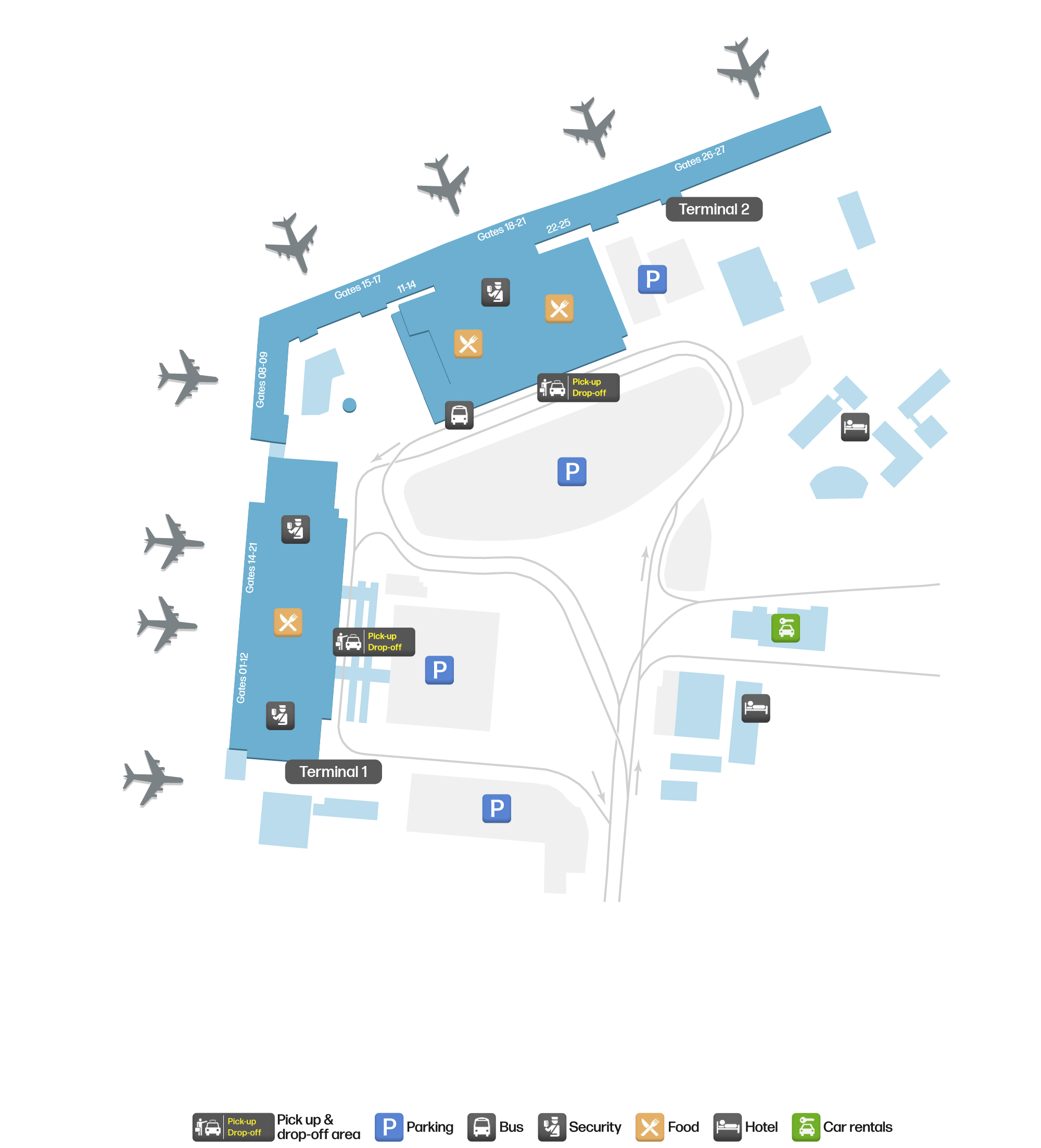
Descargar mapas de aeropuertosDescargas
Fotos del aeropuertoFotos del aeropuerto
Fotos reales de este aeropuerto, cada una con la referencia de la página web pública donde se encontró; los derechos de autor siguen siendo de los fotógrafos originales. Haz clic en una foto para ampliarla o en la línea de crédito para abrir su página de origen.
Vista satelital: las terminales, las pistas y la ciudad circundante del Aeropuerto Internacional de Tan Son Nhat (SGN).
Información horaria del aeropuerto — hora actual en SGNHora del aeropuerto
Hora actual en SGN (Asia/Ho_Chi_Minh) en comparación con tu hora local.
Mapa de rutas de Aeropuerto Internacional de Tan Son Nhat — destinos directosMapa de rutas
50 destinos directos: mapa, aerolíneas que operan y distancias.
Vuelos de Aeropuerto Internacional de Tan Son Nhat — salidas y llegadasPanel de vuelos
2752 números de vuelo de 90 aerolíneas y 89 destinos, divididos por dirección. Se incluyen los números de código compartido.
| Vuelo | Aerolínea | Destino | País/región |
|---|---|---|---|
| 3U3904 | Sichuan Airlines | Chengdu Tianfu International Airport | China |
| 3U7006 | Sichuan Airlines | Aeropuerto Internacional de Cantón-Baiyun | China |
| 3U7048 | Sichuan Airlines | Aeropuerto Internacional de Cantón-Baiyun | China |
| 3U7050 | Sichuan Airlines | Aeropuerto Internacional de Cantón-Baiyun | China |
| 3U7066 | Sichuan Airlines | Aeropuerto Internacional de Cantón-Baiyun | China |
| 5J752 | Cebu Pacific | Aeropuerto Internacional Ninoy Aquino | Filipinas |
| 5J754 | Cebu Pacific | Aeropuerto Internacional Ninoy Aquino | Filipinas |
| 5J5781 | Cebu Pacific | Mactan Cebu International Airport | Filipinas |
| 8M453 | Myanmar Airways International | Yangón (RGN) Yangon International Airport | Myanmar |
| 9C7348 | Spring Airlines | Aeropuerto Internacional de Cantón-Baiyun | China |
| 9C7546 | Spring Airlines | Aeropuerto Internacional de Shanghái-Pudong | China |
| 9C7558 | Spring Airlines | Aeropuerto Internacional de Shanghái-Pudong | China |
| 9G400 | Sun Phuquoc Airways | Aeropuerto Internacional de Incheon | Corea del Sur |
| 9G634 | Sun Phuquoc Airways | Aeropuerto Internacional de Shanghái-Pudong | China |
| 9G640 | Sun Phuquoc Airways | Chengdu Tianfu International Airport | China |
| 9G802 | Sun Phuquoc Airways | Noi Bai International Airport | Vietnam |
| 9G804 | Sun Phuquoc Airways | Noi Bai International Airport | Vietnam |
| 9G808 | Sun Phuquoc Airways | Noi Bai International Airport | Vietnam |
| 9G810 | Sun Phuquoc Airways | Noi Bai International Airport | Vietnam |
| 9G816 | Sun Phuquoc Airways | Noi Bai International Airport | Vietnam |
Números de vuelo y rutas del índice de vuelos de aviability.com (instantánea de 26 de octubre de 2026); se incluyen los números de código compartido y no se muestran horarios de salida. Fuente: aviability.com ↗
Información y datos del aeropuertoDatos del aeropuerto
Mapa interactivo — ubicación de Aeropuerto Internacional de Tan Son NhatMapa interactivo
Consulta este aeropuerto en otros servicios de mapas:
Tan Son Nhat International Airport terminal guideGuía del aeropuerto
Tan Son Nhat sits right up against Ho Chi Minh City, about 8 km from the city centre, and handles around 43 million passengers a year. It is a city airport, and its layout changed significantly in 2025: the new T3 opened in April 2025 and takes domestic flights only, carrying about 80% of domestic traffic — the three terminals now have clearly divided roles, and turning up at the wrong building is a wasted trip.
Satellite view
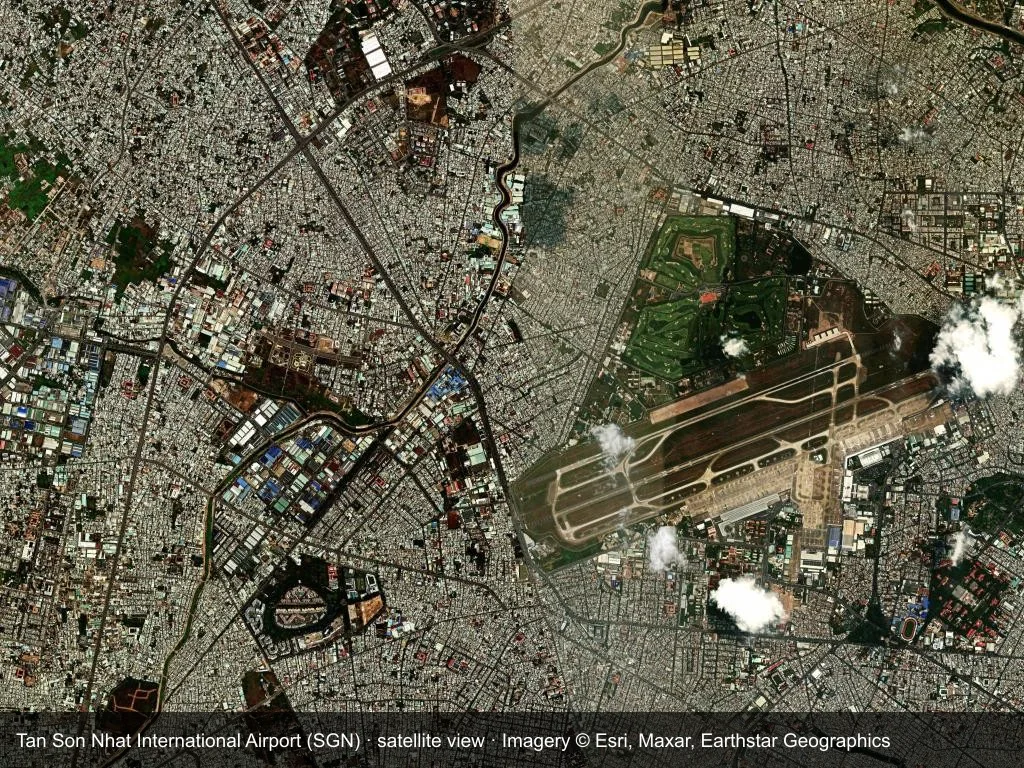
Satellite view: the terminals, runways and surrounding city at Tan Son Nhat International Airport (SGN).
The satellite image comes from Esri World Imagery (© Esri, Maxar, Earthstar Geographics); the field and attribution are labelled in the image. This is a satellite view, not a ground-level photograph.
The three terminals
| Code | Name | Main flights | Main users |
|---|---|---|---|
| T1 | Terminal 1 | Domestic | Vietjet Air only |
| T2 | Terminal 2 | International | All international flights |
| T3 | Terminal 3 | Domestic (opened 2025) | Vietnam Airlines and five other carriers; about 80% of domestic flights |
Working out which building you need:
- International flights are always at T2 — that one is the simplest rule.
- Domestic flights depend on the airline: Vietjet is at T1; Vietnam Airlines, Pacific Airlines, Bamboo Airways and three others — six carriers in all — are at T3.
- The three are separate buildings, linked by a free shuttle bus (roughly every 20 minutes).
Our diagram draws the three terminals separately, with the T3 added in 2025 marked out on its own, precisely to make the point that on the domestic side it is the airline that decides which building you need.
Transfers and connections
- International to domestic is the most common connection: first confirm whether your domestic leg leaves from T1 or T3, then add the shuttle time.
- For a connection between buildings, allow more than 3 hours — you have to leave the building, take the shuttle and clear security again.
- Vietnamese domestic routes are dense and punctuality is only average, so err on the side of a longer connection.
Routes and flights
| Aspect | Detail |
|---|---|
| Routes | Vietnam's largest airport and main international gateway, with around 50 international points covering China, Northeast Asia, South-East Asia, Europe and Oceania (long-haul examples: Tokyo, Seoul, Singapore, Bangkok, Taipei, Frankfurt); domestic routes are dense to Hanoi, Da Nang, Phu Quoc and others. |
| Flights | Around 42.5 million passengers in 2025, on roughly 256,000 flights (about 700 a day); before T3 opened the airport had been running at around 110% of its designed capacity, and T3 lifted annual capacity to about 50 million in 2025. |
| Aircraft | The main bases are Vietnam Airlines (SkyTeam; A321 workhorses with A350 and 787 widebodies on long-haul) and Vietjet Air (an all-A320 low-cost fleet, using T1 exclusively). |
Getting into Ho Chi Minh City
- Taxi / ride-hailing — only about 8 km, but the city centre congests badly and the journey can take twice as long at peak times; use a licensed taxi company or order through an app.
- Local buses — routes run direct to the city centre at very low fares; a new city route now serves T3 directly.
- Airport buses (routes 109, 152 and others) — link the main sights and the hotel districts.
- No rail link — the city metro does not yet reach the airport, so the road is the only way in.
Practical tips
- Ho Chi Minh City Metro Line 1 is open but does not go to the airport; to reach the metro you first need road transport to a station.
- For domestic flights arrive 2 hours ahead, for international flights 3 hours — that is the airport's own official advice.
- Low-cost carriers (Vietjet) enforce strict baggage rules and their check-in queues are long, so allow extra time.
References
Guías del aeropuerto SGNDel blog
1 artículos de este sitio tratan sobre SGN: llegadas, transporte terrestre, equipajes y conexiones.

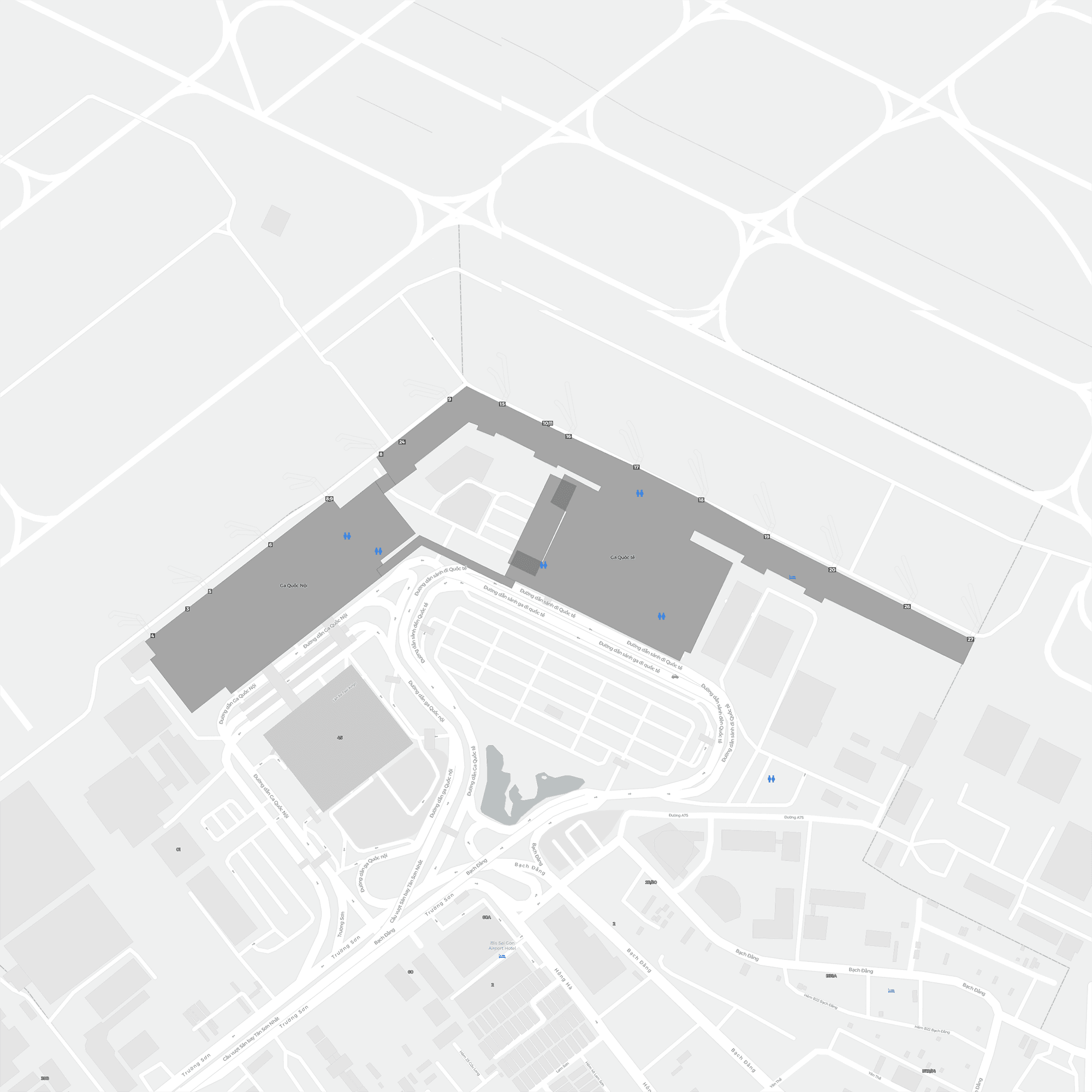
Guía de terminalesGuía de terminales
Rangos de puertas, principales aerolíneas e instalaciones de cada terminal de Aeropuerto Internacional de Tan Son Nhat.
Comentarios de los lectoresDebate
Las preguntas, los relatos de viaje y las correcciones son bienvenidos. Los comentarios son públicos.
Cargando…
Cargando comentarios…