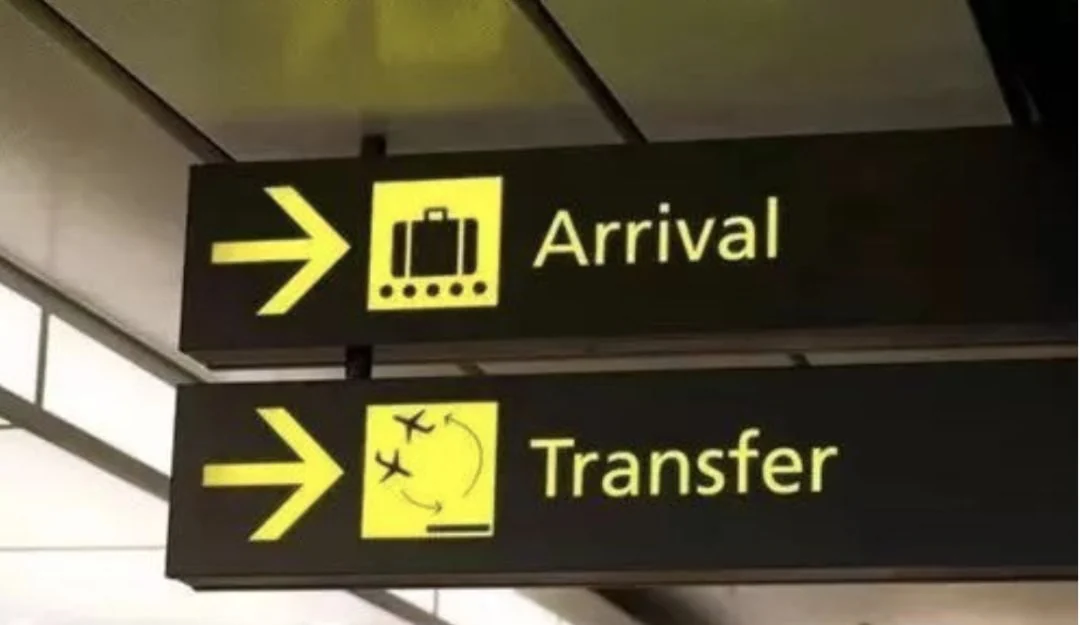
Arriving in France: Navigating Paris CDG to Your Next Train, Bus or Flight
- Paris CDG
- CDG
- studying in France
- airport transport
- French phrases
Term is nearly here. For a first trip to France, booking the flight is the easy part — the harder question is how to get out of the airport and to the city where you will study. Cities such as Lyon, Bordeaux, Marseille and Strasbourg do have international flights, but the vast majority of flights from China land at Paris Charles de Gaulle (CDG).
The good news is that CDG is unusually friendly to Chinese-speaking travellers: boarding, check-in and even the toilets are signed in Chinese, so following the signs is usually enough. This guide covers finding your way on arrival, terminals and the railway station, onward travel and a French phrase list for the airport.
1. Finding your way on arrival
The arrival tunnel: three signs decide everything
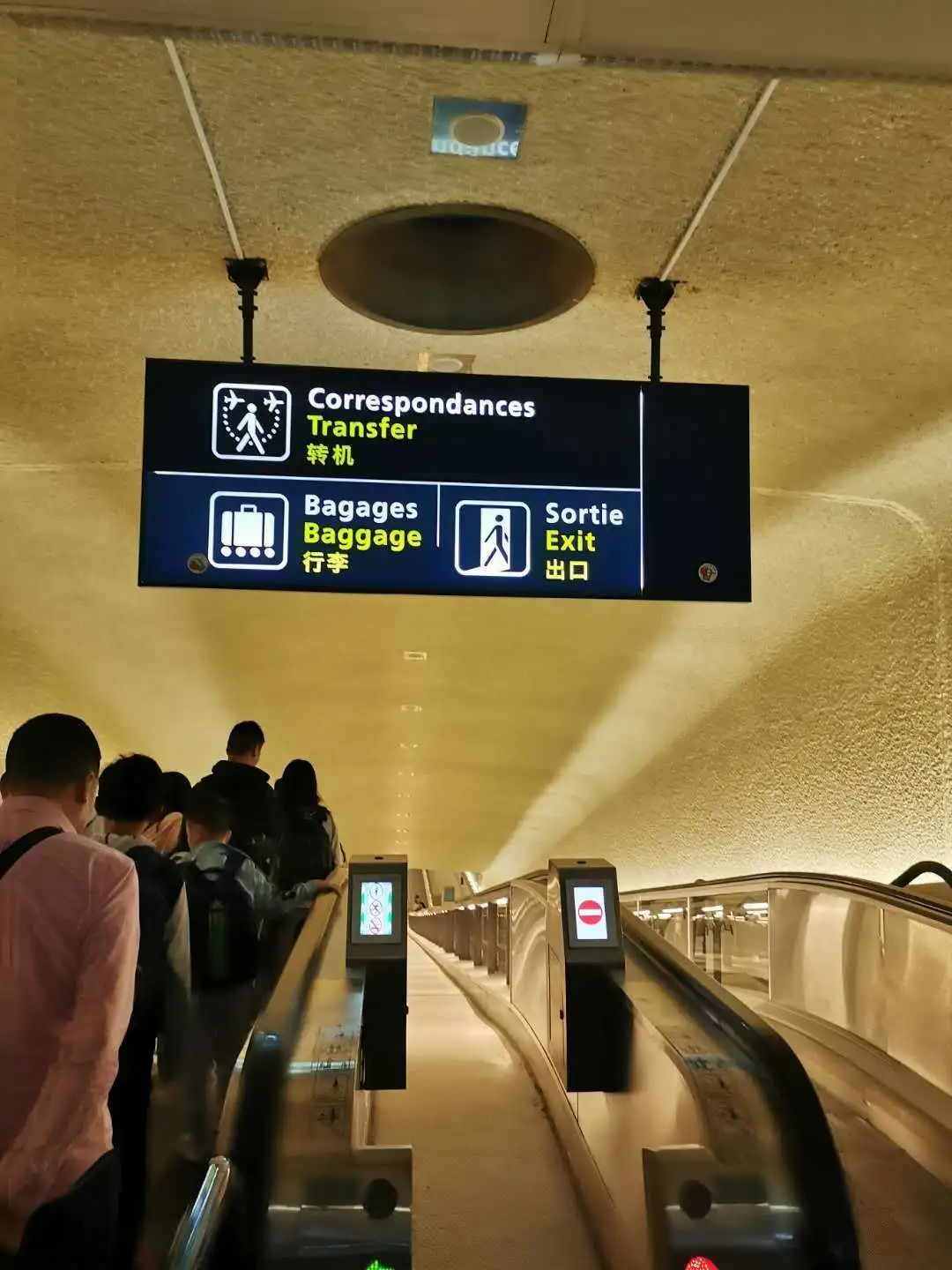
The first stretch after you leave the aircraft is CDG's famous "arrival tunnel" — a long travelator under a sign that has already sorted the crowd for you:
- Correspondances / Transfer — staying inside the airport for your next flight;
- Bagages / Baggage — collecting checked luggage from the carousels;
- Sortie / Exit — leaving the airport after collecting your bags and clearing customs.
The classic first-timer's mistake is to follow "Exit" all the way out and forget about a connecting flight or a train ticket. Remember the order: decide whether you are connecting first, then choose baggage or exit.
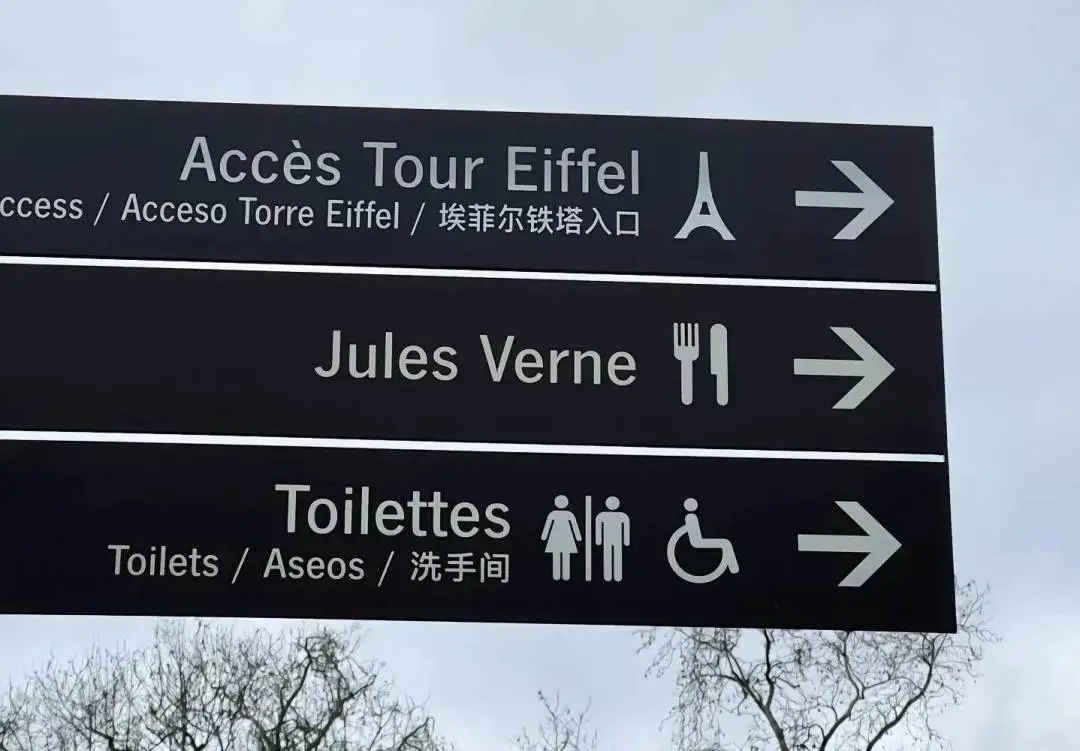
Chinese signage, all the way to the toilets
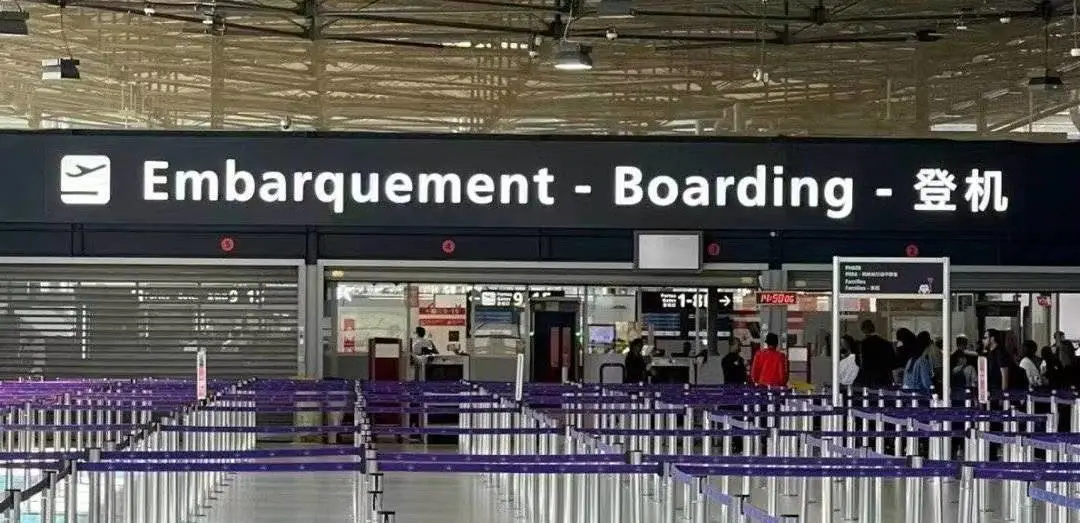
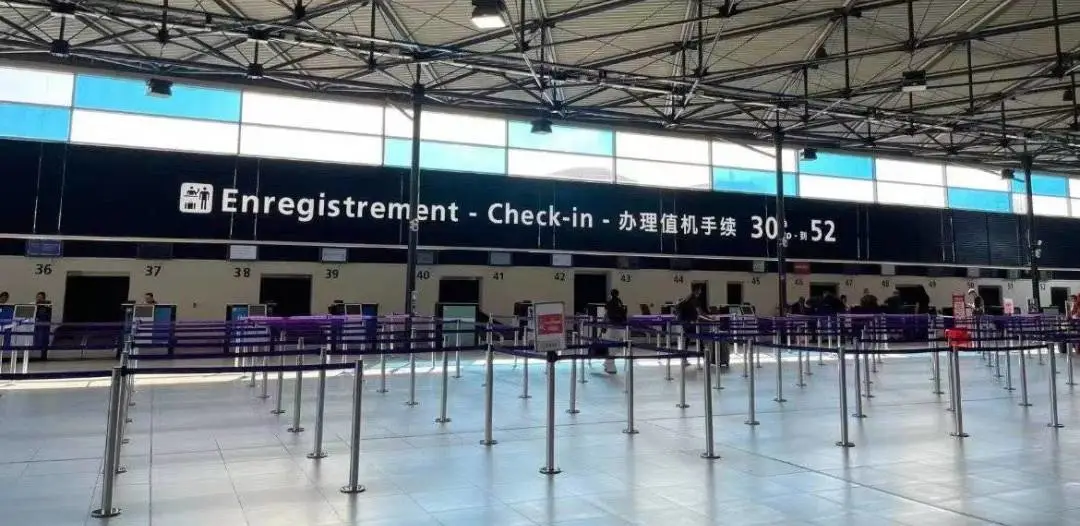
CDG runs a complete Chinese-language trail: gates carry "Embarquement - Boarding - 登机", the check-in area says "Enregistrement - Check-in - 办理值机手续", and even the toilets add "洗手间" alongside the French and English. Signs in central Paris often carry Chinese too, so language is not what will get you lost.
Beware unlicensed taxis — and know the paid porter service
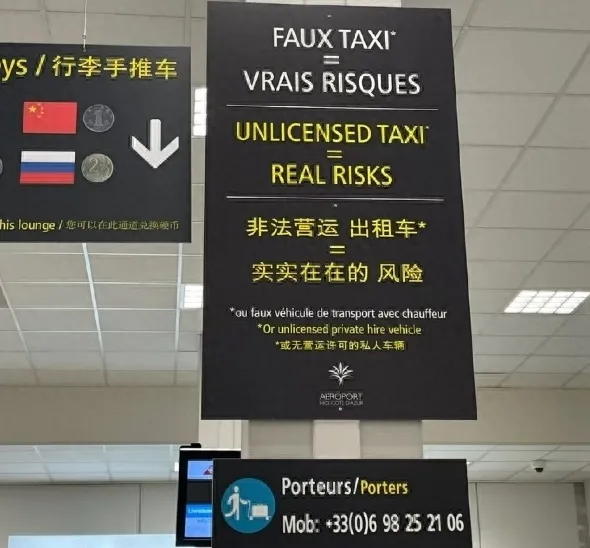
Warnings are posted throughout the airport, in Chinese, English and French: unlicensed taxis are real risks (FAUX TAXI = VRAIS RISQUES). Take a taxi from the official rank, or meet a ride-hailing car at the designated pick-up point — never accept a driver who approaches you.
With a lot of luggage, use the airport's official porter service (Porteurs / Porters), whose desk shows a phone number and charges a fee. Luggage trolleys are likewise chargeable, so keep some coins or a working bank card handy.
2. Terminals, the railway station and getting around the airport
Three terminals, and seven sub-terminals inside T2
CDG has three terminals: 1, 2 and 3. Terminal 2 is the main one and is divided into seven sub-terminals — T2A, T2B, T2C, T2D, T2E, T2F and T2G — arranged symmetrically in a petal pattern; Terminal 1 is a circular "flying saucer" in the north-west; Terminal 3 is the smallest, in the north, and mostly handles low-cost and charter carriers.
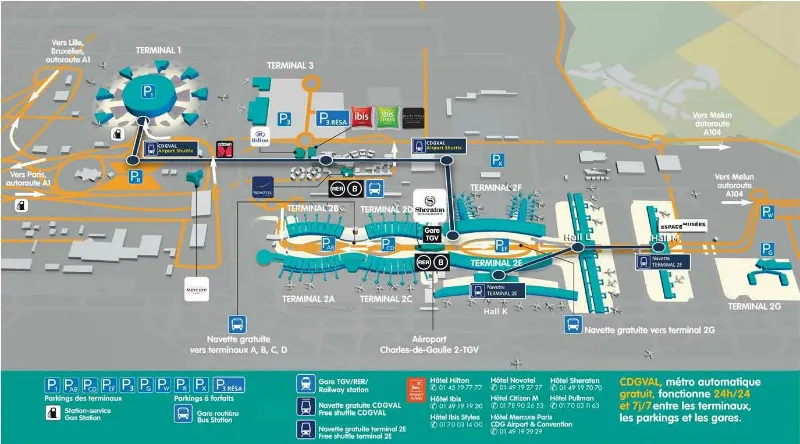
The terminals are not close together, but the layout is clear: check which sub-terminal your flight uses (for instance T2E on your boarding pass) and head there.
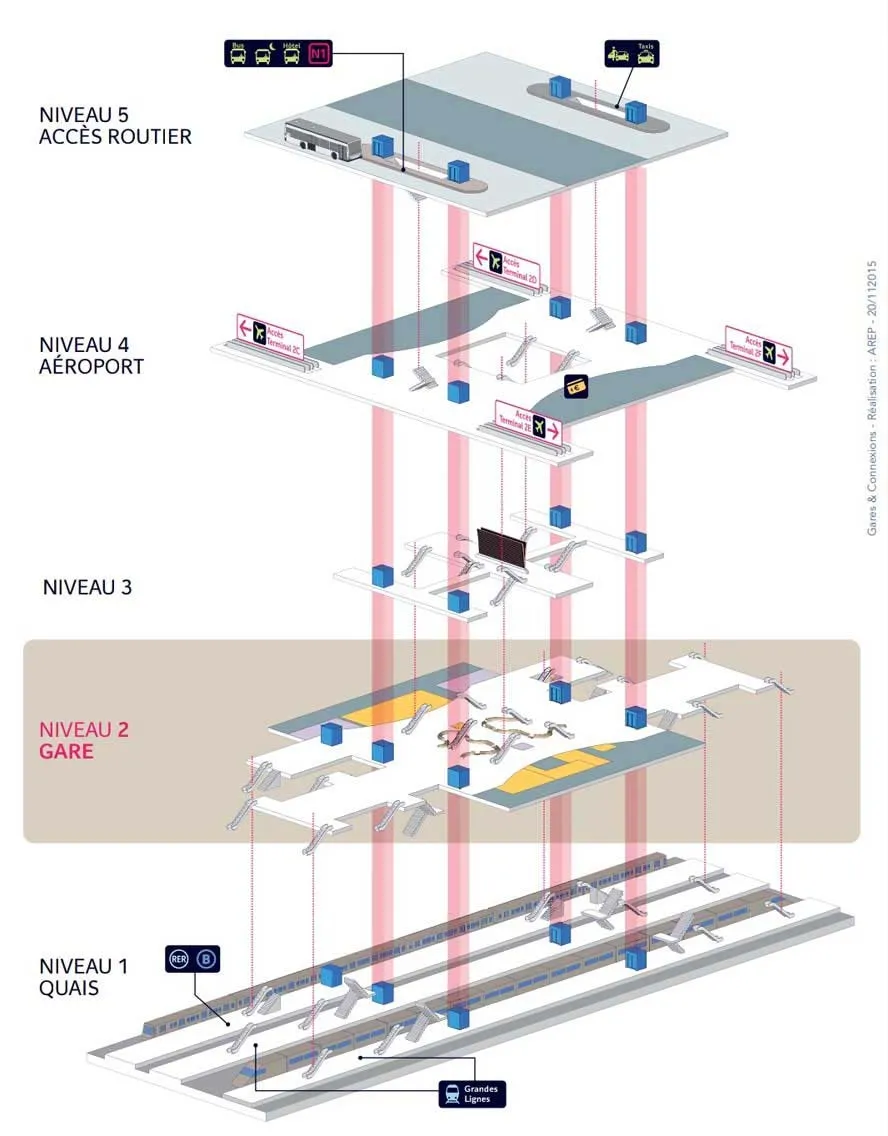
The railway station: RER B and TGV, both at T2
CDG's station sits under Terminal 2 — La gare SNCF de l'aéroport Paris-Charles de Gaulle — reached by escalator straight from the terminal. According to the airport's own description, it connects to the TGV Sud, Ouest and Nord networks as well as the main Ouigo, Thalys and Eurostar lines, and it is where you pick up the RER B into Paris.
| Line | Where it takes you |
|---|---|
| RER B | Central Paris (Gare du Nord, Châtelet and more), about 25–30 minutes |
| TGV Sud / Ouest / Nord | Lyon, Bordeaux, Nantes, Lille and the rest of France |
| Ouigo | Budget high-speed services towards Lyon, Marseille and beyond |
| Thalys / Eurostar | Brussels, Amsterdam and London |
Buy your ticket before you fly if you can. There are machines and staffed counters at the station, but collecting bags and finding the platform eats time, and at peak periods same-day tickets sell out. SNCF Connect (or sncf.com) works from China — you will need a card that can pay in euros — and tickets are usually electronic, scanned at the gate. Alternatively ask a friend already in France to buy for you.
CDGVAL: the free shuttle train that runs 24 hours
Moving between terminals, car parks and the railway station inside the airport is the job of the free CDGVAL shuttle train (also called RoissyVal). The line is simple: T1 → car park PR → Roissypole (where Terminal 3 is, about a 5-minute walk) → car park PX → T2, where you can change to main-line TGV trains and the RER B, next to the Sheraton hotel, hotel shuttle buses and the left-luggage office.
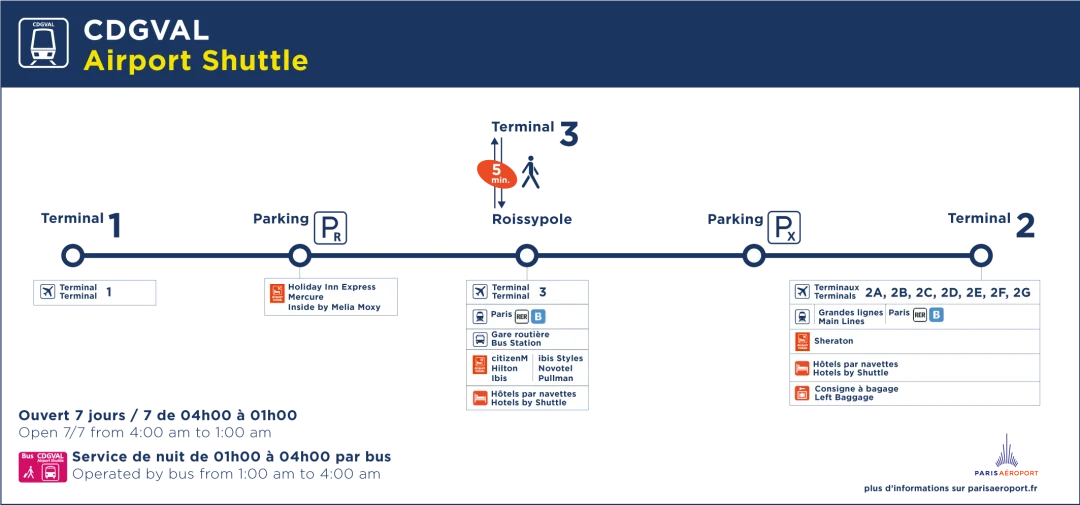
Hours: the train runs 04:00–01:00 every day, and a shuttle bus covers 01:00–04:00, so the link never closes. Local N1 and N2 shuttle buses supplement it, and the walkways between terminals are well signed — with light luggage, walking is often quicker than waiting.
3. Onward travel: connections, Orly, and the provinces
1. Connecting at CDG
If your next flight also leaves from CDG, you simply change terminals inside the airport on the free CDGVAL train (see above). One decision matters:
- Bags not through-checked (separate tickets): you must clear immigration, collect your luggage, take it to the terminal your next flight leaves from and check in again;
- Bags through-checked (one ticket): follow the Transfer signs straight to the next flight's terminal and gate — no need to collect anything.
Either way the signage is in Chinese, so you will not get lost.
2. Getting to Orly (ORY)
If your onward flight leaves from Paris Orly, note that there is no direct rail link between the two airports — you change on the city side. The current options:
- RER B + Orlyval: take the RER B to Antony, then change to the Orlyval automatic shuttle straight to Orly's terminals; around 60–90 minutes, and the shortest connection to walk with luggage;
- RER B + Metro line 14: into the city, then line 14, which was extended to Orly in 2024 — about 25 minutes from the centre;
- Taxi or private transfer: door to door in roughly 45–60 minutes, best when time or luggage is tight.
Be aware that the old Air France coach (Le Bus Direct, formerly Les Cars Air France) has ceased operating; the "line 3 coach" advice still circulating online is out of date, so do not wait around for it at the airport.
3. Taking the TGV to the provinces
Terminal 2 has its own SNCF high-speed station, and if your university city has a direct service this is the simplest option — no detour into Paris. Buy in advance as described above, and leave plenty of time, in case you get lost, wait too long for your bags, or hit a peak-period sell-out.
If there is no direct ticket, travel into Paris first and leave from the right station: the airport's bus station (Gare routière) is at Roissypole beside Terminal 3, with routes such as Roissybus into the city, and the RER B also reaches the city's stations. Fares and routes change — check Île-de-France Mobilités for the day you travel.
4. The six main railway stations in Paris
Paris has six main stations, one per direction of the country. Check which one is printed on your ticket before you set off:
| Station | Main direction | Metro / RER |
|---|---|---|
| Gare du Nord | Northern France, Belgium, the UK (Eurostar) | Lines 4, 5; RER B, D |
| Gare de l'Est | Eastern France, Germany, Luxembourg | Lines 4, 5, 7 |
| Gare de Lyon | South-eastern France, Switzerland, Italy | Lines 1, 14; RER A, D |
| Gare d'Austerlitz | South-western France, Spain, Portugal | Lines 5, 10; RER C |
| Gare Montparnasse | Western France, Brittany | Lines 4, 6, 12, 13 |
| Gare Saint-Lazare | Towards Normandy | Lines 3, 12, 13, 14 |
At the station, staff will tell you the exact departures for your destination — buy the ticket and board. With heavy bags, bear in mind that the older metro lines (line 4 in particular) often mean stairs between platforms, so allow time for carrying luggage.
4. Airport French phrase list
You do not need French to get through CDG — these tables cover the whole route from landing to customs, and reading them off your phone is usually enough.
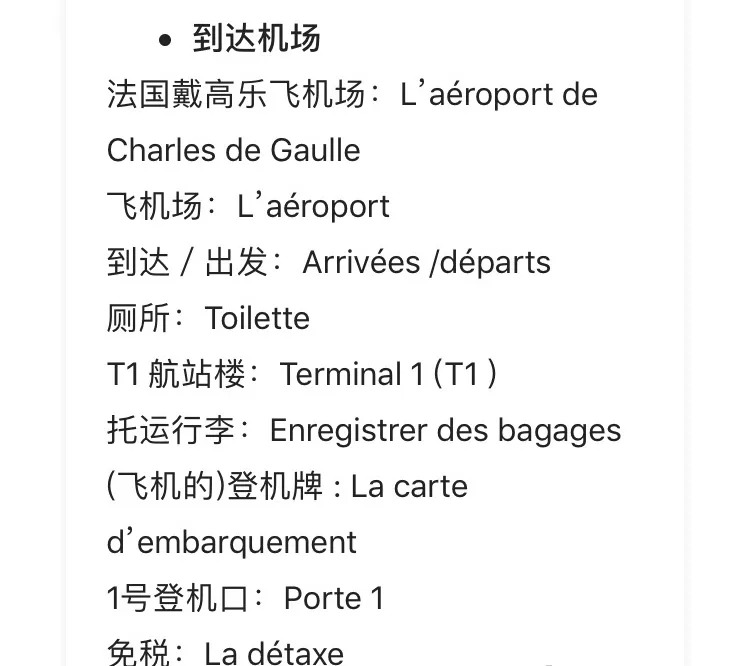
Arriving at the airport
| Chinese | French |
|---|---|
| Paris Charles de Gaulle Airport | L'aéroport de Charles de Gaulle |
| Airport | L'aéroport |
| Arrivals / departures | Arrivées / départs |
| Toilets | Toilette |
| Terminal 1 | Terminal 1 (T1) |
| To check in baggage | Enregistrer des bagages |
| Boarding pass | La carte d'embarquement |
| Gate 1 | Porte 1 |
| Tax refund | La détaxe |
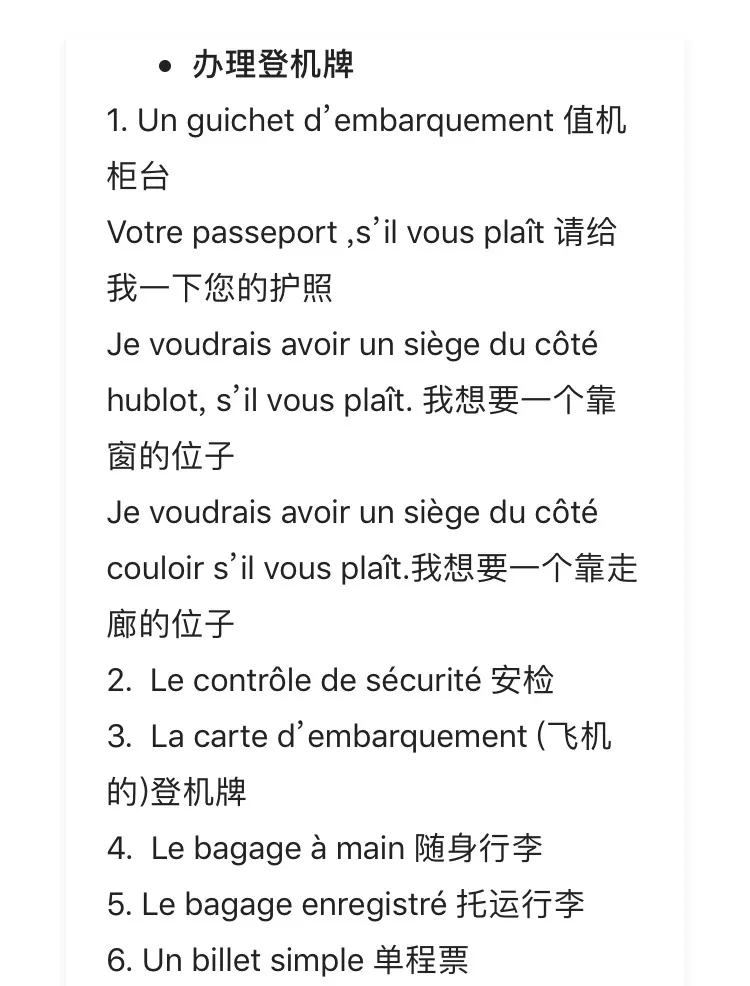
Check-in and security
| Chinese | French |
|---|---|
| Check-in desk | Un guichet d'embarquement |
| Your passport, please | Votre passeport, s'il vous plaît |
| I would like a window seat | Je voudrais avoir un siège du côté hublot, s'il vous plaît |
| I would like an aisle seat | Je voudrais avoir un siège du côté couloir, s'il vous plaît |
| Security check | Le contrôle de sécurité |
| Hand luggage | Le bagage à main |
| Checked baggage | Le bagage enregistré |
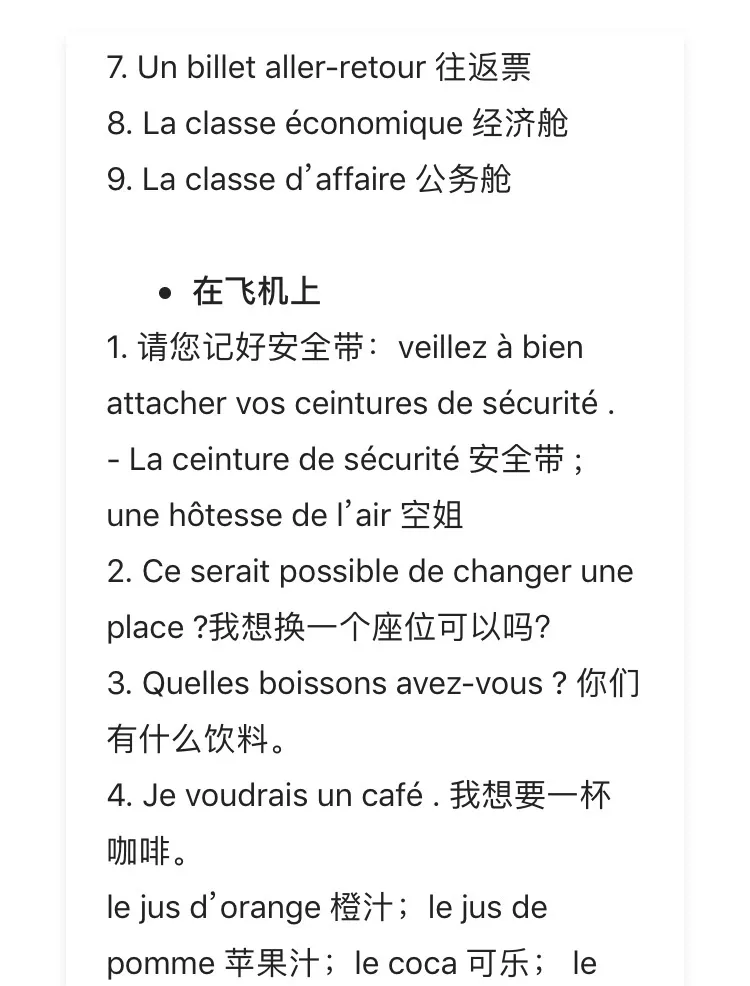
| One-way / return ticket | Un billet simple / un billet aller-retour |
| Economy / business class | La classe économique / la classe d'affaire |
On board
| Chinese | French |
|---|---|
| Please fasten your seat belts | Veillez à bien attacher vos ceintures de sécurité |
| Seat belt / flight attendant | La ceinture de sécurité / une hôtesse de l'air |
| Could I change seats? | Ce serait possible de changer une place ? |
| What drinks do you have? | Quelles boissons avez-vous ? |
| I would like a coffee | Je voudrais un café |
| Orange juice / apple juice / cola | le jus d'orange / le jus de pomme / le coca |
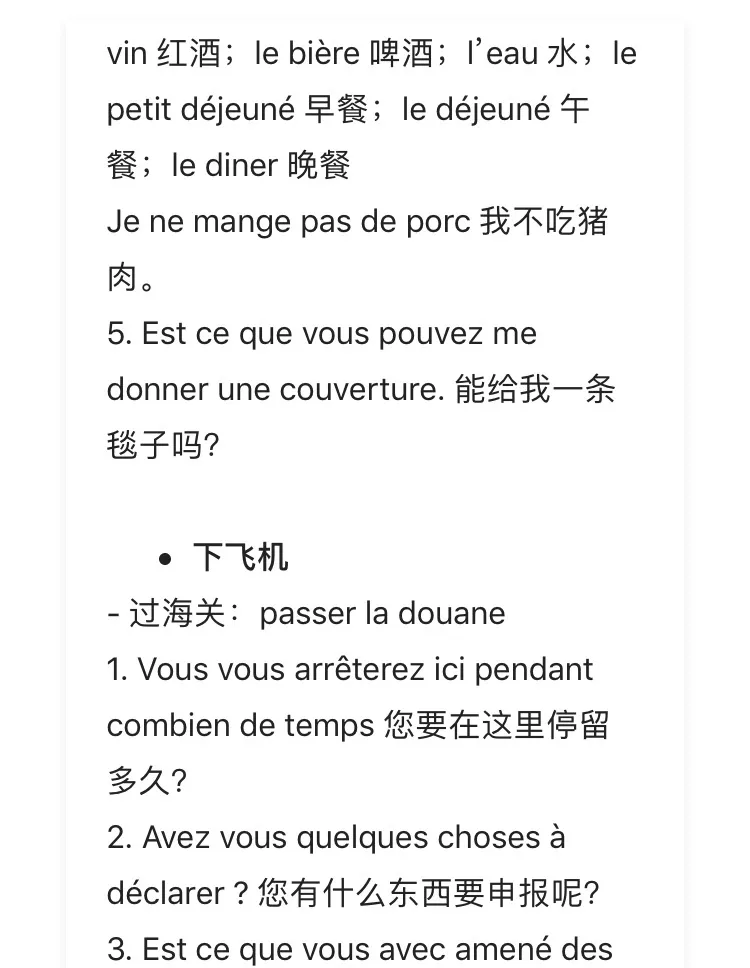
| Wine / beer / water | le vin / la bière / l'eau |
| Breakfast / lunch / dinner | le petit déjeuner / le déjeuner / le dîner |
| I don't eat pork | Je ne mange pas de porc |
| Could you give me a blanket? | Est-ce que vous pouvez me donner une couverture ? |
Leaving the aircraft, customs and baggage
| Chinese | French |
|---|---|
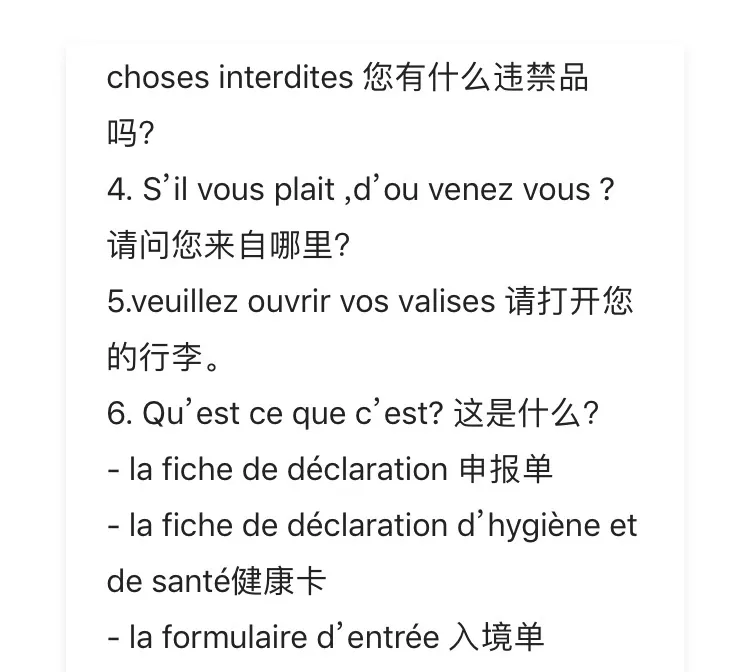
| Going through customs | passer la douane |
| How long are you staying here? | Vous vous arrêterez ici pendant combien de temps ? |
| Do you have anything to declare? | Avez-vous quelques choses à déclarer ? |
| Do you have any prohibited items? | Avez-vous des choses interdites ? |
| Where are you from? | S'il vous plaît, d'où venez-vous ? |
| Please open your suitcases. | Veuillez ouvrir vos valises. |
| What is this? | Qu'est-ce que c'est ? |
| Declaration / health / arrival form | la fiche de déclaration / la fiche de déclaration d'hygiène et de santé / la formulaire d'entrée |
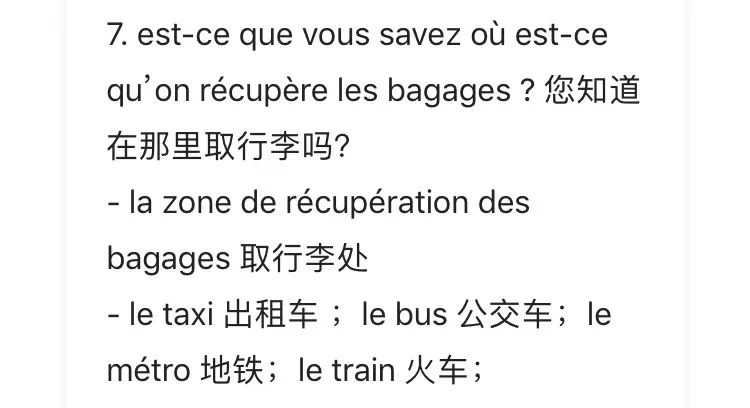
| Do you know where to collect the baggage? | Est-ce que vous savez où est-ce qu'on récupère les bagages ? |
| Baggage reclaim | la zone de récupération des bagages |
| Taxi / bus / metro / train | le taxi / le bus / le métro / le train |
The original screenshots of the phrase list are below if you would rather save them to your phone.
Related links
- On this site: Paris Charles de Gaulle Airport (CDG), Paris Orly Airport (ORY), France (FR)
- Wikipedia: Charles de Gaulle Airport, Orly Airport
- Baidu Baike: Charles de Gaulle Airport, Orly Airport
More articlesTravel notes
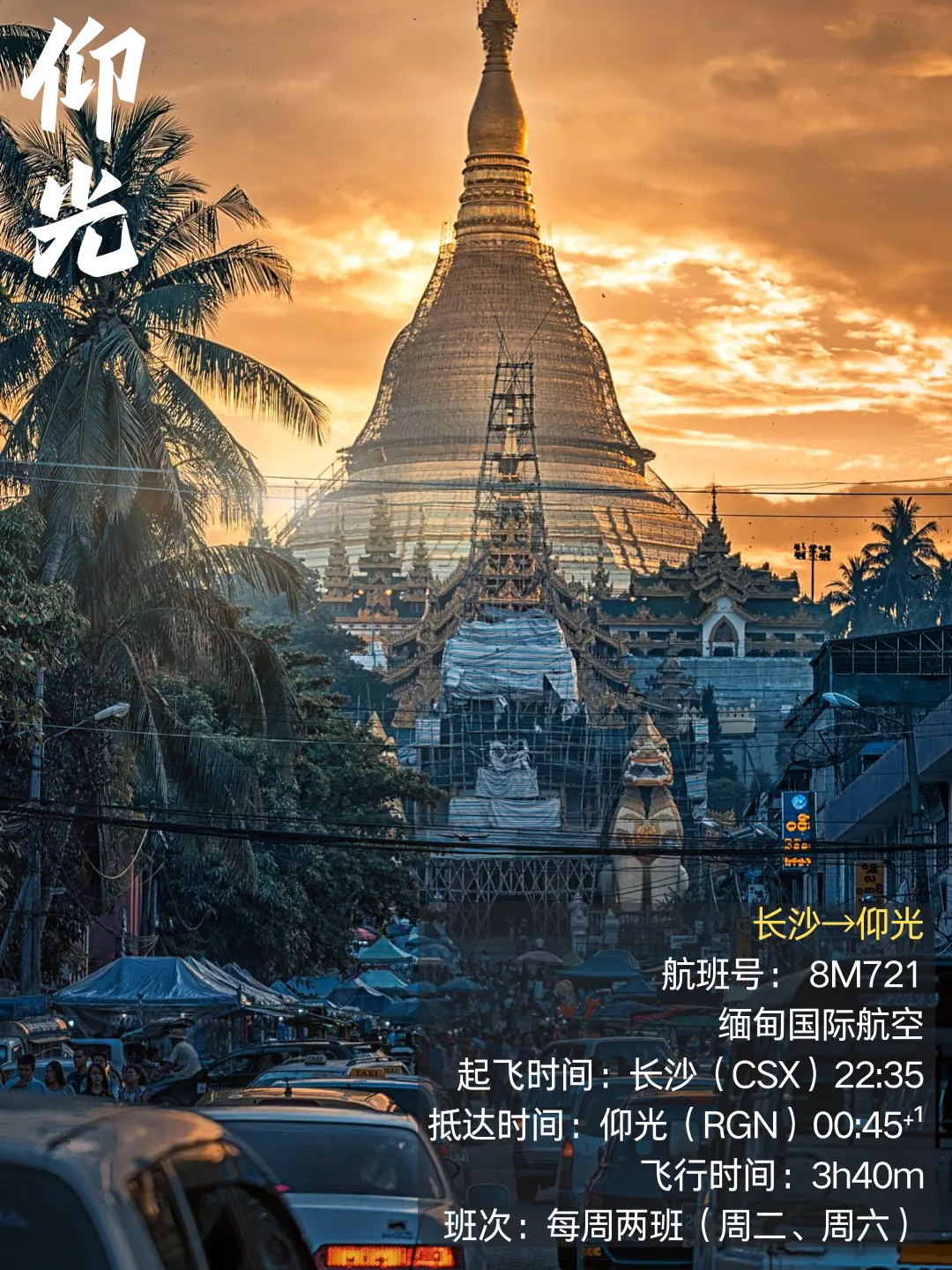
Direct International Flights from Changsha Huanghua Airport: 15 Routes, Airlines and Schedules
Which international and regional destinations you can fly to non-stop from Changsha Huanghua International Airport (CSX): Yangon, Bangkok (BKK and DMK), Phuket, London, Seoul, Hong Kong, Kuala Lumpur, Singapore, Phnom Penh, Jakarta, Hanoi, Ho Chi Minh City, Vientiane and Nairobi — 15 routes with the airline, flight number, departure and arrival times, flight time and frequency for each, plus how to check the current schedule before you book.6 min read
Paris Charles de Gaulle Airport: Left Luggage, Transport, Tax Refunds and Rest Areas
Everything worth knowing about Paris Charles de Gaulle (CDG) before you land: the layout of Terminals 1, 2 and 3 and the floors of T1, which airlines use which terminal, the free CDGVAL shuttle, left luggage and baggage services, banks and currency exchange, the tax-refund (détaxe) rules and where to claim, free rest areas and lounges, Wi-Fi and charging, SIM cards, and accessibility and family facilities.6 min read