Saudi Arabia's Plan for the World's Largest Airport: King Salman International
- King Salman International Airport
- Riyadh
- Saudi Arabia
- Vision 2030
- airport expansion
In April 2024, Saudi Arabia's General Authority of Civil Aviation (GACA) set out the aviation strategy behind the Riyadh government's plans: by 2030 the kingdom wants to triple annual air passenger traffic to 330 million, lift air cargo to 4.5 million tonnes, and increase the frequency of links to more than 250 destinations worldwide. To pay for it, the country intends to invest up to $100 billion in aviation.
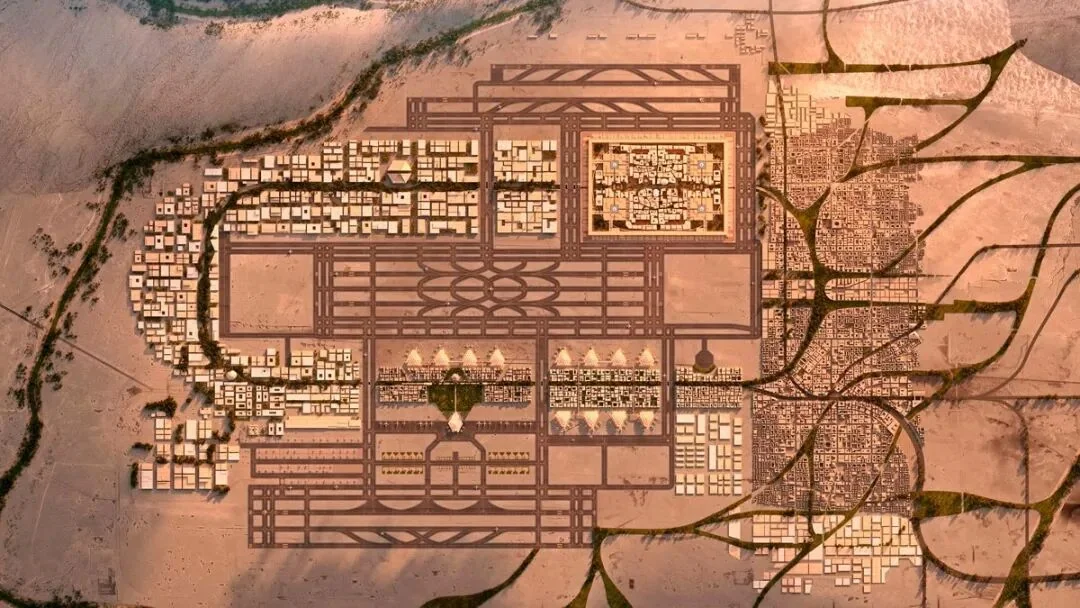
The physical anchor for those numbers is King Salman International Airport (KSIA). As published, the airport will occupy about 57 square kilometres in Riyadh, with six parallel runways, capacity for 120 million passengers by 2030, and the existing King Khalid International Airport (KKIA) terminals folded into the plan. This is not a terminal extension. It is the city's airport rebuilt around itself.
1. Where 330 million passengers come from
Saudi Arabia has a population of just over 30 million, so 330 million passengers a year works out at roughly ten flights per resident. That traffic cannot come from domestic demand. It has to come from three other pools: passengers connecting between third countries, business and conference travel, and religious travel. Pilgrimage has long been the steady base of Saudi aviation, but most of it lands at Jeddah. Riyadh is chasing the first two pools.
That is also why the same strategy pairs 250-plus destinations with 4.5 million tonnes of cargo. Point-to-point markets cannot support that scale; only a hub needs dense route coverage and a large cargo apron at the same time. Vision 2030, launched in 2016 to reduce the economy's dependence on oil, treats aviation as exportable infrastructure: keep the passengers, the freight and the regional headquarters inside the country.
The competition already exists. Dubai and Doha spent two decades turning east–west transfers into an industry, and a large share of traffic between Europe, South Asia and Southeast Asia connects through one of them. Saudi Arabia is trying to take share on a route network that already works, rather than opening a market nobody has served. That lowers the demand risk, but it also means competing head-on with two mature hubs on price, frequency and the quality of the connection.
2. The hardware on 57 square kilometres
KSIA's scale shows up first in land and runways. Fifty-seven square kilometres is the built-up area of a mid-sized city, handed over to an airport. Six parallel runways keep peak-hour movements from waiting on each other. Twelve square kilometres of support facilities are zoned for housing, entertainment, retail and logistics, which makes the airport less a transport facility than a new industrial town with a runway attached.
| Item | Published figure |
|---|---|
| Site area | About 57 square kilometres |
| Runways | 6 parallel runways |
| Passenger capacity, 2030 | 120 million a year |
| Passenger capacity, 2050 | 185 million a year |
| Cargo capacity, 2050 | 3.5 million tonnes a year |
| Support facilities | 12 square kilometres |
The long-range targets are just as specific: 185 million passengers and 3.5 million tonnes of cargo a year by 2050. Note that the national strategy's cargo target for 2030 is 4.5 million tonnes, so the two figures are measured on different bases. Set beside the 120 million figure for 2030, the long-range numbers show that the first phase uses only part of the planned capacity, with room deliberately left for later expansion.
One detail matters more than the renderings suggest. KSIA is not being built on an empty site: the plan explicitly absorbs the existing KKIA terminals. The new airport grows around the one that is operating, and Riyadh's flights will keep arriving and departing from the same piece of land throughout construction. Building while operating is usually harder to organise than building from scratch.
3. Where 120 million ranks globally
On 2023 figures, the world's busiest airport by passengers was Atlanta with about 104.8 million, followed by Dubai International with 86.8 million and Tokyo Haneda with 82 million. The table data comes from a 2023 global airport ranking compiled by The Paper.
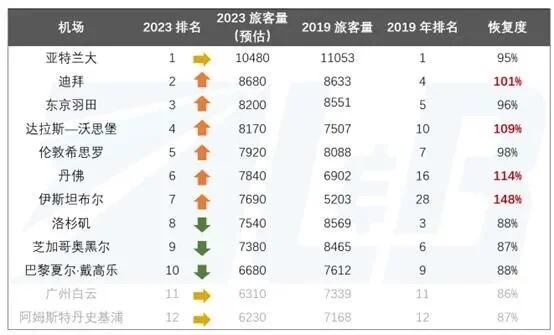
So 120 million is not a top-ten figure; it would beat the current world number one outright. GlobalData is blunter still: if KSIA is completed on time in 2030, it would become the largest operating airport in the world by passenger capacity.
Capacity and traffic are different things, though. An airport can be designed for 120 million and still handle far fewer, because what it actually flies depends on its based airlines' fleets, air service agreements, slot allocation and the quality of the connections. Saudi Arabia is working on that part too. Riyadh Air, the new carrier owned by the sovereign wealth fund, is based in Riyadh with the aim of turning the oil capital into an aviation hub. Build it as large as you like: without airline aircraft, the runways stay empty.
4. Delivery: Mace, consortia and the schedule risk
Construction has moved into delivery. In February 2024, MEED reported that Mace, the UK engineering firm, had won the delivery-partner role on the project, while contractors were forming consortia to bid for the construction work that is about to follow on what would be the world's largest airport.
Work on the existing airport is further along. In June 2023 a joint venture of Turkey's IC Ictas and the local Al-Rashid Trading & Contracting won the contract to renovate Terminals 1 and 2, having completed the refurbishment of Terminals 3 and 4 earlier in 2023. That work does not change what the airport is, but it is the precondition for joining old and new facilities together.
The risk sits here. The $100 billion is a planned investment ceiling, not money already committed. Six runways, 12 square kilometres of support facilities and a new terminal all have to move inside the same window. And 2030 is both an engineering deadline and a public promise attached to a national strategy. Very large airports rarely finish exactly on time or on budget. For KSIA, the real test is not the renderings but whether the first phase delivers a working transfer product before 2030.
5. What it means for travellers
For now, anyone flying into or out of Riyadh still uses King Khalid International Airport (RUH). KSIA has no announced opening date, and any claim that it will open "next year" should be treated with suspicion. Until the operator publishes a timetable, plan around the airport that exists.
Over the medium term, watch the route map rather than the architecture. New airlines and denser European and Asian schedules will change what Riyadh can reach long before the new terminal does. If you are planning a connection through the Middle East, Dubai and Doha remain the densest options; Riyadh is a thinner but growing one. Check GACA and the operator's latest notices before you book — more useful than studying a masterplan.
6. The 2025–2026 update: delivery team in place
In May 2025 the project added Parsons for infrastructure and Bechtel for terminal delivery alongside Mace's delivery-partner role, as Enterprise AM reported; contractor shortlists and phased tenders have moved forward since. Compared with the "consortia forming to bid" stage of 2024, the project is now in more concrete construction preparation.
That does not change the earlier judgement: KSIA still has no announced opening date, and 2030 is a capacity target rather than an opening promise. For travellers, Riyadh remains King Khalid International Airport (RUH) for now; whatever happens at KSIA ultimately has to show up in airline capacity and route networks.
Related links
- On this site: King Khalid International Airport (RUH), Saudi Arabia (SA)
- Wikipedia: King Salman International Airport, King Khalid International Airport
- Baidu Baike: King Salman International Airport
Image source: MEED and The Paper. Figures come from GACA and the project's published material; airport specifications and timetables may change, so check the operator's site before you travel.
More articlesTravel notes
Adelaide Airport Wins Two Skytrax Awards for Staff and Regional Service
Adelaide Airport has been named Best Airport Staff in Australia/Pacific for the first time and Best Regional Airport in Australia/Pacific for the fourth time in five years at the Skytrax World Airport Awards in London. Passenger numbers passed nine million in 2025, international traffic grew more than 20%, and a A$600 million expansion called Project Flight is under way.4 min read
Buying Whisky at Airport Duty-Free: A Global Shelf Guide by Flight Time
From Taoyuan and Changi to Heathrow and Sydney, airport duty-free is where whisky's travel-retail exclusives live: single casks, cask strength and no local duty. A region-by-region survey of what stood on the shelves around Chinese New Year 2020, plus how to choose by age, cask, bottle size and the liquid rules on connections.7 min read