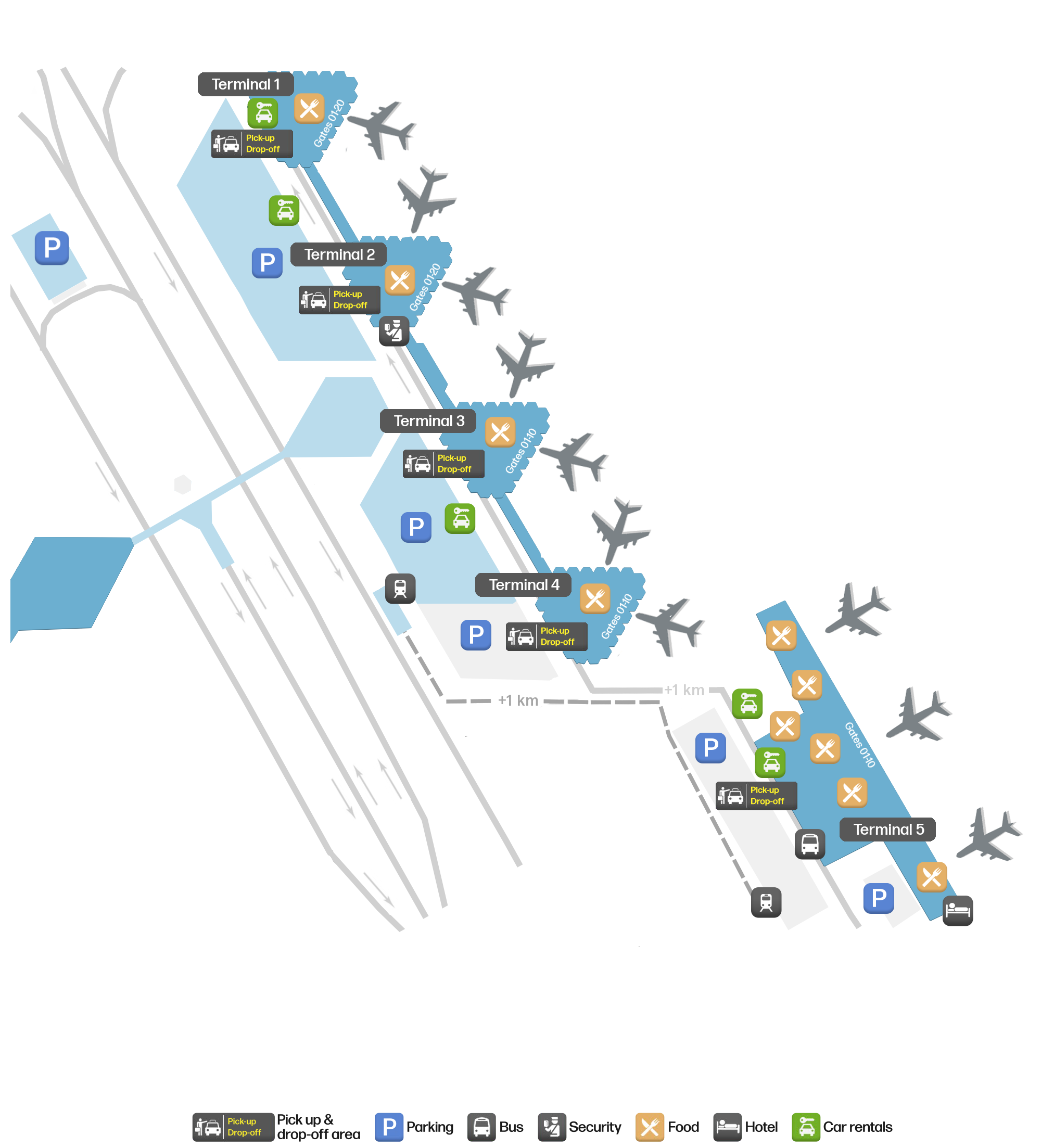
King Khalid International Airport Terminal Map
 Riyadh · Saudi Arabia· King Khalid International Airport
King Khalid International Airport (IATA: RUH, ICAO OERK) is a large airport serving Riyadh, Saudi Arabia, with 5 terminals and 72 gates, about 35 km from central Riyadh.
King Khalid International Airport (RUH) serves Riyadh, Saudi Arabia. It has 5 terminals with 72 gates in total and handles about 40 million passengers a year. The airport is about 35 km from the city centre. Ground transport into the city: bus, taxi and car.
Download Airport MapsDownloads
Airport time information — RUH current timeAirport Time
Current time at RUH (Asia/Riyadh) compared with your local time.
King Khalid International Airport route map — direct destinationsRoute Map
80 direct destinations: map, operating airlines and distances.
Airport information & detailsAirport Details
Interactive map — King Khalid International Airport locationInteractive Map
View this airport on other map services:
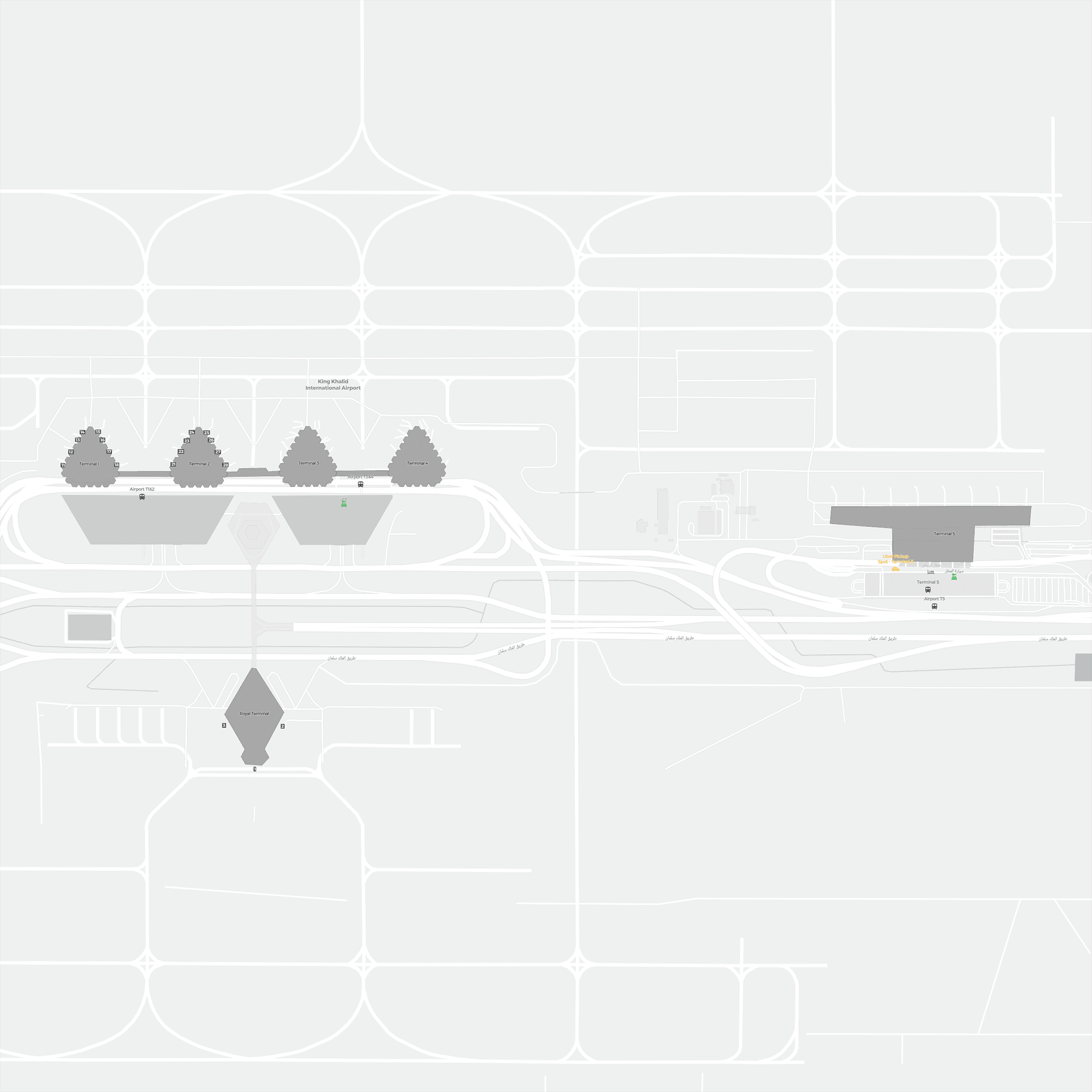
Riyadh King Khalid International Airport terminal guideAirport Guide
King Khalid International Airport sits in Riyadh's northern outskirts, about 35 km from the city centre, and handles around 41 million passengers a year as Saudi Arabia's main gateway. In February 2026 the airport completed the first full terminal reallocation in the forty years since it opened — the rules for which buildings national and foreign carriers use are now completely different from older guides, so check everything against the new ones.
The five terminals (new allocation from February 2026)
| Code | Name | New role (from February 2026) |
|---|---|---|
| T1 / T2 | Terminals 1 and 2 | National carriers' international flights (Saudia, Riyadh Air and others) |
| T3 / T4 | Terminals 3 and 4 | National carriers' domestic flights |
| T5 | Terminal 5 | Foreign carriers' international flights |
How to tell where you are going:
- Start with the airline's nationality: national carriers (the Saudia group) use T1/T2 for international flights and T3/T4 for domestic; foreign carriers' international flights are in T5.
- The change re-splits international and domestic traffic by national versus foreign carrier, and capacity has risen accordingly (annual capacity is moving from about 42 million towards 56 million).
Our diagram labels the five buildings by their new roles precisely to reflect that reallocation: the terminal assignments on older maps no longer apply.
Transfers and connections
- A Saudia-group connection is completed within the national-carrier buildings and is relatively smooth.
- Foreign carriers are concentrated in T5 — if one of your two flights is in T5 and the other in T1/T2, allow more than 2 hours.
- Domestic flights are concentrated in T3/T4, so for an international-to-domestic connection, recalculate the time from the distance between the buildings.
Routes and flights
| Aspect | Detail |
|---|---|
| Routes | Around 60 airlines serve 120+ domestic and international destinations; long-haul points cover London, Paris, Frankfurt, Istanbul, Dubai, Mumbai, Guangzhou and Beijing, making it one of the Arabian Peninsula's main hubs to Europe and Asia. |
| Flights | Around 296,800 aircraft movements in 2025, roughly 810 a day; daily passenger traffic averaged about 112,000 in 2025. |
| Aircraft | The main bases are Saudia and the newly launched Riyadh Air, which together form the national-carrier core; Saudia's workhorses are the Airbus A320 family, with A330 / A350 and Boeing 777 on long-haul. |
Getting into Riyadh
- Taxi / ride-hailing — about 35 km and roughly 35 minutes without traffic; the most common way in.
- Airport buses — cover the main districts of the city, with limited frequencies.
- Metro — Riyadh's metro network is open and links to areas around the airport, but a change requires a road transfer.
- Car hire — useful for trips to nearby cities and desert sights.
Practical tips
- Always check the terminal number on your boarding pass — the February 2026 reallocation invalidated a great deal of older information; judge by the airline's nationality first, then go by the boarding pass.
- Saudi Arabia is building King Salman International Airport (six runways planned, with long-term capacity above 100 million passengers a year), expected to open around 2029, so the airport picture will keep changing over the coming years.
- Saudi Arabia controls incoming goods and some medicines strictly; check the customs rules in advance.
Terminal guideTerminal Guide
Gate ranges, main airlines and facilities for each terminal at King Khalid International Airport.