Paris Transport Tickets: RER B from CDG, Single Rides, Day Passes and the Weekly Navigo
- Paris transport
- CDG
- RER B
- Navigo
- Paris metro
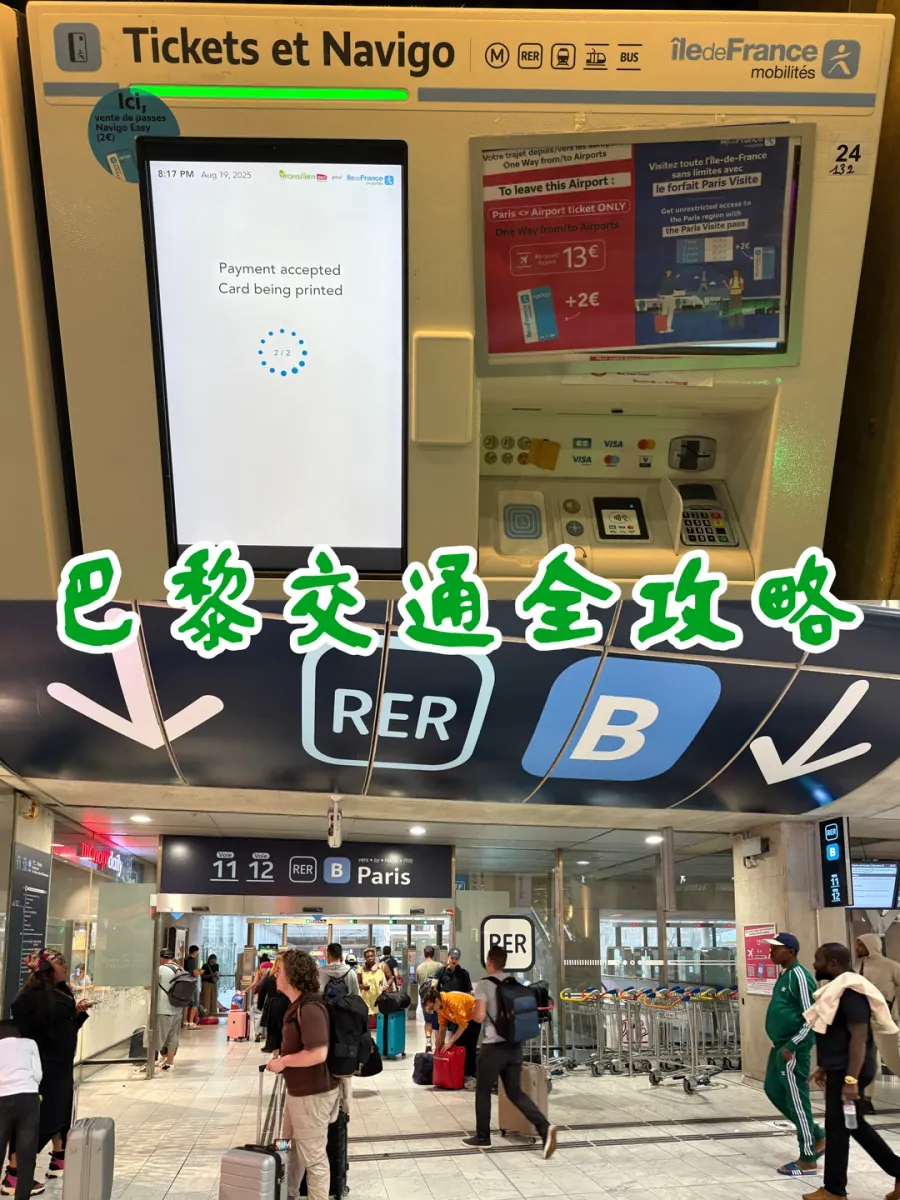
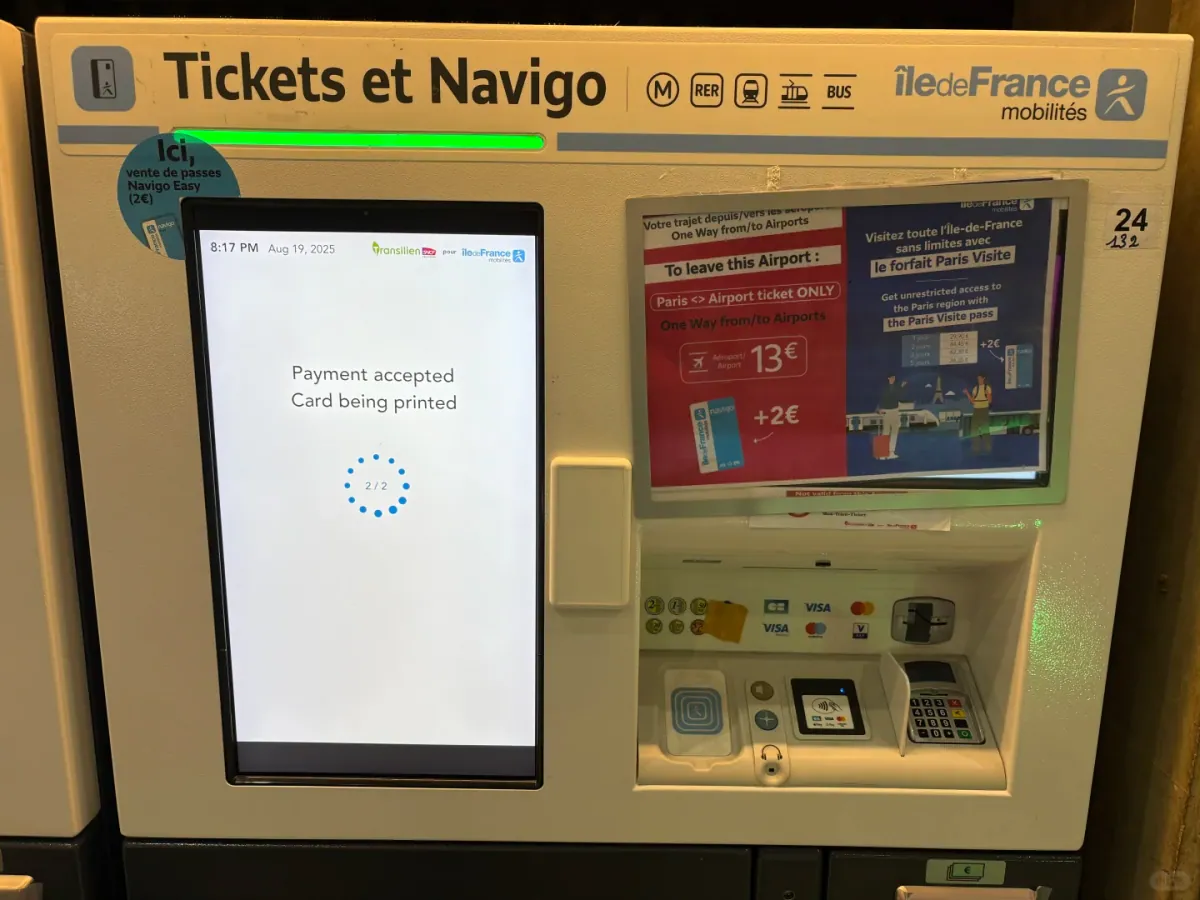
CDG lies about 25 km north-east of Paris, and the way into town is simple: follow the Train / RER signs down to the station and take the RER B. The confusion starts at the ticket hall, where yellow "Tickets et Navigo" machines offer Tickets, Passes and Airport Tickets while a poster promises "Paris ↔ Airport 13€ +2€".
This guide follows one arrival: the platform, the five ticket types, the rules that make the weekly pass easy to waste money on, the machine screen by screen, and which station your train to the provinces leaves from. Prices are what the traveller paid in August 2026.
The RER B is no separate "airport express" but line B of the Paris regional network, running through the city with stops at Gare du Nord and Châtelet; Google Maps labels it RER B, and the white B on blue is the mark to follow.
1. Getting into Paris from CDG
Out of baggage claim, look for Train / RER or Gares, not Métro. The station is under Terminal 2, one level down from arrivals; from Terminals 1 or 3, take the free CDGVAL shuttle to T2 first.
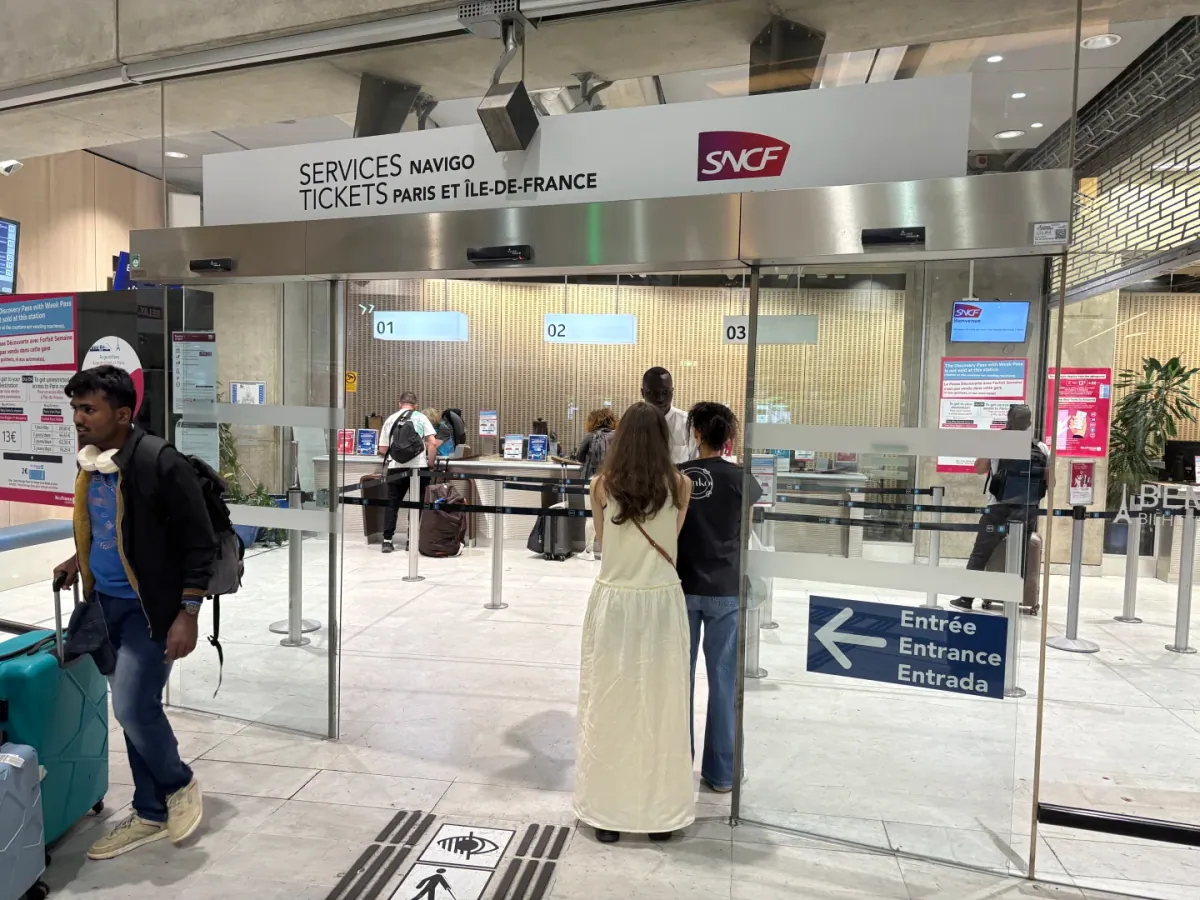
Downstairs are two options: a row of yellow machines, and a glass-walled SNCF office reading "Services Navigo / Tickets Paris et Île-de-France" with counters 01 to 03. The machine is quickest for a single airport ticket; the counter handles weekly-pass questions, changes and train tickets.
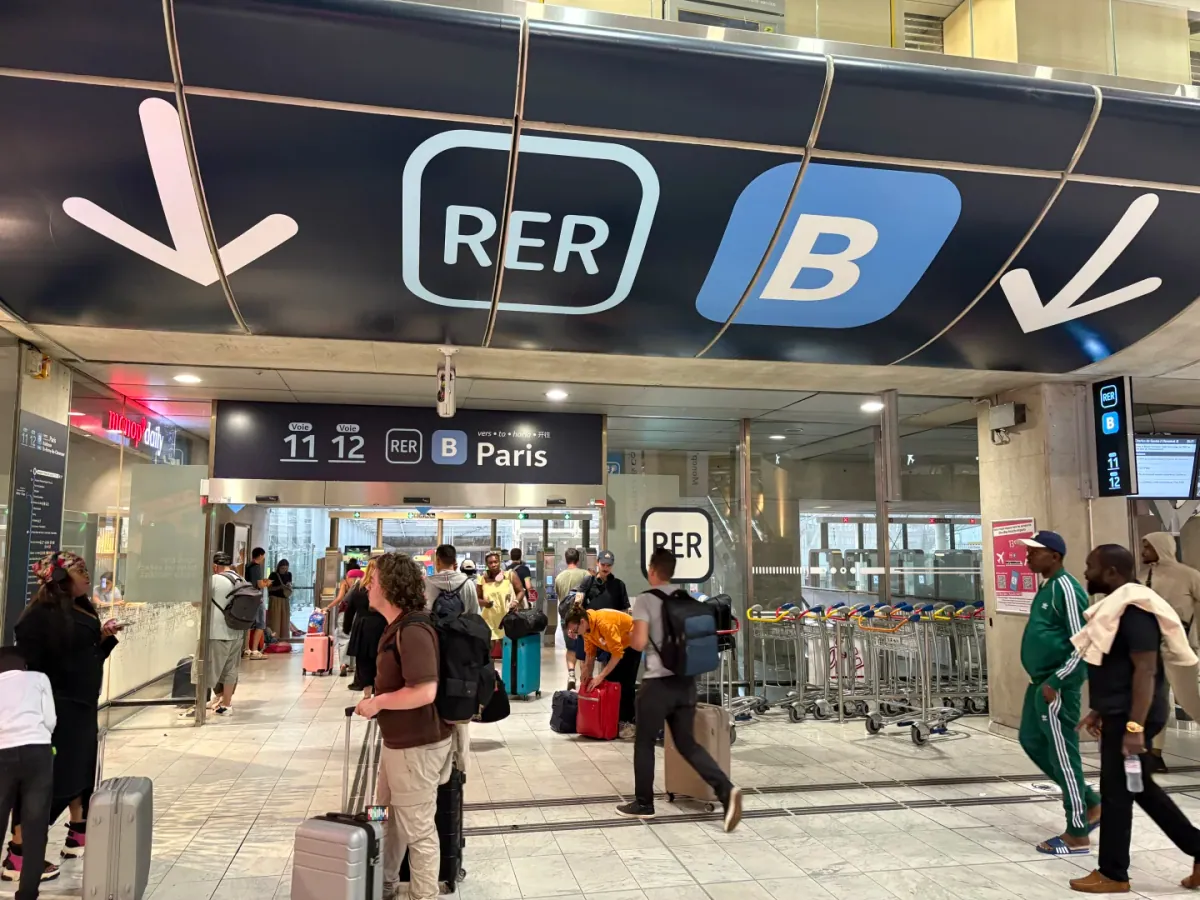
Past the gates, a dark-blue sign with a white-framed RER, a blue B and two down arrows marks the platforms, with Voie 11, 12 and Paris below. The ride to Gare du Nord or Châtelet-Les Halles takes about 25–30 minutes. With big cases, avoid the morning peak.
The airport single costs €13, the most expensive ticket of the trip and the only one valid on the RER B between airport and city. It covers that leg only, so Paris metro and bus rides need a city ticket. Even with a weekly pass in mind, you buy this €13 ticket at the airport — see section 3.
2. Ticket types and prices in Paris
Five tickets exist: a single ride, the airport ticket, a carnet of ten, a one-day pass and the weekly pass. The first card carries a €2 fee, and the same card reloads afterwards. Decide by days and rides: two days at three or four rides is singles or a carnet; five days across a week points to the weekly pass.
| Ticket | Price | Best for | Covers the airport line? |
|---|---|---|---|
| Single ride (metro / RER in the city) | €2.50 | Two or three rides a day | No |
| Single ride (bus) | €2 | Short hops, sightseeing on the way | No |
| Airport single | €13 | Arrival or departure day | Yes |
| Carnet of ten | €25 | Three to five days, no queueing | No |
| One-day pass | €12 | Several sights in one day | No |
| Weekly Navigo | €31.50 plus a €5 card | Stays that cross a week, daily travel | Yes |
A metro single is €2.50, a bus single €2. The carnet is €25, or €2.50 a ride — the same as singles, so it buys queueing time, not a discount. The day pass is €12 and expires at 24:00 that day, not 24 hours later, so buy it in the morning.
Two details matter. Once an airport ticket is on a card, the traveller found the card could not later take metro singles, only bus tickets. And the day pass excludes the airport line — the screen says "excluding airports" — so the RER B needs a separate €13 ticket.
The weekly pass is €31.50 plus a €5 card, the only long-period ticket that covers the airport line.
3. The four rules of the weekly pass
The pass ends at 24:00 on the Sunday of the week you bought it, not seven rolling days later. Monday gives seven days, Thursday four, Sunday almost none; it is a calendar-week product, unlike the day pass or the carnet. The card needs a passport-sized photo, without which it can be treated as invalid. It is sold only at staffed counters and in the Île-de-France Mobilités app, never by machine. And the airport cannot sell it: buy the €13 single on arrival (plus €2 if you have no card), then buy the weekly pass at a city station counter.
The pass covers the airport line, unlike singles and day passes: land midweek and leave at the weekend and the €13 return is included, while leaving after Sunday 24:00 means another single.
The app avoids the card fee if you add the ticket to Apple Wallet, but registration usually needs a European phone number. With the card, the pass costs €31.50 + €5 = €36.50 against €12 a day: four day passes are €48, three are €36 and nearly tie, though the pass covers one airport trip.
| Buy on | Days you actually get | Verdict |
|---|---|---|
| Monday | 7 | Best value; just buy it |
| Tuesday | 6 | Good value |
| Wednesday | 5 | Good value |
| Thursday | 4 | Level with four day passes, plus one airport trip |
| Friday | 3 | Only worth it if the return trip is by RER too |
| Saturday | 2 | A day pass is better |
| Sunday | 1 | Expires that night; do not buy |
4. Buying a ticket at the machine
Two machines share a casing: one marked ticket sells and reloads cards, one marked recharge only reloads. With no card, choose ticket. They take Visa, Mastercard and coins.
The red poster on the right reads "To leave this Airport: Paris ↔ Airport ticket ONLY", with 13€ and +2€ — the official version of the fare and the new-card fee.
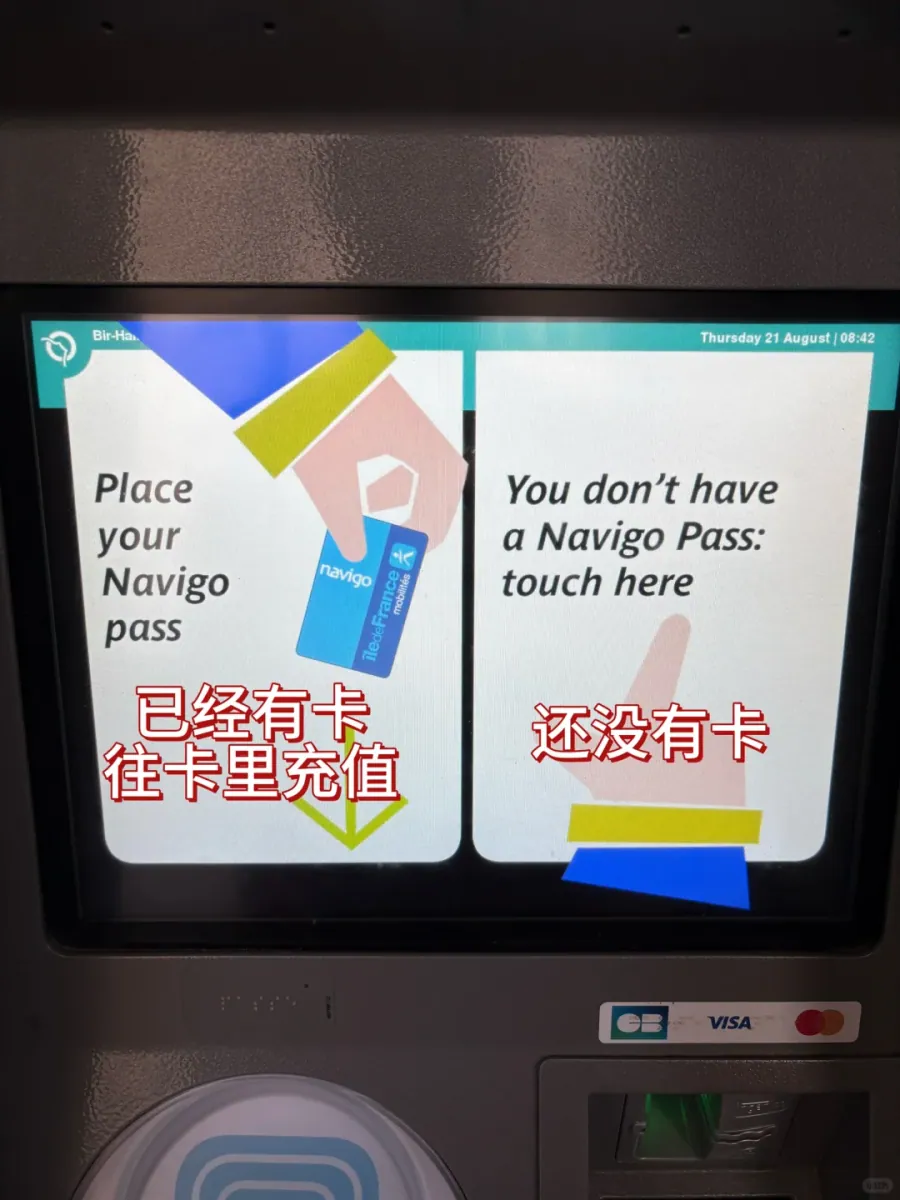
Screen one offers "Place your Navigo pass" to reload an existing card, or "You don't have a Navigo Pass: touch here" to buy one.
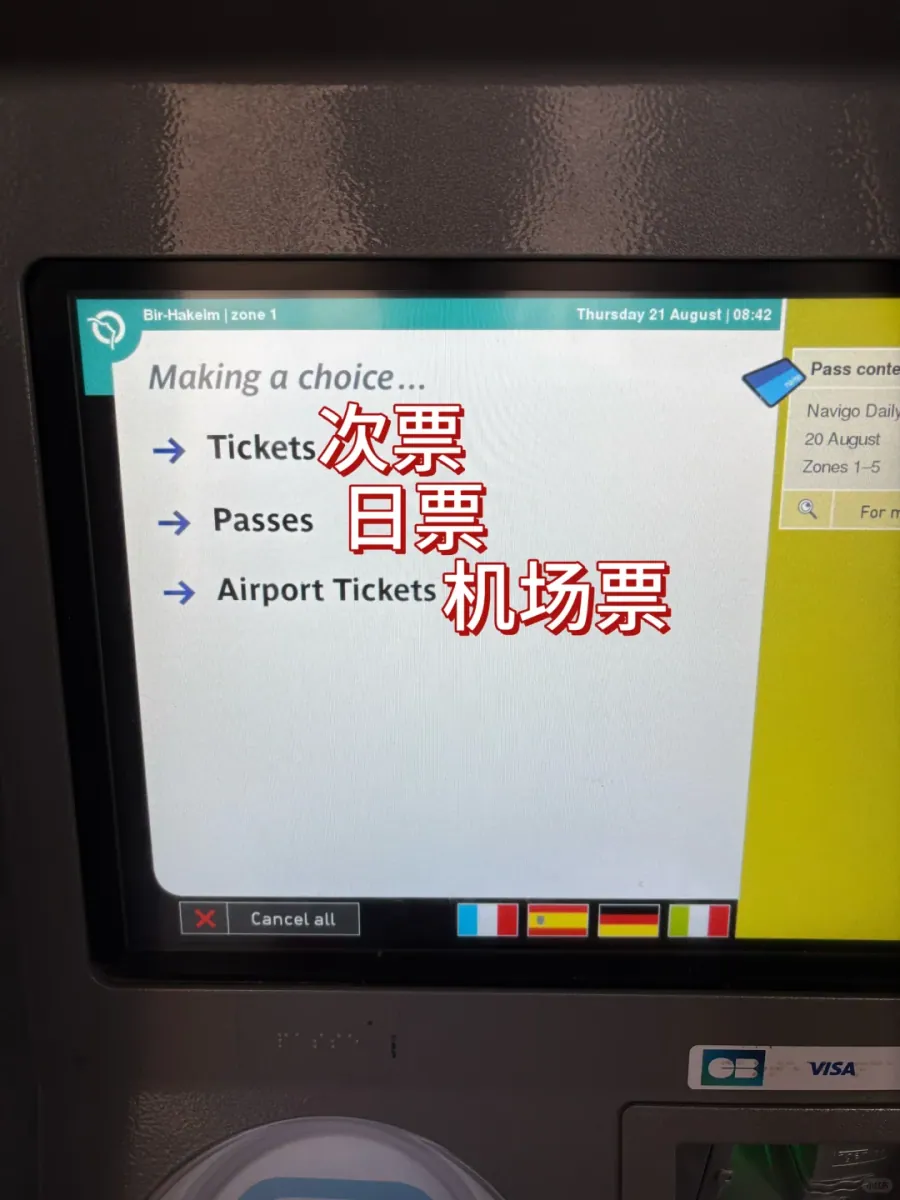
Screen two lists Tickets, Passes and Airport Tickets. Airport Tickets adds the fare and the card fee together.
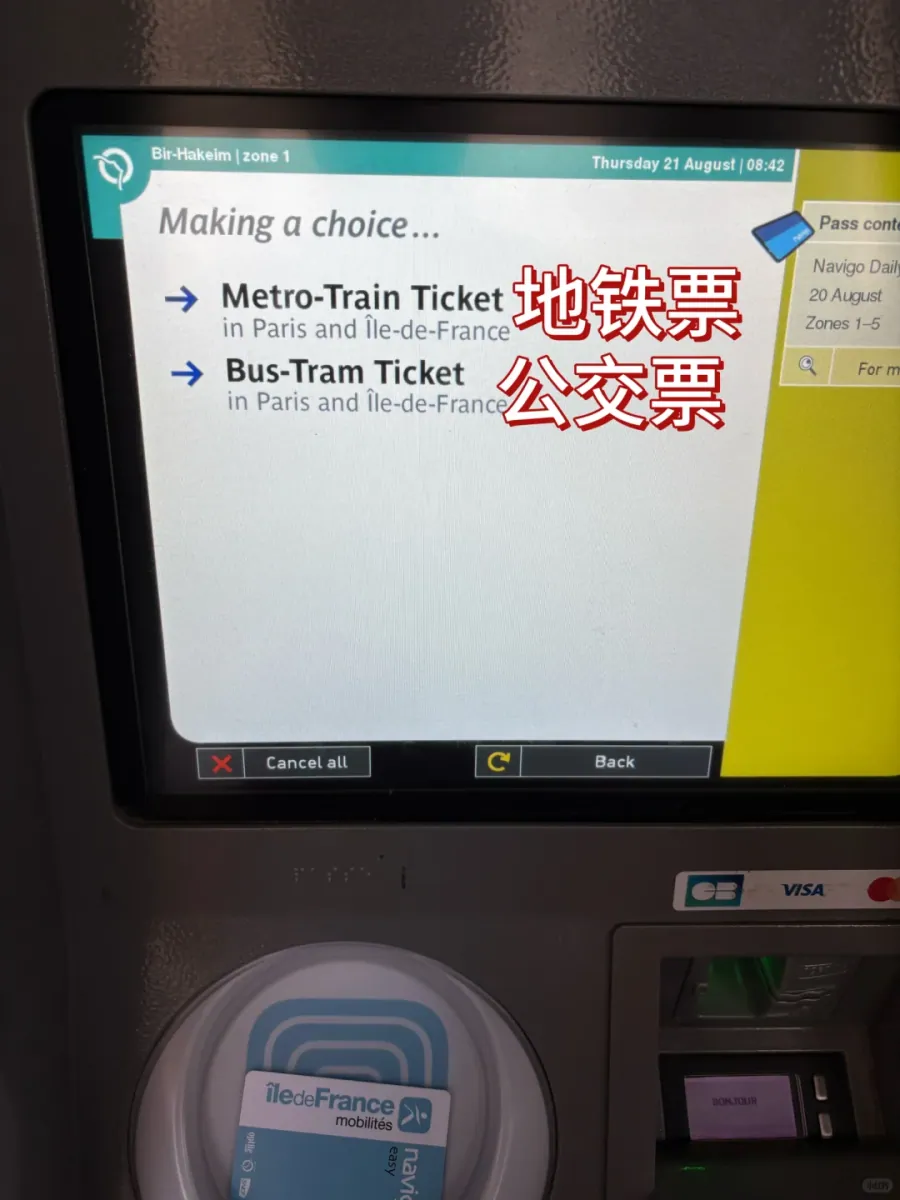
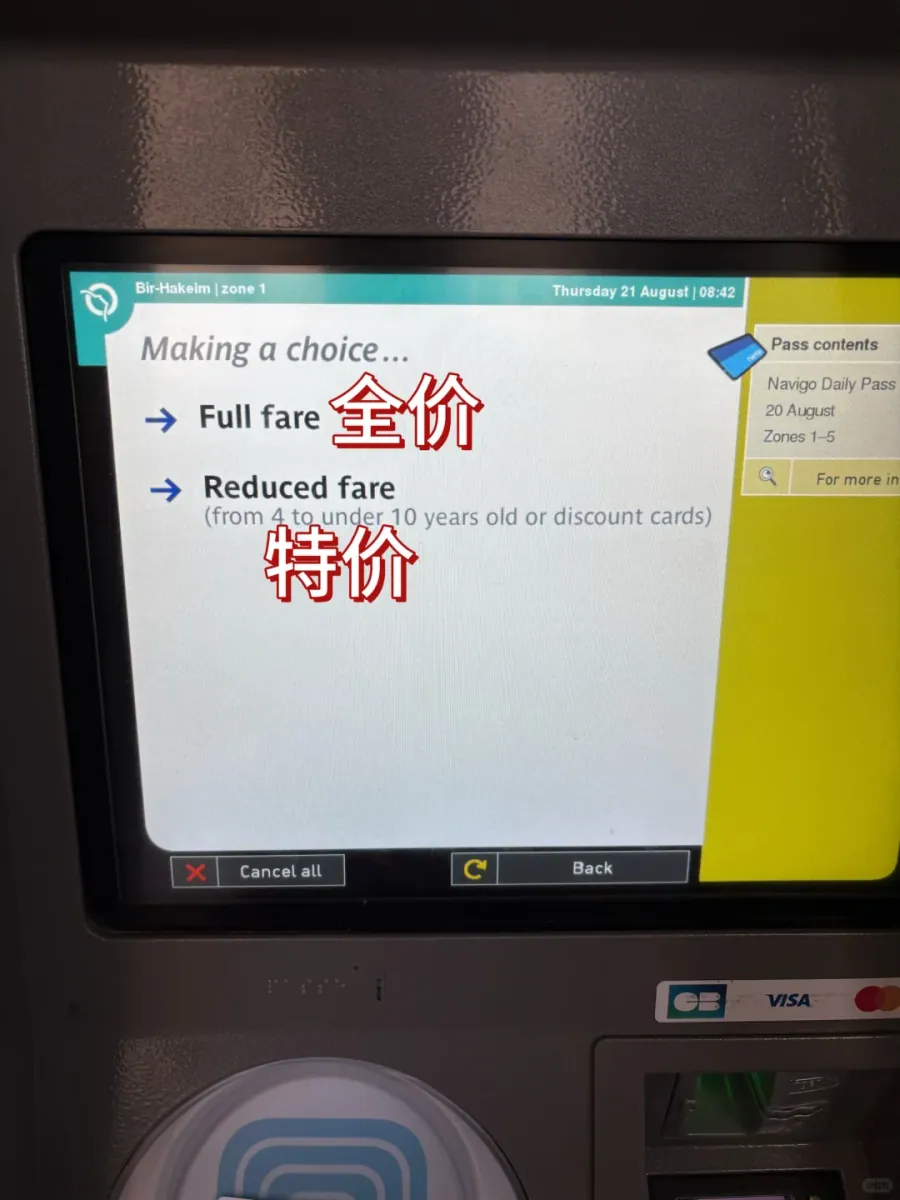
Tickets leads to Metro-Train or Bus-Tram (€2.50 against €2), then to full fare or reduced fare; reduced is for children from 4 to under 10 or discount-card holders, so visitors want full fare.
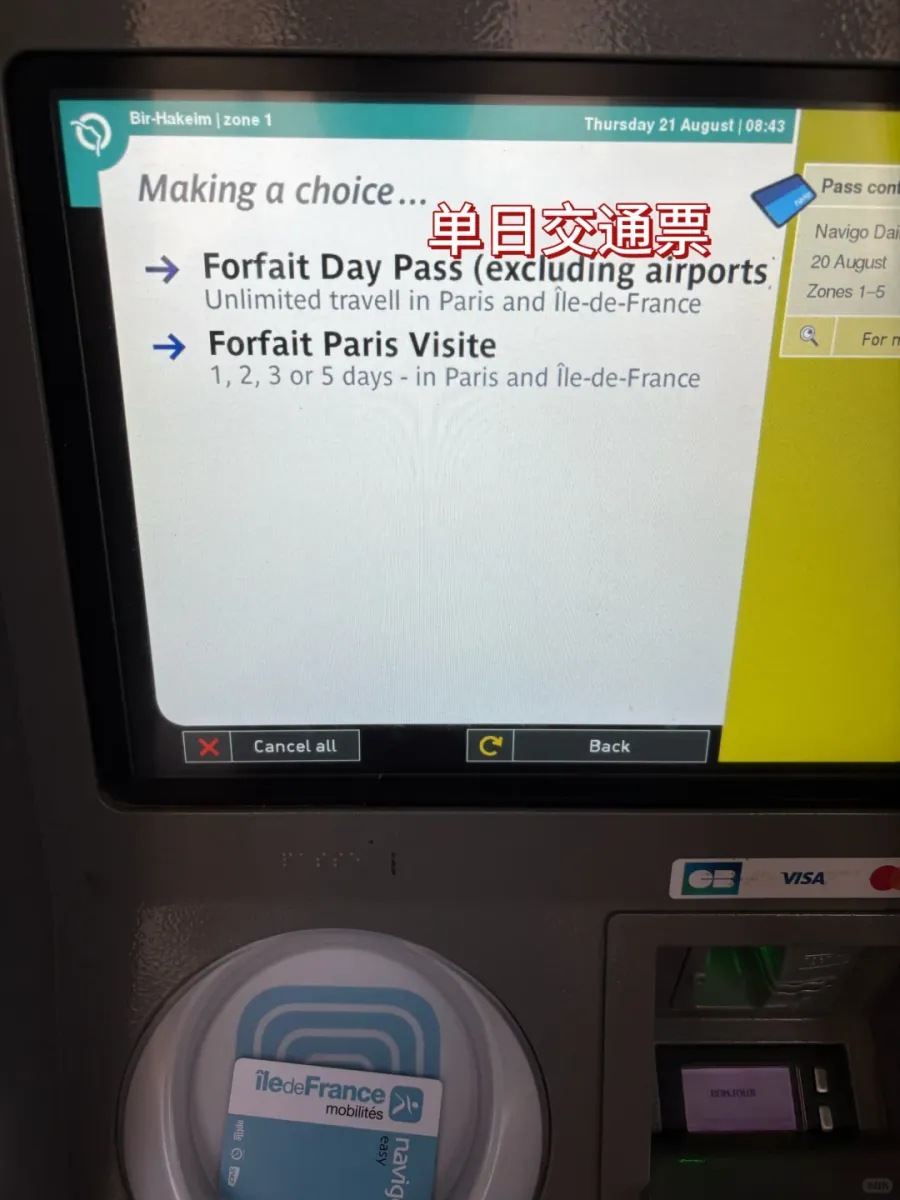
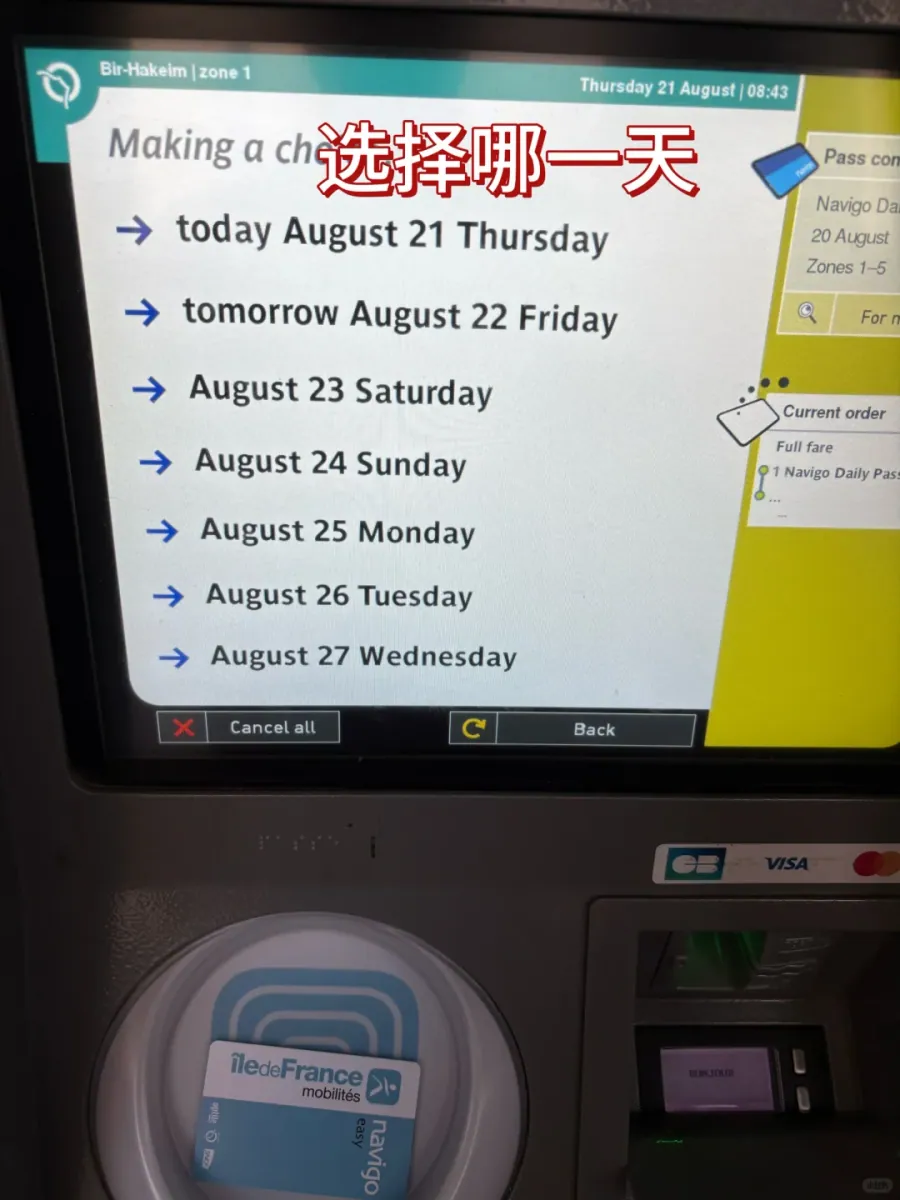
Passes leads to Forfait Day Pass (excluding airports) or Forfait Paris Visite (1, 2, 3 or 5 days). The day pass then asks for a start date, listed from today to seven days out; do not tap today out of habit.
Pay by card or coins; a new card adds €2 at the end. The weekly pass is not sold here at all.
- Pick the machine: ticket sells new cards, recharge only reloads.
- First screen: present a card, or tap "You don't have a Navigo Pass".
- Second screen: Tickets, Passes or Airport Tickets.
- Third screen (for singles): Metro-Train or Bus-Tram.
- Fourth screen: full fare or reduced fare.
- For a day pass: Passes → Forfait Day Pass → start date.
- Pay; a new card adds €2 automatically.
5. Leaving Paris: know your station
Paris has six main-line stations, each serving its own directions, much like Beijing's several termini: the wrong one means a missed train.
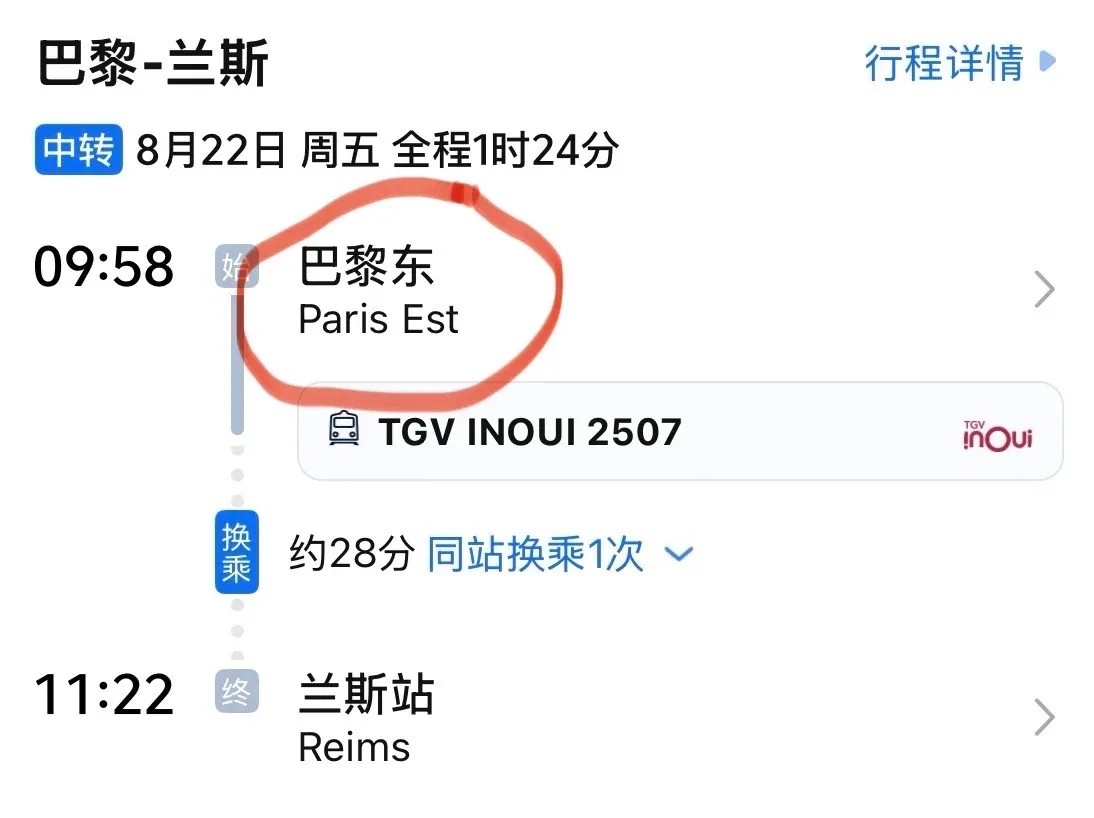
Booking apps translate station names, so "Paris Est" and "Paris Gare de Lyon" both read as Paris while sitting kilometres apart. The screenshots show the Reims train leaving Paris Est at 09:58 and reaching Reims at 11:22, and the Lyon train leaving Paris Gare de Lyon at 11:52 and reaching Lyon Part-Dieu at 13:56.
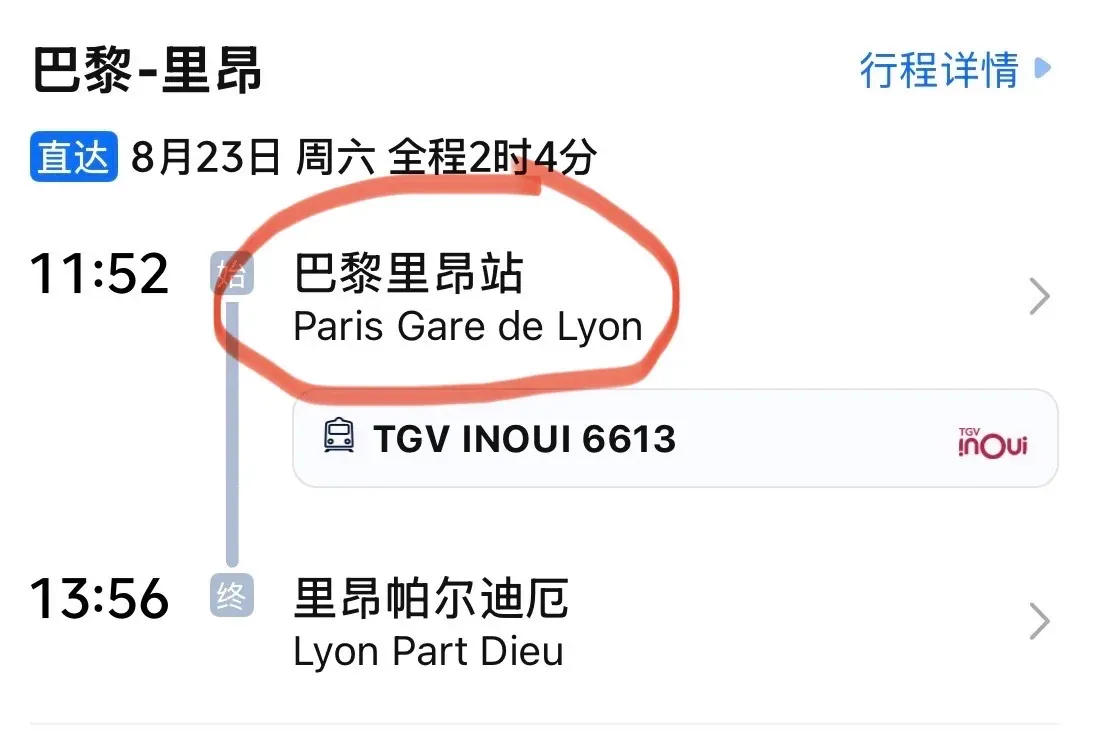
A third possibility: a ticket naming Aéroport Charles de Gaulle 2 TGV, the station under Terminal 2, where you can go downstairs instead of into the city.
| Station | Main directions | Metro / RER |
|---|---|---|
| Gare du Nord | Northern France, Belgium, Britain (Eurostar) | Lines 4, 5; RER B, D |
| Gare de l'Est | Eastern France, Germany, Luxembourg | Lines 4, 5, 7 |
| Gare de Lyon | South-eastern France, Switzerland, Italy | Lines 1, 14; RER A, D |
| Gare d'Austerlitz | South-western France, Spain, Portugal | Lines 5, 10; RER C |
| Gare Montparnasse | Western France, Brittany | Lines 4, 6, 12, 13 |
| Gare Saint-Lazare | Normandy | Lines 3, 12, 13, 14 |
Old termini are mostly dead-end: check the board for the train and its platform (voie), then walk to the track. Older metro lines mean stairs and few lifts, so allow time for a heavy case; 45–60 minutes before departure is a sensible buffer.
Done in that order, Paris transport is simple: buy the €13 airport single, weigh the day pass against the weekly pass, use a machine for ordinary tickets and the counter or app for the weekly pass, and check your station. Fares and arrangements change, so check Île-de-France Mobilités and SNCF on the day.
Related links
- On this site: Paris Charles de Gaulle Airport (CDG), France (FR)
- Wikipedia: Paris Charles de Gaulle Airport
- Baidu Baike: Paris Charles de Gaulle Airport
More articlesTravel notes
Frankfurt Airport Terminal 2 to Frankfurt Hauptbahnhof: SkyLine, then the S8 or S9
How to get from Frankfurt Airport Terminal 2 to Frankfurt Hauptbahnhof without stepping outside: the free SkyLine people mover to Terminal 1, the Bahnhof signs down to the regional station, and about fifteen minutes on the S8 or S9, plus tickets, frequencies and the five wrong turns.10 min read
Frankfurt Airport Terminal 3 to the Fernbahnhof: SkyLine, a long corridor, and 1 hour 40 minutes
A step-by-step account of reaching Frankfurt Airport long-distance station from Terminal 3: the free SkyLine to Terminal 1, the blue Fernbahnhof signs and the corridor to The Squaire, waiting for a platform number on the Abfahrt board, and how much time to allow.10 min read