Getting from Haneda Airport into Tokyo: Monorail, Keikyu or Bus?
- Haneda Airport transport
- Tokyo Monorail
- Keikyu
- airport bus
- Tokyo travel
Haneda sits close to central Tokyo and offers several ways in: monorail, Keikyu trains, airport buses and taxis, each with its own sensible use. Three things decide the answer — which side of Tokyo you are staying on, how much luggage you are moving, and how late you land.
This guide covers the stretch from the terminal to the city: where each line goes, what it costs, where you change, and what to do if you land after the trains stop. For the terminals themselves, the restaurants and the souvenirs, see the companion Haneda airport guide.
1. Which line for which area
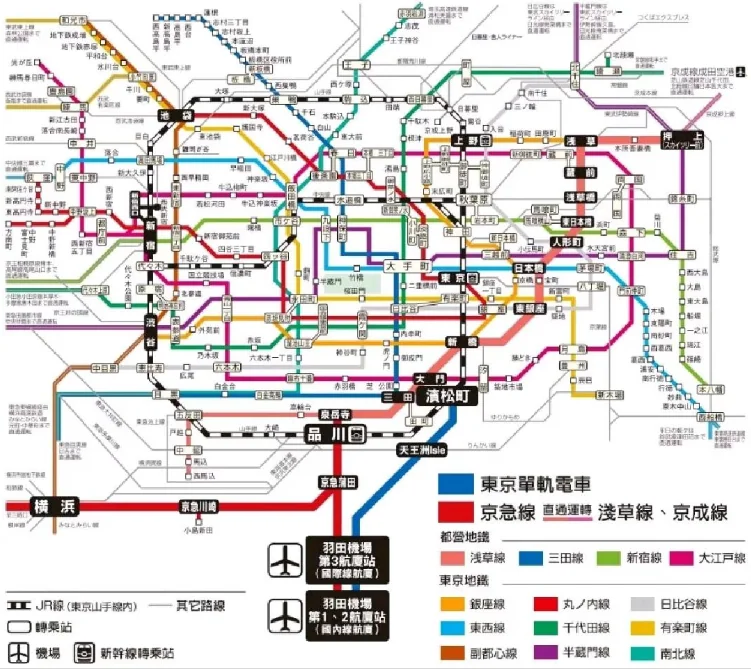
Comparing "the fastest line" is the wrong question. Haneda's two railways both leave the airport, but one runs north-east and the other north-west, and picking the wrong one adds transfers.
| Area and destination | Best option | Change at | Reference fare |
|---|---|---|---|
| Hamamatsucho, Shimbashi, Shiodome; Odaiba | Tokyo Monorail | Tennozu Isle for the Rinkai Line to Odaiba | about ¥500 |
| Tokyo Station, Akihabara, Ueno | Monorail → Hamamatsucho → JR Yamanote or Keihin-Tohoku Line | Hamamatsucho | about ¥500, plus the JR leg |
| Shinagawa, Gotanda, Shibuya, Shinjuku, Ikebukuro | Keikyu → Shinagawa → JR Yamanote Line | Shinagawa | about ¥300, plus the JR leg |
| Ginza, Nihombashi, Asakusa, Oshiage | Keikyu through service onto the Toei Asakusa Line | none | ¥430–530 |
| Yokohama, Chinatown | Keikyu | none | about ¥340 |
| Your hotel door, Disney, Hakone, Karuizawa | Airport bus | none | zonal, generally above the train |
| Late arrival, a group, heavy bags | Taxi | none | metered |
In one sentence: head east on the monorail, head west or south on Keikyu, and think about the bus only when the destination is a hotel or somewhere out in the Kanto region. These are reference figures — check the operators' own sites before you travel.
2. Tokyo Monorail — fastest for eastern Tokyo
The Tokyo Monorail is run by JR East and has a single line, the Haneda Airport Line, running from the airport to Hamamatsucho. Until Keikyu reached the airport in 1998 it was the only railway into Haneda.
- Fare: about ¥500 from any Haneda terminal to Hamamatsucho.
- Journey time: about 14 minutes at its fastest from Terminal 3 (international) to Hamamatsucho; all-stations trains take a little longer.
- Transfers: Hamamatsucho connects with the JR Yamanote and Keihin-Tohoku lines, so Shimbashi, Tokyo Station, Akihabara, Ueno and the rest of the JR network are straightforward.
For Odaiba, change at Tennozu Isle onto the Rinkai Line rather than going into town and doubling back. It has a station at each of T1, T2 and T3 — follow the Monorail signs from arrivals. Being part of the JR group, it takes IC cards at the gate.

3. Keikyu — Shinagawa, Yokohama and Asakusa
Keikyu leaves Haneda Airport station, reaching Shinagawa in about 11 minutes at its fastest to the north and Yokohama to the south, which makes it the workhorse for western Tokyo and Kanagawa. It runs five classes of train, from slowest to fastest: local, airport express, express, rapid limited express and airport rapid limited express. The fare is the same on all of them — only the number of stops changes. If you are in a hurry, wait for a rapid; if not, take whatever comes first.
Fares are banded by destination, from Terminal 3:
- Shinagawa and Sengakuji, to the north: about ¥300
- Yokohama, to the south: about ¥340
- Through Sengakuji onto the Toei Asakusa Line: about ¥430 to Shimbashi, ¥470 to Higashi-Ginza and Nihombashi, and ¥530 to Asakusa and Oshiage
Because Keikyu runs through onto the Toei Asakusa Line, Ginza, Nihombashi and Asakusa need no change at Sengakuji. That through service is what makes Keikyu a better bet than the monorail for Higashi-Ginza and Asakusa. At Shinagawa you can change to the JR Yamanote, Keihin-Tohoku and Tokaido lines and to the Tokaido Shinkansen; at Daimon you can change to the Toei subway. For Shibuya, Shinjuku and Ikebukuro, take Keikyu to Shinagawa and then the Yamanote Line, or Keikyu to Daimon and then the subway.

4. Airport buses — door to door, but slower and dearer
The airport bus is the only option that carries you and your bags to a hotel entrance. Haneda's network is wide: in Tokyo it serves Tokyo Station, Shinjuku, Ikebukuro, Shibuya, Shinagawa, Roppongi, Ginza, Akihabara, Asakusa and Odaiba, and across Kanto it reaches Chiba, Kanagawa, Saitama, Ibaraki, Tochigi, Gunma, Yamanashi and Fukushima, plus Tokyo Disney Resort, Hakone, Karuizawa, Lake Kawaguchi and Gotemba.

According to the estimates the airport currently publishes, the main runs take roughly:
| Destination | Estimated time | Stop at T3 |
|---|---|---|
| Tokyo Station | about 35 minutes | 1F, stand 1 |
| Shinjuku Station | about 35 minutes | stand 3 |
| Shibuya Station | about 40 minutes | stand 4 |
| Ikebukuro Station | about 55 minutes | stand 2 |
| Asakusa | about 1 hour 5 minutes | stand 5 |
| Tokyo Disney Resort | about 30–40 minutes | stand 5 |
| Yokohama Station | about 30 minutes | stand 7 |
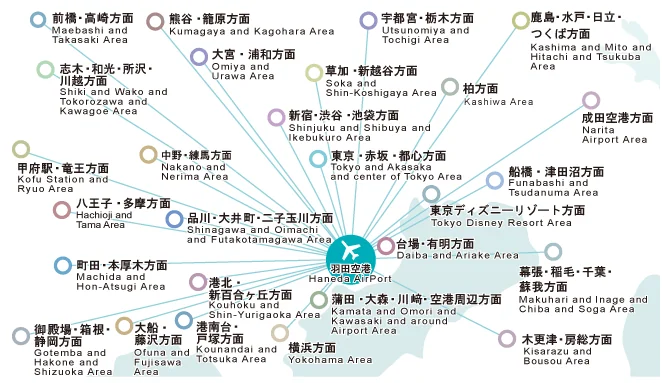
A few things to know: the stands are on the first floor, and at T3 you go down from the second-floor arrivals lobby to reach them. Tickets come from machines or the counter, and some routes can be reserved. Routes to Ginza, Akasaka/Roppongi, Akihabara, Toranomon and Shinagawa/Ebisu are currently suspended, so confirm on the airport site first. The conclusion is plain: for a simple city round trip the bus costs more than the train and is not necessarily quicker. Its value is fewer changes, a guaranteed seat, and a stop at the hotel or out in the suburbs.
5. Taxis and late arrivals
Taxis queue on the first floor outside all three terminals — follow the Taxi signs. The meter runs, and most central destinations cost far more than the train or the bus; a late-night surcharge applies from around 22:00, so a taxi mainly makes sense when the fare is split or the bags are numerous.
The bigger issue is not price but the last train. The monorail and Keikyu both stop around midnight, and the exact times vary by terminal and day of the week. The airport also runs late-night and early-morning shuttle buses to the main Tokyo stations and some hotels, far less frequently than during the day. If you land near midnight, look up that night's last trains and late-night buses before deciding to take a taxi.
6. IC cards, fares and last trains
- IC cards: Suica, PASMO and the nationally interoperable IC cards (ICOCA and others) work on the monorail, Keikyu and the airport buses; tap in and out and skip the ticket queue. Cards are sold and topped up at station machines, and Suica or PASMO in your phone works the same way.
- Fares: monorail by section, Keikyu by distance, with any JR or subway leg charged separately. One card through the whole trip beats buying each segment.
- Last trains: both railways stop around midnight, and T3 differs slightly from T1 and T2. Do not assume there will still be a train.
- Check before you go: the fares quoted here date from 2023. For current monorail, Keikyu and airport-bus fares, timetables and late-night services, use the operators' websites on the day.
Related links
- On this site: Haneda Airport (HND), Japan (JP)
- Wikipedia: Haneda Airport
- Baidu Baike: Haneda Airport
- Airport site: Haneda Airport access, highway and dedicated buses
Image source: images from the original article; the route maps are published by the airport and the operators. Most fares here date from 2023 — check the Tokyo Monorail, Keikyu and Haneda Airport websites on the day you travel.
More articlesTravel notes
Duty-Free at Haneda Airport: T2 and T3 Shops, Brands and Transit Rules
A practical guide to duty-free shopping at Haneda Airport (HND): the T2 TIAT DUTY FREE SOUVENIR, the two T3 shops by gate 109, their hours and brands, ANA vouchers and online pre-order, plus duty-free versus tax-free, liquids on connections and what is worth buying at the airport rather than in town.5 min read
Ibaraki Airport to Tokyo: the highway bus, fares and reservations
Ibaraki Airport (IBR) has no railway station, so the run into Tokyo is a highway coach to Tokyo Station’s Yaesu South Exit: about 85 km and 100 minutes, ¥2,200 one way since 30 March 2025. This guide covers the current fare and payment, the Japan Bus Online reservation rules, the sparse 2026 summer timetable, and the three-minute walk from arrivals to the stop.4 min read