San Francisco International Airport Terminal Map
 San Francisco · United States· San Francisco International Airport
San Francisco International Airport (IATA: SFO, ICAO KSFO) is a large airport serving San Francisco, United States, with 4 terminals and 83 gates, about 21 km from central San Francisco.
San Francisco International Airport (SFO) serves San Francisco, United States. It has 4 terminals with 83 gates in total and handles about 54 million passengers a year. The airport is about 21 km from the city centre. Ground transport into the city: rail, bus and taxi.
Download Airport MapsDownloads
Airport time information — SFO current timeAirport Time
Current time at SFO (America/Los_Angeles) compared with your local time.
San Francisco International Airport route map — direct destinationsRoute Map
101 direct destinations: map, operating airlines and distances.
Airport information & detailsAirport Details
Interactive map — San Francisco International Airport locationInteractive Map
View this airport on other map services:
San Francisco International Airport terminal guideAirport Guide
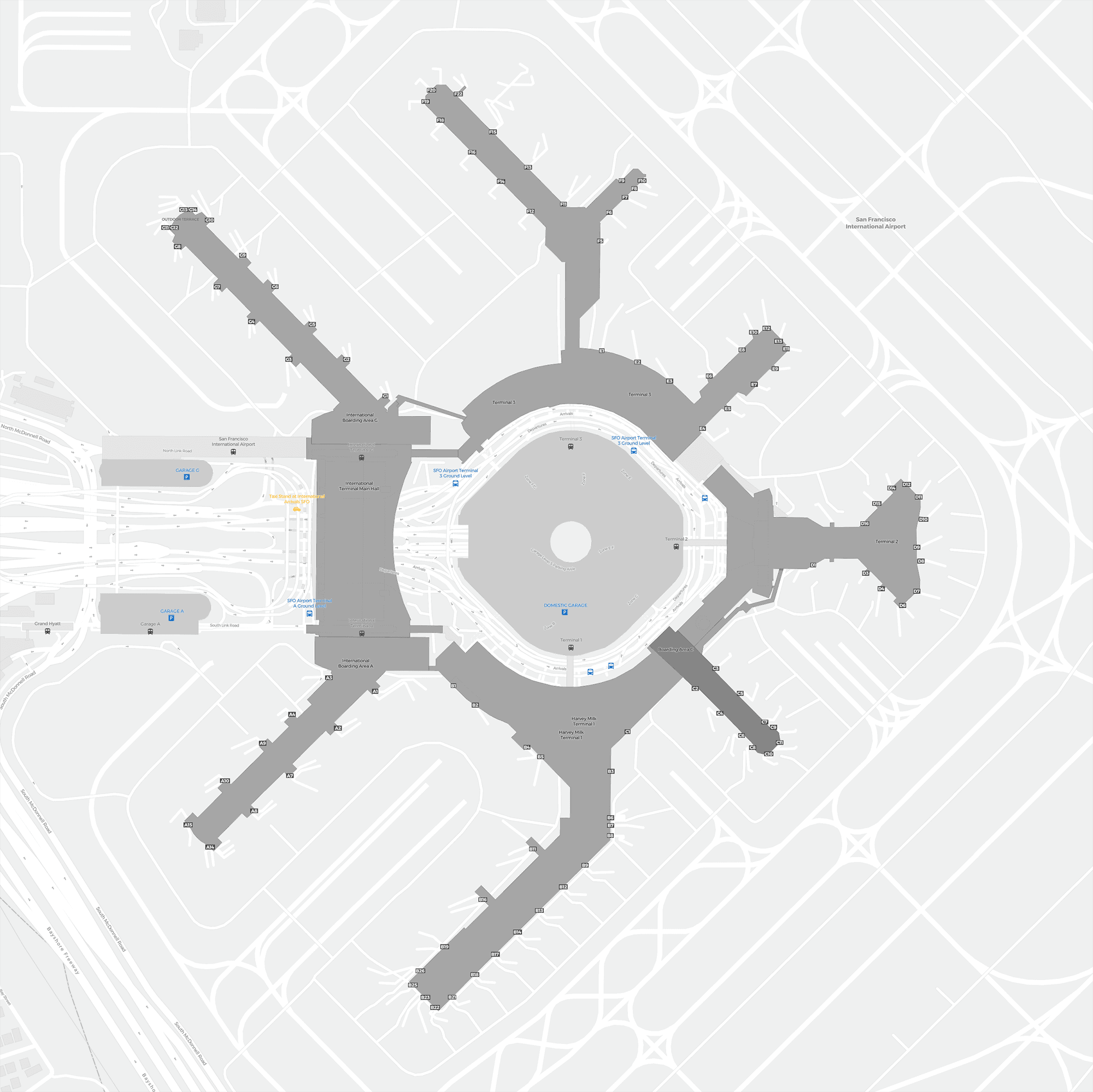
San Francisco International Airport sits about 21 km from the city centre and handles around 54 million passengers a year. Its four terminals are laid out in a U: three domestic terminals (Harvey Milk T1, T2 and T3) plus one international terminal — but the international terminal is itself split into two boarding areas, A and G, at opposite ends of the U, and that is the structure most easily overlooked at this Bay Area airport.
The four terminals
| Code | Name | Boarding area | Main users |
|---|---|---|---|
| T1 | Harvey Milk Terminal 1 | B | Delta, Alaska, Southwest, JetBlue and others |
| T2 | Terminal 2 | D | Air Canada, WestJet and some United domestic flights |
| T3 | Terminal 3 | E / F | United domestic only |
| T4 | International Terminal | A / G | All international flights |
How to tell where you are going: international gates always carry an A or G prefix, and the two sit at opposite ends of the terminal:
- Area G connects to T3 and Area A connects to Harvey Milk T1.
- There is no direct passage between Areas A and G; crossing on foot means passing through the terminals in between, about 20–25 minutes.
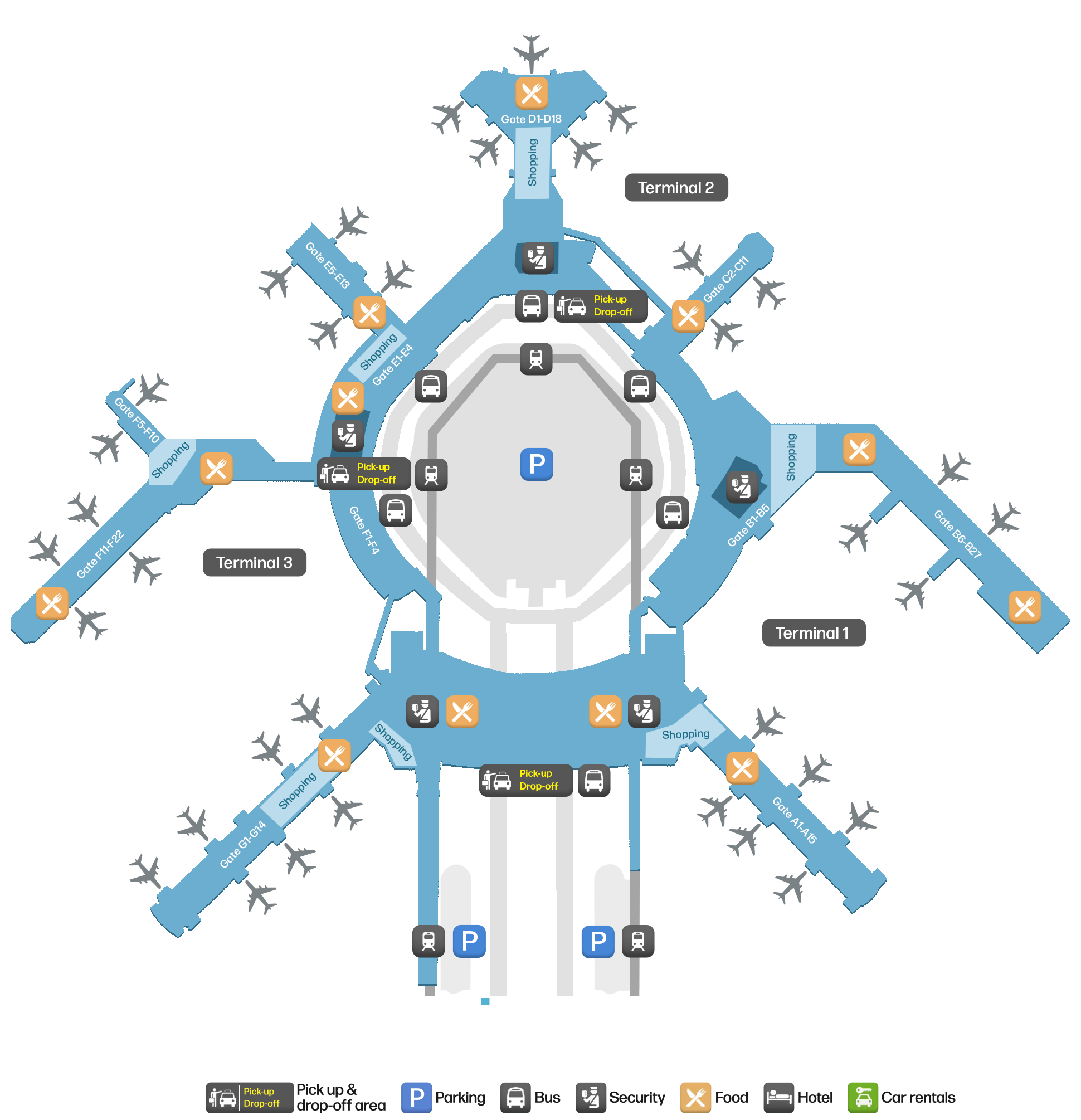
Our diagram draws the International Terminal as one end of the U and marks the A and G boarding areas at its two ends precisely to show that distance — one building, two separate areas.
Transfers and connections
- First see whether the international gate is A or G, then confirm which building the domestic leg uses.
- Area G with T3 (United) and Area A with T1 are the smoothest pairings, completed inside the building without clearing security.
- Moving from G to A is a long-distance connection: allow more than 90 minutes, or take the airside walkway instead.
Routes and flights
| Aspect | Detail |
|---|---|
| Routes | Non-stop to 58 international and 86 domestic destinations (about 144 in total); Asia-Pacific makes up about 11.8% of international passengers and Europe 7.8%. It is United's main gateway to Asia-Pacific, with long-haul points such as Singapore, Hong Kong, Tokyo, Sydney and Frankfurt. |
| Flights | Around 54 million passengers in calendar 2025; about 7,200 flights a week. |
| Aircraft | The main base is United Airlines, around 44% of the market; its long-haul fleet flies Boeing 777 / 787 / 767 widebodies and its domestic fleet the A320 family and Boeing 737. Next come Delta (around 7.6%) and American (around 6.9%). |
Getting into San Francisco
- BART — the station is inside the International Terminal (Level 4), about 30 minutes direct to the city centre, and the first choice for getting into town.
- AirTrain — free, running 24 hours and every few minutes, connecting the four terminals, the car parks and the BART station.
- Taxi / ride-hailing — from designated pickup points, about 21 km; US 101 is heavily congested at peak times.
- Caltrain connection — one BART stop to Millbrae and then a change, good for the Silicon Valley direction.
Practical tips
- The Bay Area has a dense cluster of airports: Oakland (OAK) and San José (SJC) are both nearby, so check the three-letter code when booking or arranging a pickup.
- From the International Terminal to the domestic terminals you can stay indoors the whole way, using the walkways plus the AirTrain — no need to leave the building in the rain.
- BART runs until around midnight; for a late arrival, have a taxi or ride-hailing plan ready.
Terminal guideTerminal Guide
Gate ranges, main airlines and facilities for each terminal at San Francisco International Airport.