Italy Entry Guide 2026: Milan Queues, Rome Speed, and the Paperwork That Matters
- Italy entry
- Milan Malpensa
- Rome Fiumicino
- Schengen visa
- Italian customs
Fly to Italy from China and there are essentially two doors: Milan Malpensa (MXP) in the north and Rome Fiumicino (FCO) in the capital. The same Schengen visa and the same long flight can still produce arrivals hours apart — not because of the traveller, but because of how many officers each airport puts behind the manual counters for non-EU passports.
In 2026 the EU's Entry/Exit System (EES) is also fully in operation, so non-EU visitors register fingerprints and a facial image at a kiosk on first entry before the manual check. The extra step is not slow in itself, but it changes the shape of the queue. Every waiting time below comes from travellers' reports, not an airport promise.
1. Two airports, two experiences
The Schengen rules are identical at both airports; the way they are applied is not. The difference shows up in how many manual counters are staffed, in how arrivals are batched through the day, and in how fast a queue is absorbed.
Milan Malpensa (MXP): where the queue is
Malpensa is northern Italy's long-haul gateway and the airport Chinese non-stop flights to Milan use. Non-EU passports can only use manual booths, and in peak season often just two are open. Long-haul arrivals bunch up as well: 16:00 to 21:00 is the peak, when several wide-body aircraft land within an hour and hundreds of non-EU passengers converge on one lane. Travellers report queues starting at two hours; in 2026 one Chinese traveller waited three hours for an entry stamp.
Rome Fiumicino (FCO): the smoother one
Fiumicino is Italy's busiest airport and has invested more in border technology: 77 e-gates, more than any other airport in Europe. Most EU passport holders are filtered onto the machines, which takes pressure off the counters. Early flights are the quietest window: those landing between 06:00 and 09:00 barely queue and clear in about ten minutes. Chinese passports still cannot use the e-gates, but more counters are open and the checks move faster.
| Point | Milan Malpensa (MXP) | Rome Fiumicino (FCO) |
|---|---|---|
| Lane for Chinese passports | Manual counters only | Manual counters only |
| Peak window | 16:00–21:00, long-haul arrivals bunch up | Early flights 06:00–09:00 are quietest |
| Typical wait | Two hours and up; three-hour reports | About ten minutes on an early flight |
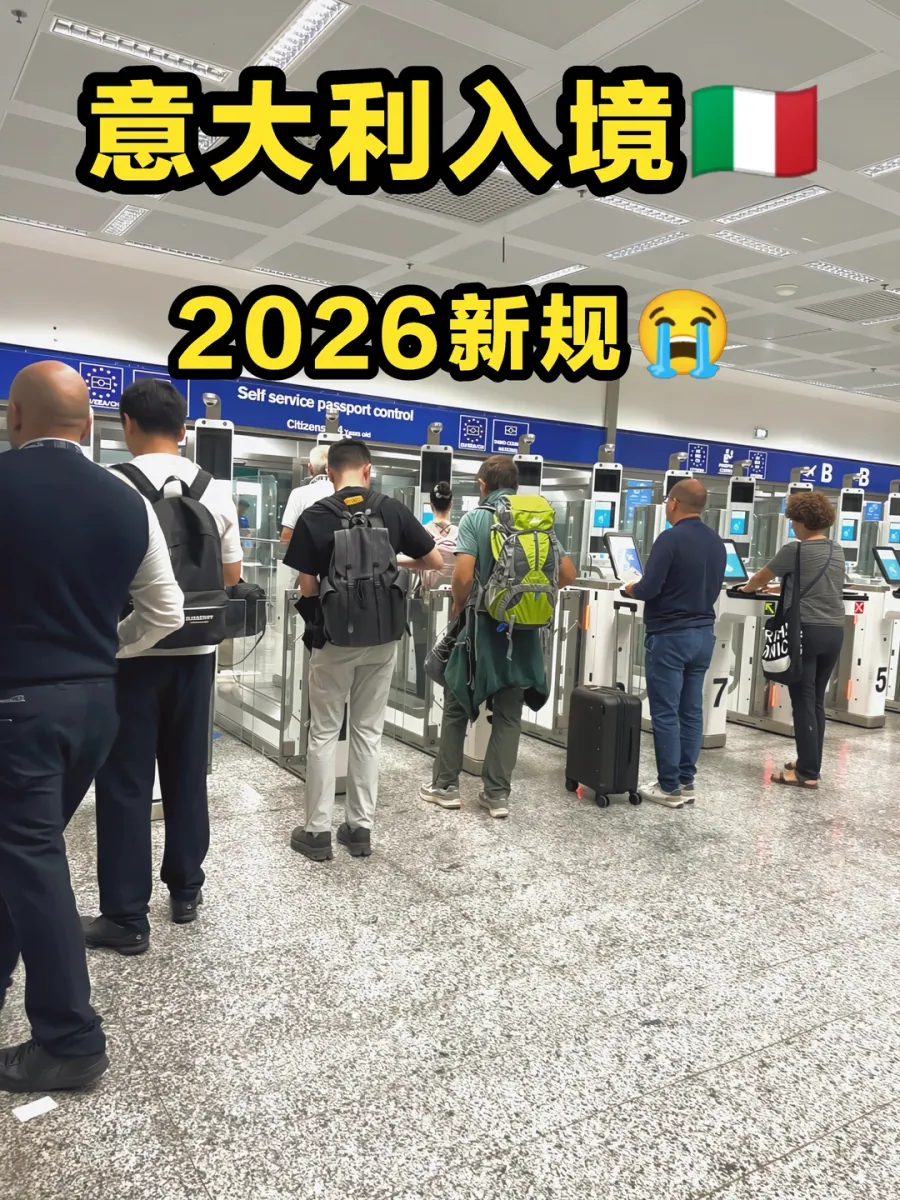
Those gates serve EU, EEA and Swiss travellers; the sign reads Self service passport control. With a Chinese passport, do not join that line — keep walking until you see All Passports / TUTTI I PASSAPORTI.
2. What to prepare before you fly
A border officer looks at a passport for perhaps thirty seconds, and whether that goes smoothly depends less on your English than on whether the paperwork is ready to hand over.
- Passport, valid at least six months. The thing people discover too late: a passport with two months left can still get a visa and still be refused entry.
- Schengen visa (type C, short stay). Apply about 1.5 months ahead; in peak season appointments and processing can stretch to 30–45 days.
- Return or onward ticket. Proof you will leave on time; print the whole journey.
- Hotel bookings, ideally printed. Your first night's address matters most.
- Travel insurance. Mandatory for a Schengen visa and covering the whole stay; keep the certificate with you.
Print all three documents — itinerary, booking, policy — and keep them with your passport. For the first hour after landing, your phone is your least reliable possession.
3. Customs and cash: the hard limits
Clearing immigration is half of arriving; after baggage claim comes customs, which is blunter than border control — an officer can discuss things with you, a rule cannot.
- Cash: up to €10,000 needs no declaration, above that you must declare it. The threshold is not a ban; declaring is legal, failing to declare is not.
- Prohibited: meat and dairy products. Sausages, beef jerky, cured sausage, cheese — vacuum packing makes no difference, and checked bags are searched too.
- Tobacco: 200 cigarettes, for travellers aged 17 or over.
- Alcohol: one bottle of spirits or two bottles of lower-strength alcohol.
- Medicine: personal-use quantities only, with a prescription. Narcotics are checked most strictly.
| Item | Limit | Notes |
|---|---|---|
| Cash | Up to €10,000 without declaring | Above that, declare; family travelling together counted jointly |
| Meat and dairy | Prohibited | Vacuum packing makes no difference |
| Cigarettes | 200 | Travellers aged 17 and over |
| Alcohol | One bottle of spirits or two of lower-strength alcohol | Wine, beer and similar |
| Medicine | Personal-use quantity plus prescription | Keep original packaging |
The trap most Chinese travellers fall into is meat. A few sausages and a bag of beef jerky look unremarkable in a suitcase, but if they are found they are confiscated on the spot, with a fine in the more serious cases.
4. The walk from the gate to the carousel
An Italian airport has essentially one main route from the aircraft door to the baggage carousel, signposted in Italian and English. First-timers hesitate over which lane to join, and that hesitation is exactly how a queue gets longer.
- Follow USCITA / Exit. Do not stop on the jet bridge for signal, and do not follow the Transfer arrows unless you really are connecting.
- Take All Passports / TUTTI I PASSAPORTI. The hall splits into self-service and manual lanes; a Chinese passport belongs in the manual one, and the e-gates will not produce an entry record for you.
- Register with EES on first entry. Scan your passport at the kiosk, give fingerprints and a photo, confirm the receipt, then go to a manual counter. Registering is not the same as being admitted.
- Collect your bags. Find your flight number on the screens. At Milan the bags are sometimes already offloaded beside the belt, so ask staff if you cannot see them.
- Clear customs. Nothing to declare, take the green channel; over the allowance or carrying anything declarable, take the red channel.
Step three is where people most often go wrong. The EES kiosks usually sit to one side before the manual lanes, with staff directing traffic at busy times; first entry needs registration, while a re-entry within three years is usually matched to the existing record.
5. EES and the questions everyone asks
EES is the EU's electronic entry/exit system, phased in from October 2025 and fully operational from April 2026. It records each non-EU entry and exit with fingerprints and a facial image instead of a passport stamp. The visible change is an extra self-service step on first entry; the benefit is a faster counter check on any re-entry within three years.
Does EES make the queue longer? Registration adds a minute or two per person. What drives the wait is the number of counters open — Milan's problem was never slow machines but too few staffed booths.
Can a Chinese passport use the e-gates? Not at present. Italy's e-gates serve EU, EEA and Swiss travellers, plus registered travellers from certain other countries at some airports; Chinese passports are not among them.
Do I need to enter Italy if I am only connecting? If your next flight is within Schengen, you normally clear Schengen entry at the first point of arrival. Connecting internationally without entering Schengen, you stay airside.
What will they ask? Usually three things in English: what you are doing, how long you are staying, where you are staying. Specific answers work better — "tourism, ten days, first night near Milano Centrale" beats "just looking around".
One last note: counter numbers, waiting times and the exact EES procedure vary with the day's flight schedule and staffing. The times here come from travellers' measurements and reports; check the airport, Italian border police and customs websites for the day you travel.
Related links
- On this site: Rome Fiumicino Airport (FCO), Milan Malpensa Airport (MXP), Italy (IT)
- Wikipedia: Rome Fiumicino Airport, Milan Malpensa Airport
- Baidu Baike: Rome Fiumicino Airport, Milan Malpensa Airport
More articlesTravel notes
Frankfurt Airport Terminal 2 to Frankfurt Hauptbahnhof: SkyLine, then the S8 or S9
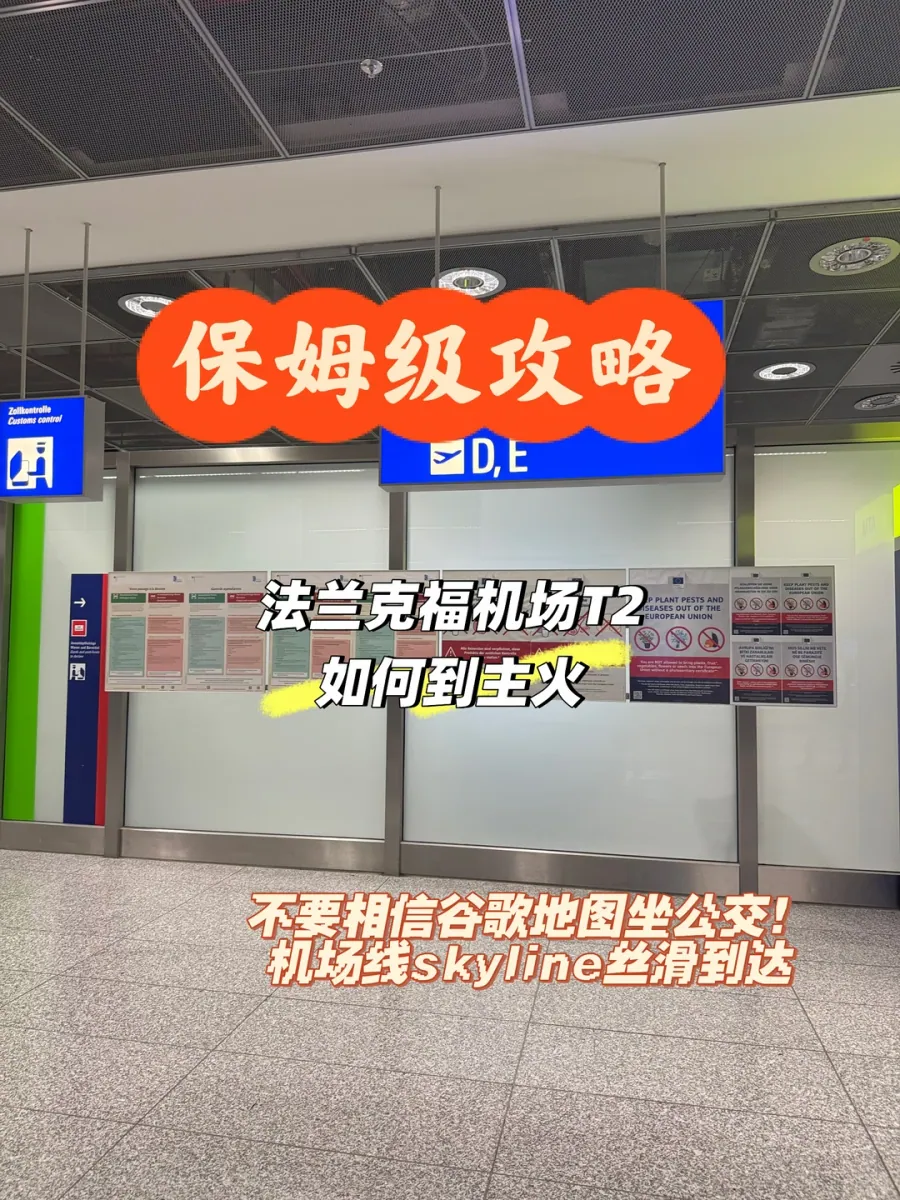
How to get from Frankfurt Airport Terminal 2 to Frankfurt Hauptbahnhof without stepping outside: the free SkyLine people mover to Terminal 1, the Bahnhof signs down to the regional station, and about fifteen minutes on the S8 or S9, plus tickets, frequencies and the five wrong turns.10 min read
Frankfurt Airport Terminal 3 to the Fernbahnhof: SkyLine, a long corridor, and 1 hour 40 minutes
A step-by-step account of reaching Frankfurt Airport long-distance station from Terminal 3: the free SkyLine to Terminal 1, the blue Fernbahnhof signs and the corridor to The Squaire, waiting for a platform number on the Abfahrt board, and how much time to allow.10 min read