
Rome Fiumicino Airport Terminal Map
 Rome · Italy· Rome Fiumicino Airport
Rome Fiumicino Airport (IATA: FCO, ICAO LIRF) is a large airport serving Rome, Italy, with 3 terminals and 107 gates, about 30 km from central Rome.
Rome Fiumicino Airport (FCO) serves Rome, Italy. It has 3 terminals with 107 gates in total and handles about 50 million passengers a year. The airport is about 30 km from the city centre. Ground transport into the city: rail, bus and taxi.
Download Airport MapsDownloads
Airport time information — FCO current timeAirport Time
Current time at FCO (Europe/Rome) compared with your local time.
Rome Fiumicino Airport route map — direct destinationsRoute Map
151 direct destinations: map, operating airlines and distances.
Airport information & detailsAirport Details
Interactive map — Rome Fiumicino Airport locationInteractive Map
View this airport on other map services:
Rome Fiumicino Airport terminal guideAirport Guide
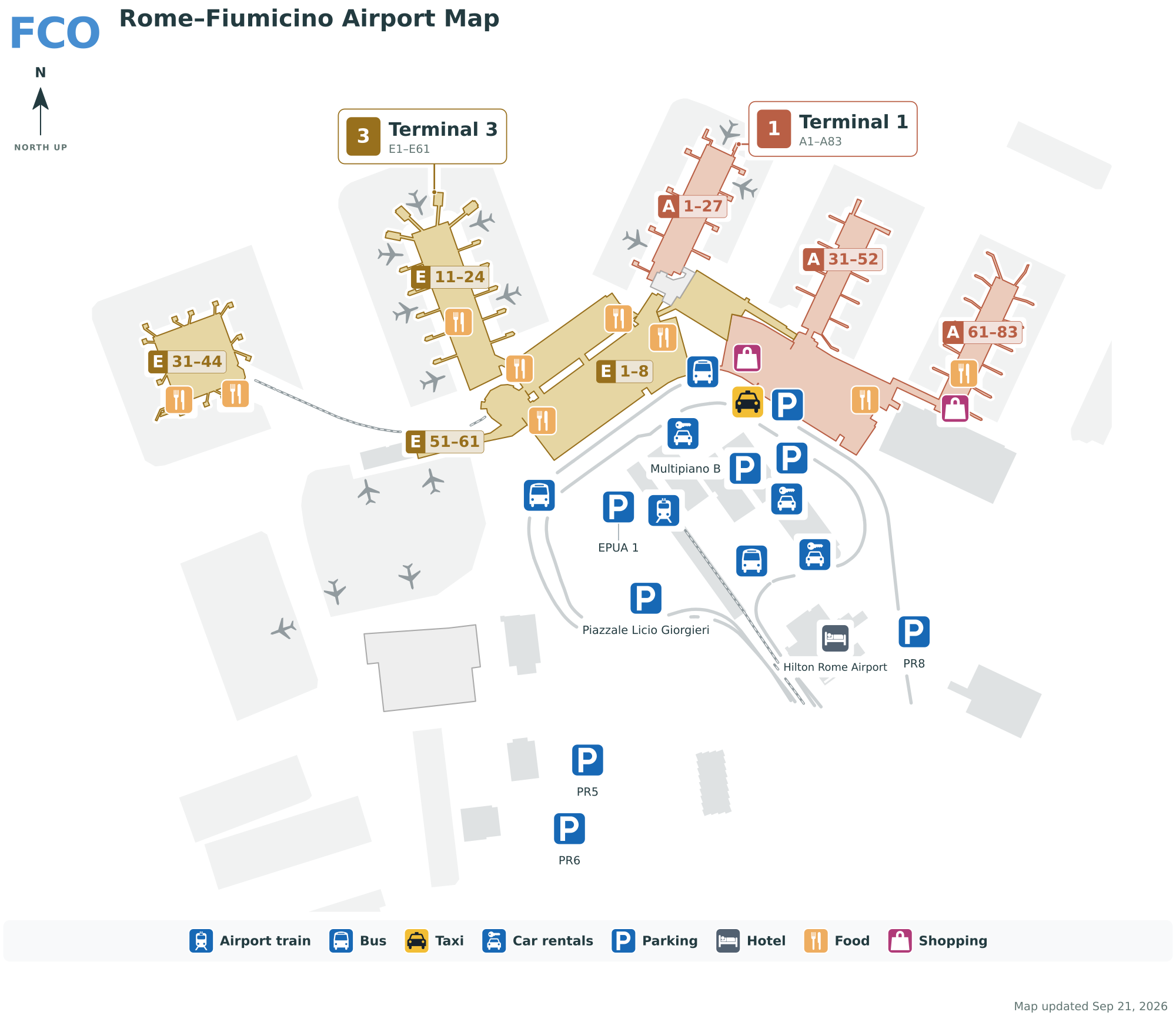
Fiumicino lies about 30 km from Rome's city centre and handles around 51.3 million passengers a year (2025), Italy's largest airport. Its terminal layout is simple: T1 takes Schengen and domestic traffic, T3 takes long-haul international — but there is one thing you must remember: the airport railway station is at T3, so passengers leaving from T1 have to walk to T3 before they can board the express.
The two terminals
| Code | Name | Main flights | Main carriers |
|---|---|---|---|
| T1 | Terminal 1 | Domestic and intra-Schengen | ITA Airways and its partners |
| T3 | Terminal 3 | Long-haul international and non-Schengen | ITA, SkyTeam, Star Alliance and oneworld carriers |
How to tell where you are:
- ITA domestic and Schengen flights use T1; intercontinental and non-Schengen flights use T3.
- T1 and T3 are joined airside by a walkway (the SkyBridge), so once through security you can walk between the two buildings.
- The airport railway station sits on the T3 side; from T1 you reach it on foot via the SkyBridge, or landside.
Our diagram draws T1 and T3 as a pair of buildings joined by a walkway precisely to mark that airside route and where the station sits.
Transfers and connections
- First check which building each flight uses: both in T3 or both in T1 is the quickest.
- Between T1 and T3 you can use the airside walkway, normally a walk of 10–15 minutes, with no need to clear security again.
- Connecting between a Schengen and a non-Schengen flight means passport control, so leave a margin on top of that.
Routes and flights
| Aspect | Details |
|---|---|
| Routes | In 2025 the airport connected Rome with about 80 countries and more than 240 destinations; 51.3 million passengers (+4%), the first time it has passed 50 million, and Italy's busiest |
| Flights | 51.3 million passengers in 2025; traditional carriers carried 37% and low-cost carriers 63% of the total |
| Aircraft | ITA Airways is the base carrier, flying A320-family aircraft and A330 widebodies on domestic, European and intercontinental routes; Ryanair and other low-cost carriers also operate extensively from T1 |
Getting into Rome
- Leonardo Express — the station is at T3, 32 minutes direct to Roma Termini, every 15 minutes, at a fixed fare.
- FL1 regional train — calls at several city stations; a lower fare but many stops, which suits areas such as Trastevere.
- Airport bus — direct to Termini and the main choice at night, once the trains stop.
- Taxi — about 30 km, with a flat rate towards the city centre, so confirm the official price before you get in.
Practical tips
- The Leonardo Express stops running after about 23:30 and resumes around 05:00, so take the airport bus or a taxi if you arrive late at night.
- Rome has two airports: Fiumicino (FCO, the main international one) and Ciampino (CIA, mostly low-cost carriers), so check the three-letter code when you book.
- If you are leaving from T1 and want the express into the city, you must first walk to the station at T3 — build that walk into your timing.
Terminal guideTerminal Guide
Gate ranges, main airlines and facilities for each terminal at Rome Fiumicino Airport.