Hong Kong Airport Wins World's Best Airport Security, and Nuctech Receives a Letter of Thanks
- Hong Kong International Airport
- HKG
- airport security
- Skytrax
- Nuctech
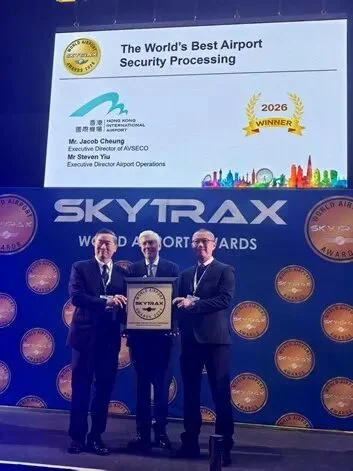
On 30 March, Nuctech said it had received a letter of thanks from the Airport Authority Hong Kong, expressing appreciation for its contribution to Hong Kong International Airport (HKG) winning the Skytrax award for World's Best Airport Security.
Rewind 12 days. On 18 March the Skytrax World Airport Awards 2026 were announced at Passenger Terminal Expo in London, where Hong Kong International ranked fourth in the world and took World's Best Airport Security for the first time. An award for the security lane sounds like a technical story, but the security check is the most tense stretch of a passenger's time in the terminal and the part most likely to generate complaints. This article keeps the award facts and the vendor's account separate, then looks at what the system actually changes.
1. The facts: fourth in the world, a first in 28 years, a first in Asia
Start with what can be checked. Hong Kong International opened at Chek Lap Kok in 1998, so 2026 is its 28th year; this is the first time it has won the security category, and the first time an Asian airport has taken it. The global top four for 2026 were Singapore Changi (second year running, 14th title), Seoul Incheon, Tokyo Haneda and Hong Kong International.
According to the Airport Authority's letter, the World Airport Survey behind the awards ran from August 2025 to February 2026 and evaluated the full passenger journey; the letter says the airport's high marks in security processing owed something to the seamless, efficient and technologically advanced environment Nuctech helped shape.
The basis of the award is worth spelling out: Skytrax ranks airports on passenger-satisfaction surveys, not on equipment specifications. Passengers may not know a baggage CT from a millimetre-wave portal, but they notice how long the queue is, whether they have to unpack, and how often a bag is pulled for a second look. Those experiences become the score.
2. What "the world's first fully integrated smart security airport" contains
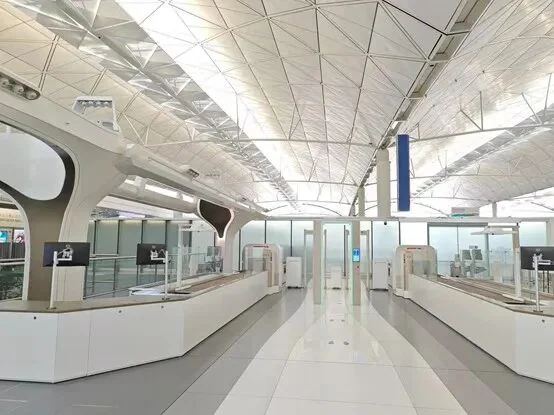
According to Nuctech, the system connects six kinds of equipment to a single management platform: cabin-baggage CT screening, static hold-baggage CT screening, automatic tray return, millimetre-wave body scanning, trace explosive detection and Raman liquid detection. Data is shared between the machines and the flow is coordinated from one place.
"Static hold-baggage CT" covers bags after check-in and before loading; "automatic tray return" addresses the old problem of trays having to be carried back to the entrance by hand; Raman detection is used to identify the contents of liquids on the spot. Putting all six on one platform is the main basis for the "fully integrated" description.
The Airport Authority's letter credits Nuctech's CT security technology and integrated security solution as the core support for the milestone, and says the company's technologies "have been pivotal in transforming security screening into a smooth, world-class experience". That is a partner's public statement recognising a supplier's contribution, not an independent test of how the system performs.
3. What passengers notice: laptops stay in the bag, ten seconds a bag
According to Nuctech, the new-generation CT's three-dimensional imaging means passengers no longer need to remove laptops, phones or other electronics, nor take out liquids, gels and aerosols in advance. For frequent flyers that is worth more than any specification: no crouching at the machine to open a bag, no taking the laptop out only to put it back.
On throughput, the company's figures are that a single lane has gone from 240 passengers an hour to 360, a rise of about 50%, and that a bag is scanned in roughly ten seconds.
Those numbers come from the equipment supplier. They are useful for understanding the ceiling of the technology, not a promise about any particular lane on any particular morning. Real speed still depends on how many lanes are open, whether passengers know the procedure, and how many bags need a second check.
4. Millimetre waves and privacy: why the screen shows only an outline
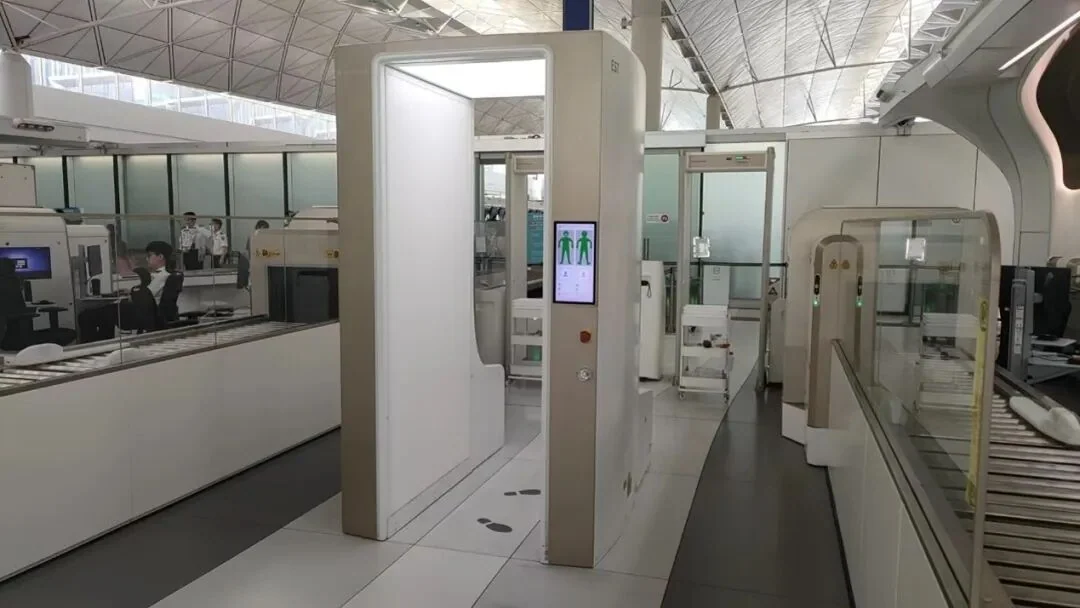
The millimetre-wave body scanner is the other piece travellers tend to misread. According to Nuctech, it scans 360 degrees without contact and presents results as a simplified body outline, marking only the position of a possible item and showing no anatomical detail. That reduces the need for pat-downs and, just as importantly, the fear of being "seen".
The same system adds automatic tray recovery, forgotten-item reminders and a new fire protection system. None of that speeds up a lane directly, but all of it decides whether the lane stays stable at peak times: trays piling up at the exit or a phone left in a bin will slow a queue as surely as a slow scanner.
5. How to read the story: two kinds of claim
There are two kinds of claim in this story, and mixing them up distorts it.
The first is the award. Skytrax, working from passenger surveys, gave Hong Kong International the 2026 World's Best Airport Security award and confirmed its fourth place overall. That can be quoted directly, and it is the first time in 28 years that the airport has taken the category.
The second is the technology: six equipment types, one platform, 360 passengers an hour, ten seconds a bag, a simplified body outline. These are the supplier's descriptions of its own system. They are very likely accurate, but they are vendor claims and should be read separately from the award.
Put the two together and the reasonable conclusion is that Hong Kong International's security experience was recognised by passengers in 2026, and that the technology behind it was supplied by Nuctech. Whether the system is the first of its kind in the world, and whether every lane hits 360 passengers an hour at every hour, is better treated as an indication of direction than as a settled result.
6. What it means if you are flying out of Hong Kong
First, the process is genuinely simpler. Not having to remove laptops and liquids means you can pack your cabin bag with the screening in mind and stop rebuilding it at the lane; on a tight connection that saves minutes that matter.
Second, do not read the award as "no queues". Lane numbers, flight waves and holiday traffic still decide how long you wait, and the morning and evening peaks remain the worst. Keep the buffer, especially if you are claiming a tax refund or carrying goods to declare.
Third, if you are asked for a second check, follow the staff. The millimetre-wave scanner shows a simplified outline and the follow-up is usually about a specific spot, not about you; the whole design is meant to squeeze the "necessary annoyance" down to the shortest possible moment.
Related links
- On this site: Hong Kong International Airport (HKG), China (CN)
- Wikipedia: Hong Kong International Airport, Nuctech
- Baidu Baike: Hong Kong International Airport, Nuctech
Image source: Nuctech. Award names and criteria are as published by Skytrax; equipment specifications and throughput figures come from the supplier, and on-the-day security arrangements are as directed at Hong Kong International Airport.
More articlesTravel notes
Adelaide Airport Wins Two Skytrax Awards for Staff and Regional Service
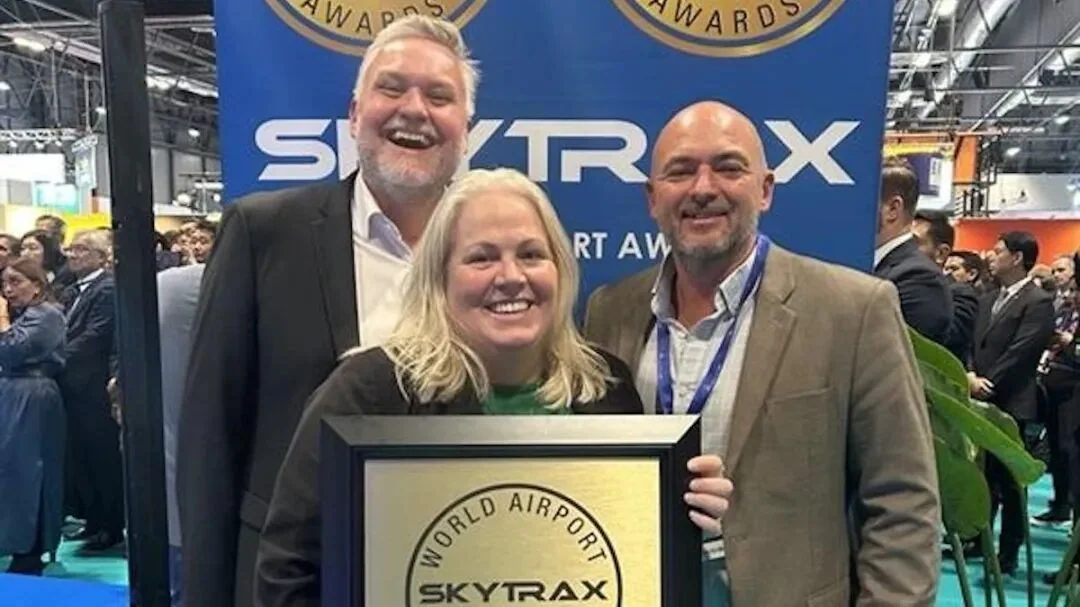
Adelaide Airport has been named Best Airport Staff in Australia/Pacific for the first time and Best Regional Airport in Australia/Pacific for the fourth time in five years at the Skytrax World Airport Awards in London. Passenger numbers passed nine million in 2025, international traffic grew more than 20%, and a A$600 million expansion called Project Flight is under way.4 min read
Buying Whisky at Airport Duty-Free: A Global Shelf Guide by Flight Time
From Taoyuan and Changi to Heathrow and Sydney, airport duty-free is where whisky's travel-retail exclusives live: single casks, cask strength and no local duty. A region-by-region survey of what stood on the shelves around Chinese New Year 2020, plus how to choose by age, cask, bottle size and the liquid rules on connections.7 min read