
Narita International Airport Terminal Map
 Tokyo · Japan· Narita International Airport
Narita International Airport (IATA: NRT, ICAO RJAA) is a large airport serving Tokyo, Japan, with 3 terminals and 96 gates, about 66 km from central Tokyo.
Narita International Airport (NRT) serves Tokyo, Japan. It has 3 terminals with 96 gates in total and handles about 40 million passengers a year. The airport is about 66 km from the city centre. Ground transport into the city: rail, bus and car.
Download Airport MapsDownloads
Airport time information — NRT current timeAirport Time
Current time at NRT (Asia/Tokyo) compared with your local time.
Narita International Airport route map — direct destinationsRoute Map
102 direct destinations: map, operating airlines and distances.
Airport information & detailsAirport Details
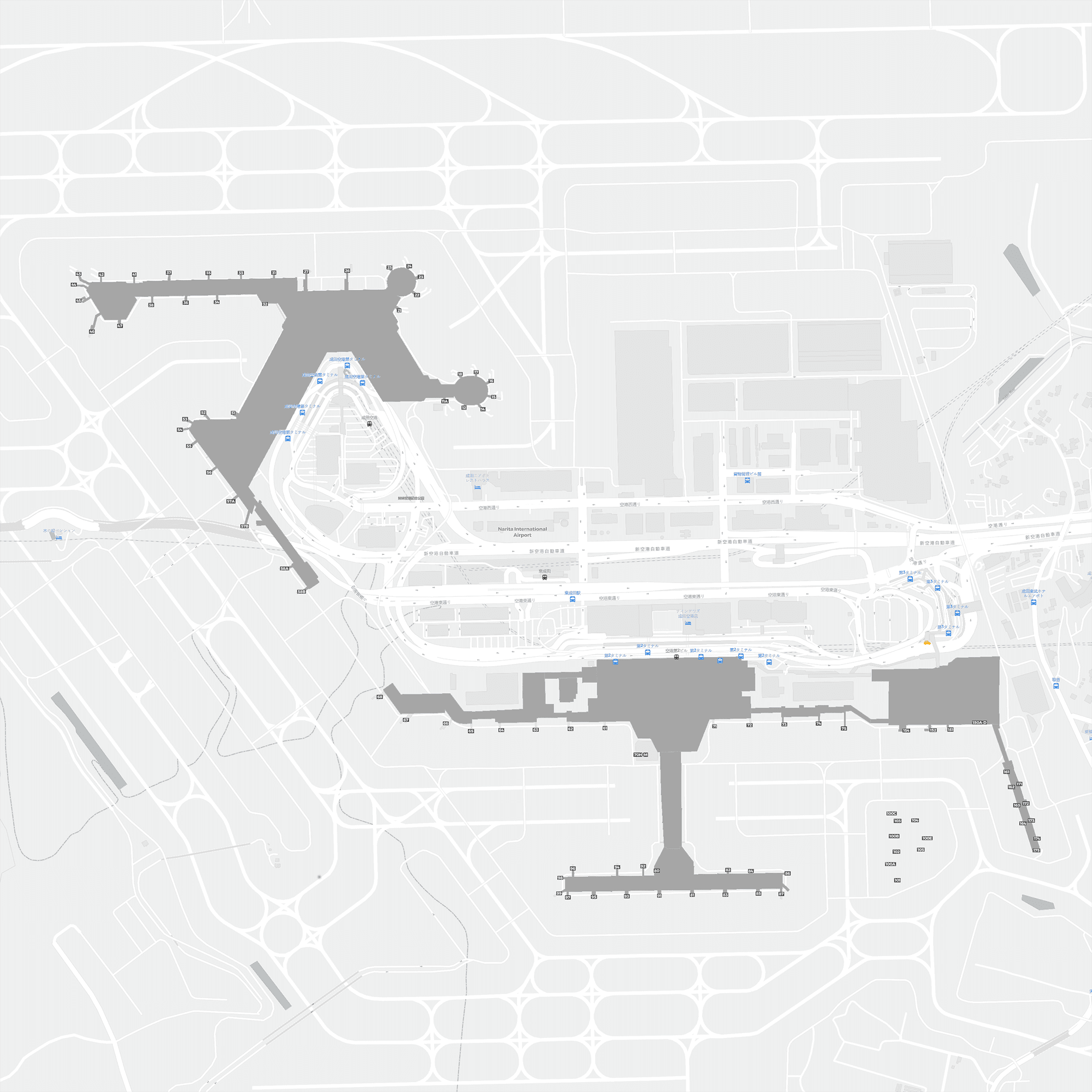
Interactive map — Narita International Airport locationInteractive Map
View this airport on other map services:
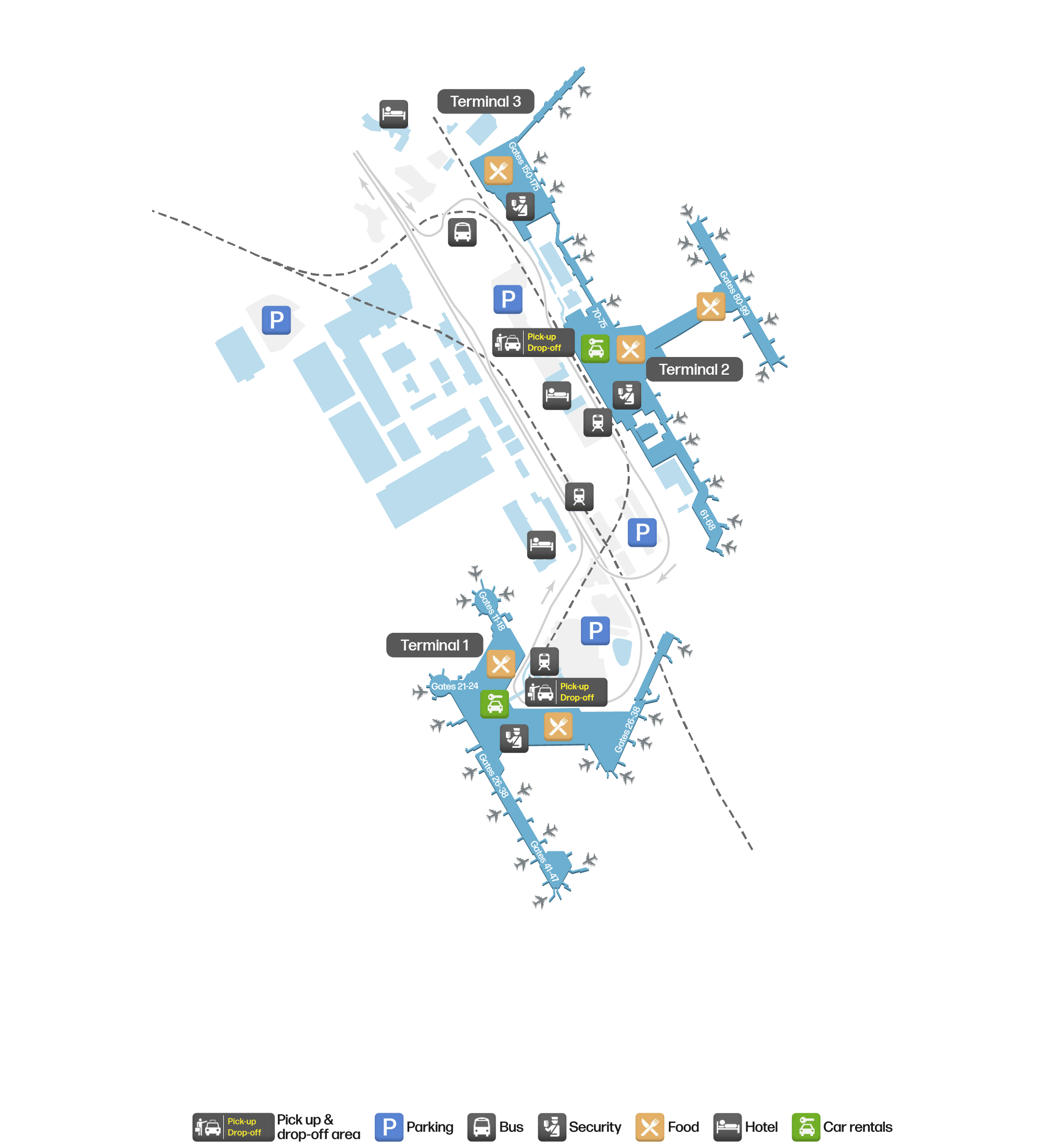
Tokyo Narita International Airport terminal guideAirport Guide
Narita sits in Chiba Prefecture, about 60 km from central Tokyo, and handles around 42.6 million passengers a year (Japanese fiscal year 2025). It is the capital region's furthest airport from the city: the terminals themselves are easy enough to grasp — it is the ground transport that is hard, and 1.5 hours each way into town is the safe budget.
Three terminals and the gate numbers
| Code | Name | Gate range | Main carriers |
|---|---|---|---|
| T1 | Terminal 1 | 11–59 | Star Alliance (south wing) and SkyTeam (north wing) |
| T2 | Terminal 2 | 21–66 | JAL and other oneworld members |
| T3 | Terminal 3 | 71–93 | Low-cost carriers (LCCs) only |
The gate-number range is the terminal: 11–59 is T1, 21–66 is T2 and 71–93 is T3. T3 is the LCC-only building, used mainly by Peach, Jetstar and others — once a gate number starting with 7 appears on your boarding pass, be ready for a bus ride and a walk to the aircraft.
Our diagram draws T3 as a small building standing apart from the two main terminals precisely to remind you that it needs a trip of its own.
Moving between the terminals
- Free shuttle bus — loops between all three buildings, about 10 minutes between T1 and T2.
- On foot — a dedicated walkway links T2 and T3, about 10 minutes, and often quicker than waiting for the bus.
When a connection involves two different terminals (common when a low-cost flight meets a full-service airline), count the shuttle's headway into your connection time; for any cross-terminal connection involving T3, allow more than 2 hours.
Routes and flights
- Routes — around 80 airlines flying to about 120 destinations; long-haul points cover Beijing, Shanghai, Guangzhou, Hong Kong, Seoul, Singapore, Bangkok, Sydney, Los Angeles, San Francisco, New York, Honolulu, Paris and Frankfurt.
- Flights — about 42.59 million passengers in Japanese fiscal year 2025 (April 2025 to March 2026), up about 4% year on year and the second-busiest year in the airport's history; inbound foreign travellers reached a record for the third straight year.
- Aircraft — main bases are ANA (T1 north wing) and JAL (T2), while the LCC-only T3 is used mainly by Peach and Jetstar Japan; the fleet is 737 and A320 family narrowbodies, with 777, 787 and A350 on long-haul.
Getting into Tokyo
- Keisei Skyliner — about 41 minutes to Nippori, then a change to the JR Yamanote line; the balance point between speed and fare.
- JR Narita Express (N'EX) — about 53 minutes direct to Tokyo Station and 80 minutes to Shinjuku, with no changes at all, good for heavy luggage or for the western side of the city.
- Limousine Bus — direct to the main city hotels, so you are not hauling luggage up and down stairs.
- Taxi — about 60 km, and the fare can reach ¥20,000 or more; not recommended unless it is late at night or split between several people.
Practical tips
- When booking, mind the difference between Narita (NRT) and Haneda (HND): Haneda is much closer to the city, so where flight times are similar, prefer Haneda and save close to two hours of ground travel.
- T3 is the LCC-only building with pared-down facilities and plenty of late-night flights, so after a red-eye arrival check the time of the first train (around 5am).
- When time matters, take the rail rather than the bus: expressway congestion is unpredictable, while the Skyliner and the N'EX both run to a fixed timetable.
Terminal guideTerminal Guide
Gate ranges, main airlines and facilities for each terminal at Narita International Airport.