
Munich Airport Terminal Map
 Munich · Germany· Munich Airport
Munich Airport (IATA: MUC, ICAO EDDM) is a large airport serving Munich, Germany, with 2 terminals and 110 gates, about 29 km from central Munich.
Munich Airport (MUC) serves Munich, Germany. It has 2 terminals with 110 gates in total and handles about 37 million passengers a year. The airport is about 29 km from the city centre. Ground transport into the city: rail, bus and taxi.
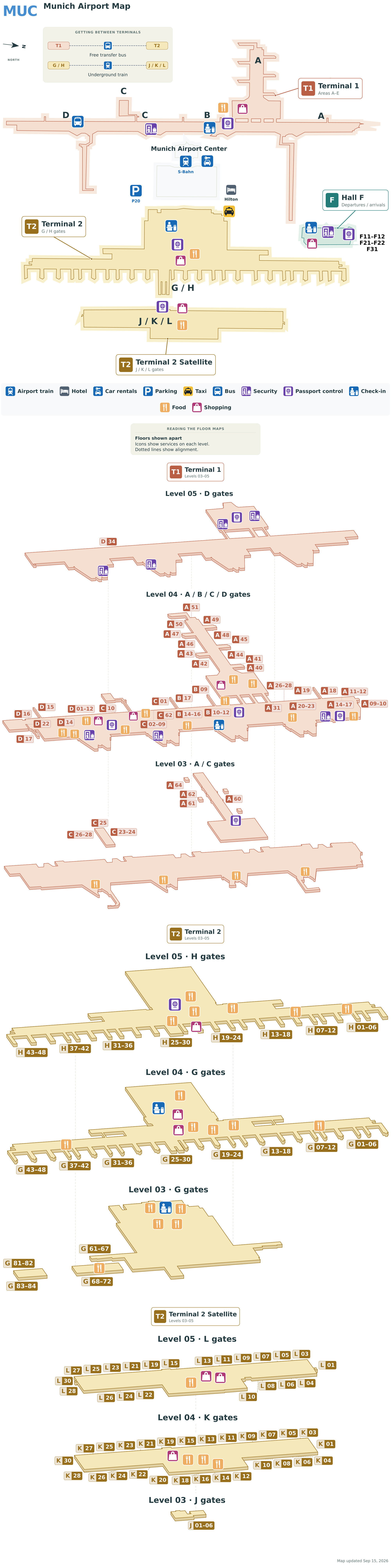
Download Airport MapsDownloads
Airport time information — MUC current timeAirport Time
Current time at MUC (Europe/Berlin) compared with your local time.
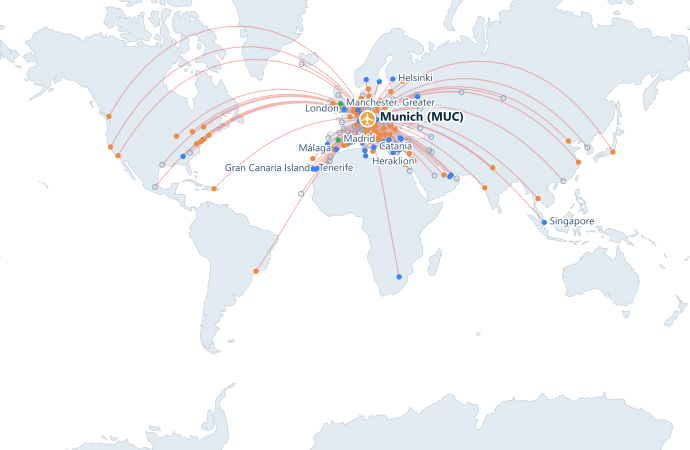
Munich Airport route map — direct destinationsRoute Map
185 direct destinations: map, operating airlines and distances.
Airport information & detailsAirport Details
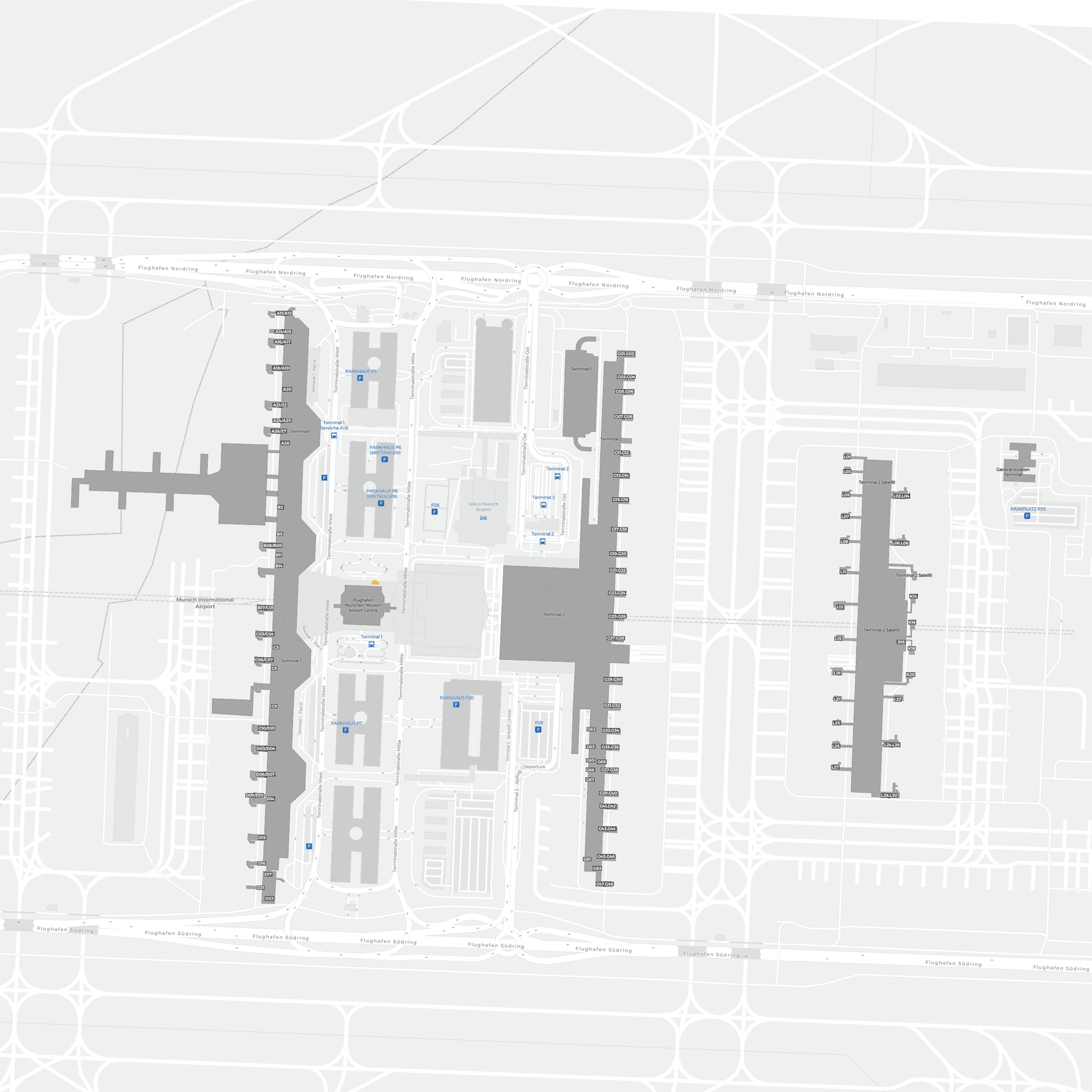
Interactive map — Munich Airport locationInteractive Map
View this airport on other map services:
Munich Airport terminal guideAirport Guide
Munich Airport lies about 28 km from the city centre and handles around 43.4 million passengers a year (2025), making it Germany's second-busiest hub. Its logic is clean: Lufthansa and Star Alliance have T2 to themselves, with every other carrier in T1 — and T2 also has a satellite building reachable only from inside the terminal, so a gate beginning with K or L means an extra hop on an underground people mover.
Two terminals and a satellite
| Code | Name | Gates | Main carriers |
|---|---|---|---|
| T1 | Terminal 1 | Modules A–E | Every carrier outside the Lufthansa group |
| T2 | Terminal 2 | G (Schengen) / H (non-Schengen) | Lufthansa and Star Alliance members |
| 2S | Terminal 2 Satellite | K (Schengen) / L (non-Schengen) | Lufthansa group remote gates |
How to tell where you are:
- The Lufthansa group is in T2; every other carrier is in T1.
- A gate K or L means the satellite — it can only be reached after security, by an underground automated people mover from T2 that takes under 2 minutes and runs every few minutes.
- The two terminals are not connected airside, so a cross-terminal connection has to go landside and through security again.
Our diagram draws the satellite as a building separate from T2 precisely to mark that people-mover link, which is airside-only.
Transfers and connections
- A Lufthansa-group connection (between T2 and the satellite) is the smoothest, usually done in 45–60 minutes.
- A T1-to-T2 connection takes the longest — landside, through security again — so allow more than 2 hours.
- Flights between inside and outside the Schengen area involve passport control, so add another notch of buffer on top.
Routes and flights
- Routes — around 100 airlines flying to about 300 destinations; long-haul points include New York, Boston, San Francisco, Dubai, Doha, Singapore, Beijing, Shanghai, Tokyo, Bangkok and Cape Town.
- Flights — 43.4 million passengers in 2025 (+4.4% year on year), with 337,438 aircraft movements; long-haul passengers reached 8.9 million, above the 2019 level.
- Aircraft — main base is Lufthansa and Star Alliance (T2 and the 2S satellite), with every other carrier in T1; Lufthansa flies the A320 family plus A350, A340 and 787 widebodies.
Getting into Munich
- S-Bahn S1 / S8 — the station sits in the airport centre between the two terminals; about 40–45 minutes direct to the main station, running frequently.
- Taxi — about 28 km, and around 35 minutes when traffic is clear.
- Airport buses — covering the city and the surrounding towns.
- Car hire — counters in both terminals, handy for driving in Bavaria.
Practical tips
- Munich has been expanding steadily, and T1's new concourse opened in 2026 for non-Schengen flights; the routes inside may shift with it, so follow the signs on the day.
- A single S-Bahn ticket covers transport throughout the city, so changing to the U-Bahn or a tram in town needs no second ticket.
- Lufthansa long-haul flights usually board at the satellite, so a "gate K/L" means leaving time for the people mover rather than estimating T2 walking distances.
Terminal guideTerminal Guide
Gate ranges, main airlines and facilities for each terminal at Munich Airport.