Narita Airport Guide: Terminals, Trains into Tokyo and Duty-Free Shopping
- Narita Airport
- NRT
- Tokyo transport
- airport duty-free
- layovers
Tokyo has two airports. Haneda is 15 km from the centre, 20 minutes by train and dense with domestic flights. Narita sits about 60 km east, the busiest international gateway for Tokyo: the Skyliner reaches town in 36 minutes, the airport serves more than 120 cities, and most late-night and early-morning low-cost departures are here. Long-haul flights, cheap fares and layover shopping usually mean Narita.
This guide covers terminals and airlines, transport into Tokyo, duty-free and shopping, transfers and overnight stays, and practical questions, for a first arrival or a connection. Fares and timetables are 2025 figures — check them before you travel.
1. Terminals and airlines
Narita International Airport (airport code NRT) has three passenger terminals, and the split broadly follows the airline alliances. T1 is Star Alliance territory, with ANA, Singapore Airlines and United. T2 is mainly oneworld — JAL, Cathay Pacific and American — and carries the densest international schedule. T3 is the low-cost terminal: Jetstar Japan, Peach, Spring Japan and Jeju Air. China Airlines spreads its flights across T1 and T2, so confirm your terminal on the airport website or in your airline's notice.
| Terminal | Alliance / type | Airlines | Notes |
|---|---|---|---|
| T1 | Star Alliance | ANA, Singapore Airlines, United | some China Airlines flights |
| T2 | oneworld | JAL, Cathay Pacific, American | busiest for international flights; some China Airlines flights |
| T3 | Low-cost carriers | Jetstar Japan, Peach, Spring Japan, Jeju Air | walkway to T2 |
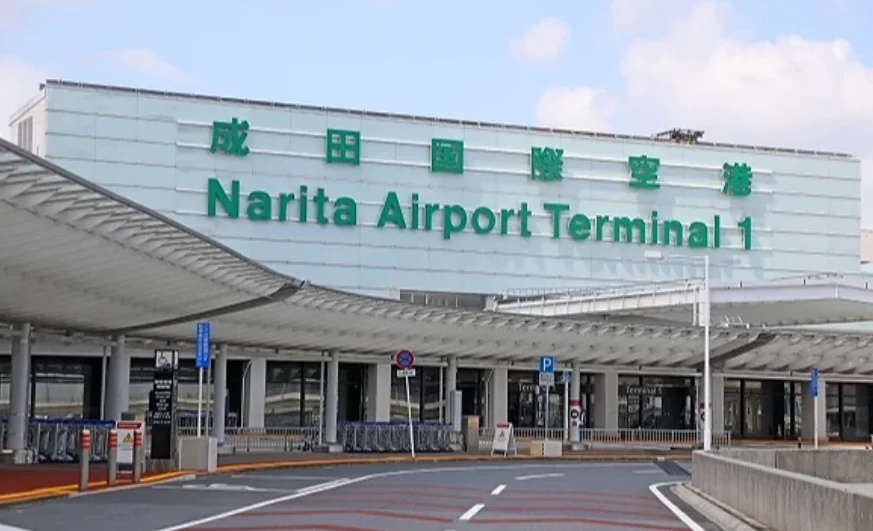
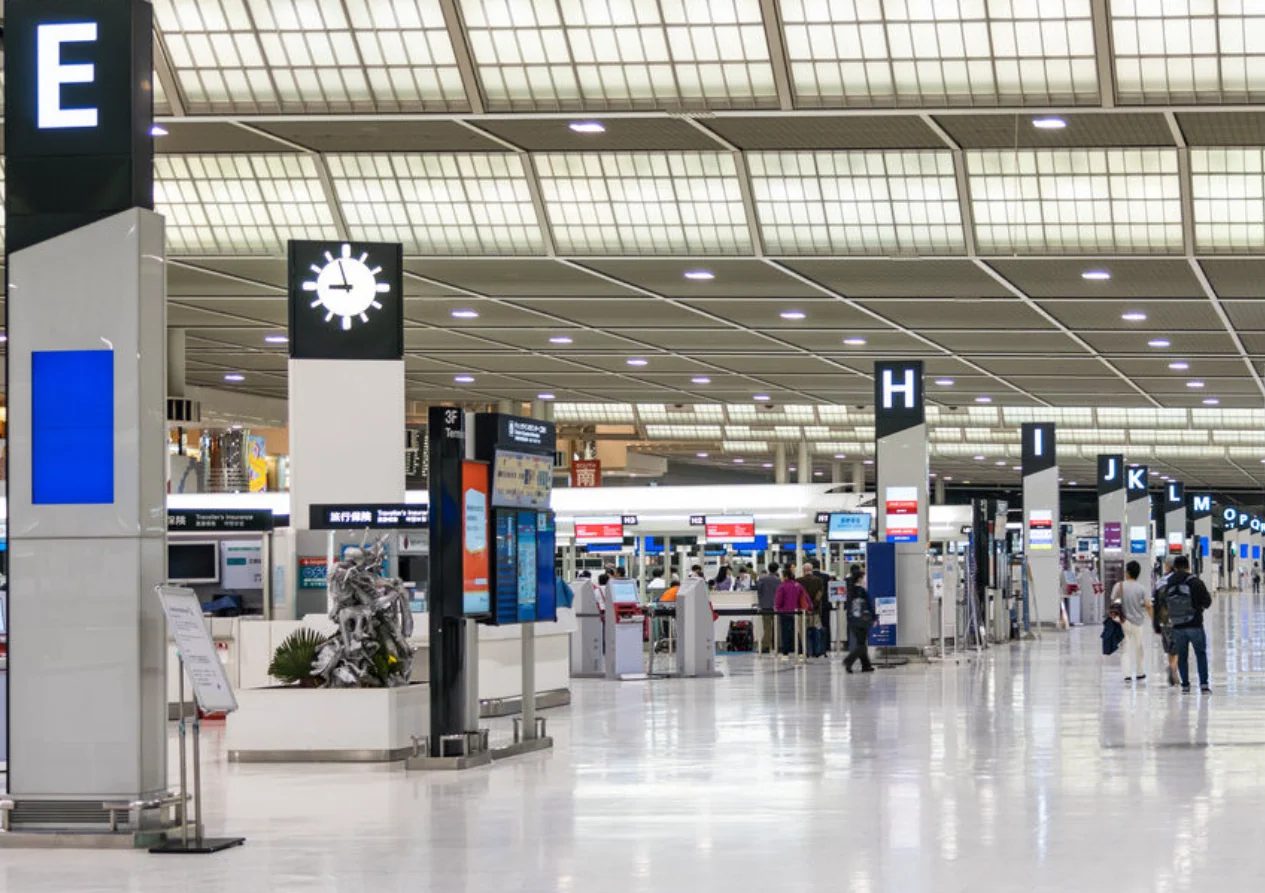
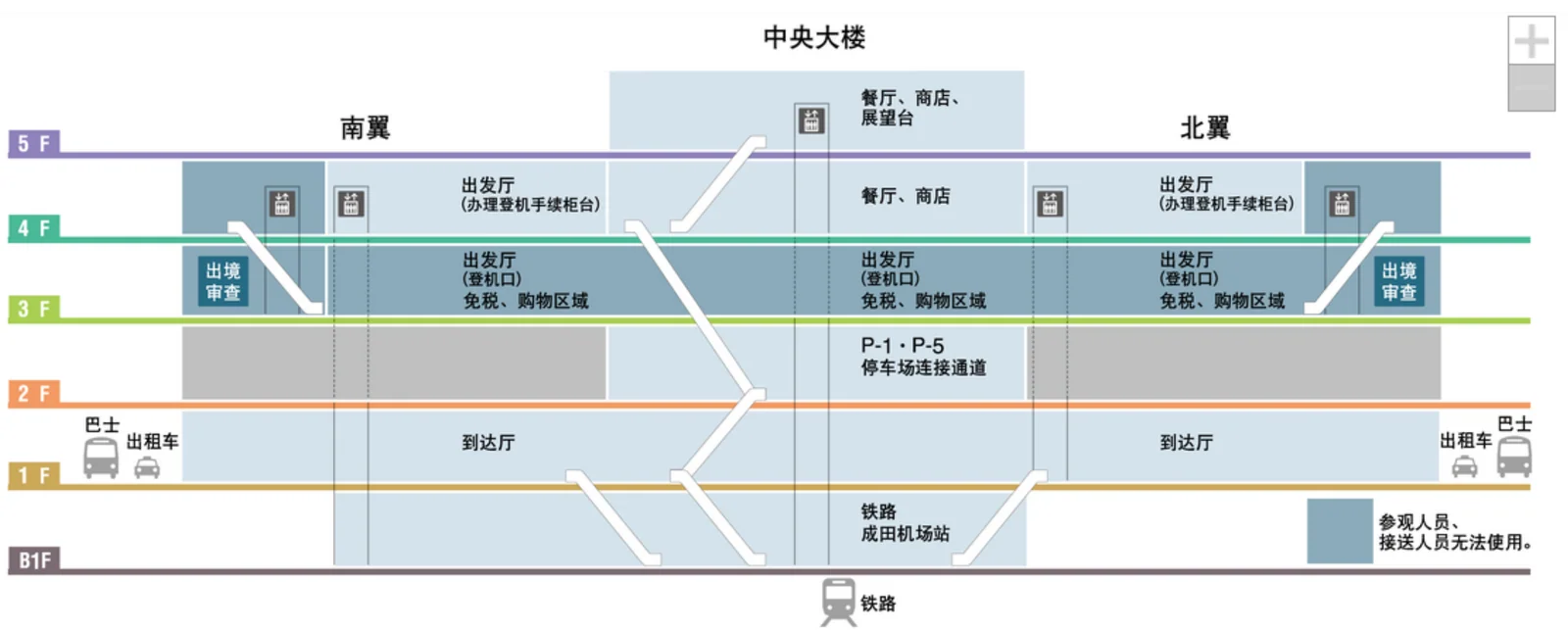
T1 has a south wing, a north wing and a central building: check-in in the wings, security and passport control one floor below, duty-free and shopping in the central building, gates along both wings. At T2 an indoor walkway links the main building to a satellite, and gates there are a few minutes further on.
Airlines move between terminals on different dates, code-shares especially. Look your terminal up the day before, on the airline app or Narita's website.
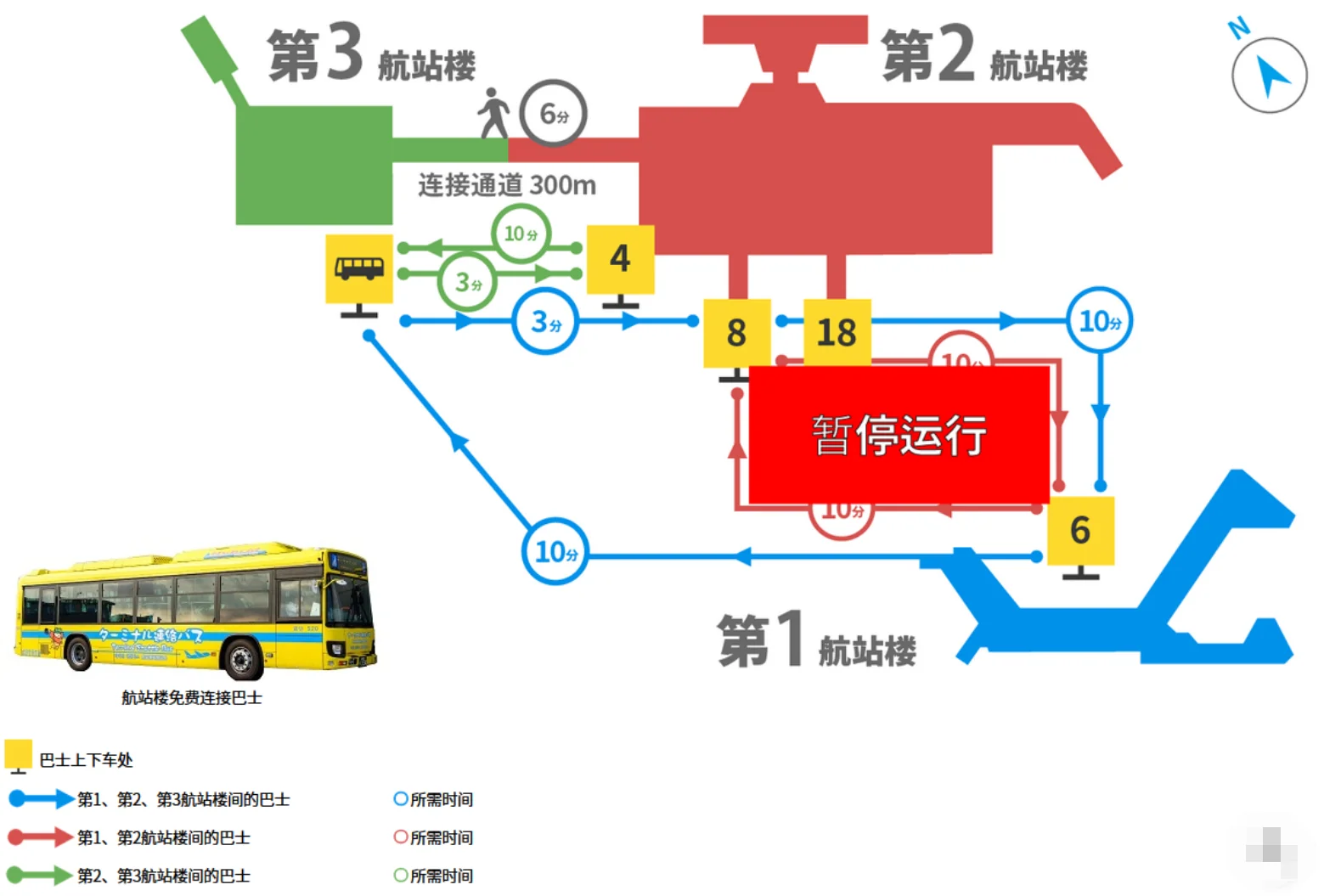
A free shuttle links all three terminals in under ten minutes: about 10 minutes from T1 to T2, and about 3 minutes from T2 to T3. A 300-metre covered walkway joins T2 and T3, roughly 6 minutes building to building; from the ticket gates at T2 station to the T3 departures hall the airport's own estimate is 13 minutes, so allow 20 with luggage.
Knowing the floors saves a lot of walking. At T1, check-in is on 4F, duty-free beyond passport control on 3F, arrivals are on 1F, B1 is the Keisei and JR Narita Airport Station, and 5F has restaurants, shops and the observation deck.
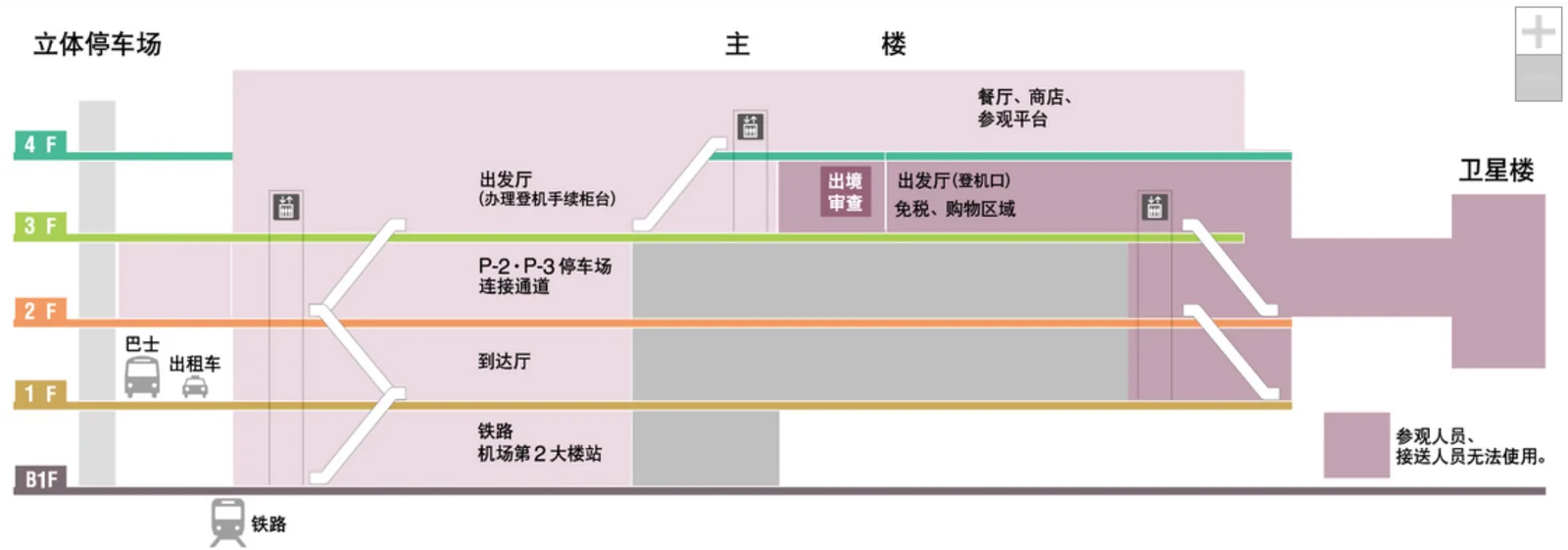
T2 is laid out similarly: check-in, gates and duty-free on 3F, restaurants, shops and an observation platform on 4F, arrivals on 1F, and Narita Airport Terminal 2·3 Station on B1. T3 departs on 2F and arrives on 1F, with check-in, security and boarding all on one level; its only duty-free shop is a Fa-So-La souvenir outlet, so take the shuttle back to T2 for the big brands.
2. Getting into Tokyo: trains, buses and taxis
Narita is about 60 km from central Tokyo, and this leg is worth deciding before you fly. Keisei runs the Skyliner, the Access Express and the Keisei Main Line; JR runs the Narita Express (N'EX). On the road there are the budget airport buses and the Airport Limousine, and taxis run around the clock. The times and indicative fares below are 2025 figures — check Keisei, JR and the airport's own sites on the day.
| Option | Main stops / destination | Journey time | Indicative fare |
|---|---|---|---|
| Keisei Skyliner | Nippori, Ueno | 36–41 min | about ¥2,570 (online early-bird) |
| JR Narita Express (N'EX) | Tokyo, Shinjuku, Shibuya, Yokohama | 53–80 min | about ¥3,070–3,250 |
| Keisei Main Line limited express | Keisei-Ueno, Nippori | most stops, slowest | about ¥1,050 |
| Keisei Access Express | Oshiage, Asakusa, Higashi-Ginza | 47–62 min | see Keisei |
| Airport bus TYO-NRT | Tokyo Station, Ginza | 65–90 min | about ¥1,500 (about ¥3,000 late at night) |
| Airport Limousine | Shinjuku, Ikebukuro, Asakusa, Shinagawa, Odaiba | 60–120 min | about ¥3,100–3,600 |
| Taxi | central Tokyo | depends on traffic | meter, plus expressway tolls |
The Skyliner is quickest: 36 minutes to Nippori, 41 to Ueno, with easy changes onto the Yamanote and Ginza lines. The one-way fare is about ¥2,570 online early-bird; the counter charges more, so book ahead.
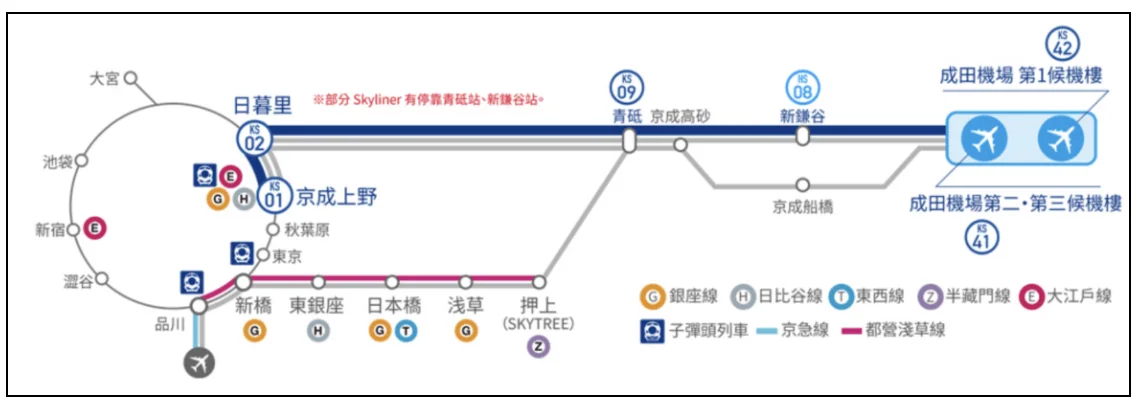
The N'EX reaches Tokyo Station in about 53 minutes, Shinjuku or Shibuya in 60–80, at about ¥3,070–3,250 one way, roomy and easy with luggage. It is the relaxed choice for the west side.
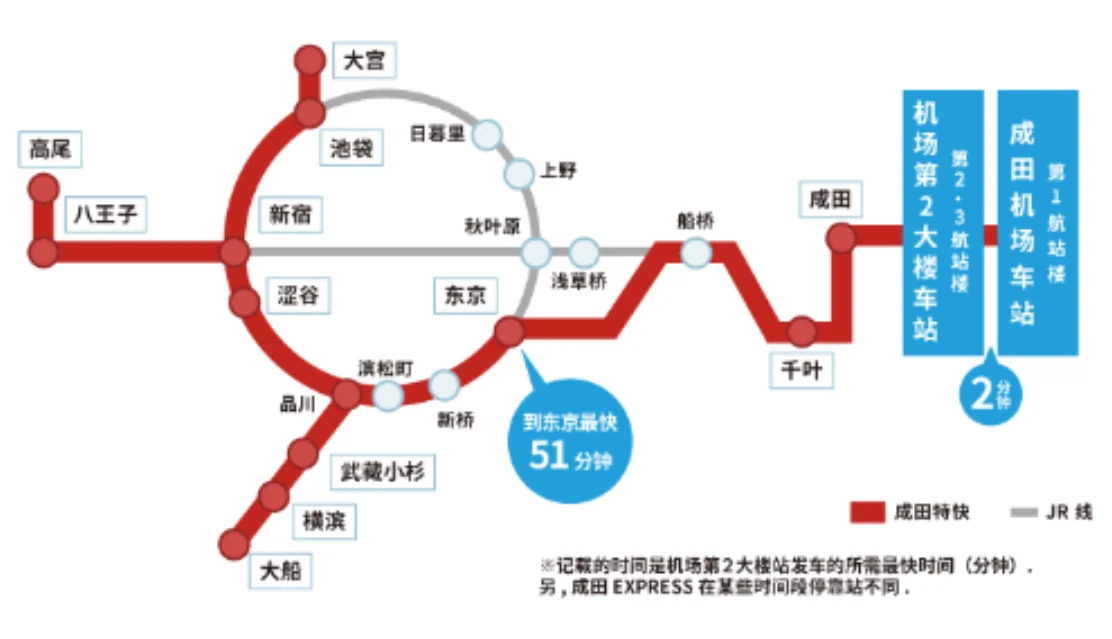
The Keisei Main Line limited express costs about ¥1,050 and stops everywhere, so it is the slowest — fine if you are not in a hurry and are staying near Keisei-Ueno or Nippori. The Access Express runs through onto the Toei Asakusa line: about 47 minutes to Oshiage, 51 to Asakusa, 62 to Higashi-Ginza.
The buses come in two flavours. TYO-NRT runs to Tokyo Station and Ginza in 65–90 minutes for about ¥1,500, or about ¥3,000 late at night. The Airport Limousine goes direct to Shinjuku, Ikebukuro, Asakusa, Shinagawa and Odaiba in 60–120 minutes for about ¥3,100–3,600, bookable online, with a hotel-door drop-off.
Taxis wait outside arrivals on 1F at T1 and T2, take the Higashi-Kanto Expressway onto the Metropolitan Expressway, and charge the meter plus tolls; book ahead at night or in rain. Watch the last trains: the final N'EX is around 21:30 and the final Skyliner around 23:00. After that, only the late-night buses (last around 03:30), a taxi or a pre-booked car.
Which to take: Ueno or Nippori, the Skyliner; Tokyo, Shinjuku, Shibuya or Yokohama, the N'EX; Asakusa or Ginza, the Access Express; heavy bags and a hotel on the Limousine route, the bus; a tight budget, the Keisei limited express or TYO-NRT.
3. Duty-free and shopping: what is new in 2025
Narita's duty-free line-up changed in 2025. All three terminals divide into landside, before security, and airside, after it; the brands differ, and the interesting ones tend to be airside.
Landside is the public area where check-in happens; airside is past security and passport control, for passengers only. Buy electronics and cosmetics landside and pack them in your checked bag, and keep snacks, nama chocolate and limited souvenirs for airside, on the last stretch.
- T1: landside has Yamada Denki's YAMADA TAX FREE, for Dyson, Nintendo and beauty devices; airside has Fa-So-La ASAKUSA, home of the Narita-only eel kabayaki-flavoured kakinotane and NEWYORK PERFECT CHEESE (three per person).
- T2: landside is Air BicCamera, for the latest α cameras and Bluetooth earphones; airside is Fa-So-La AKIHABARA, with Akihabara models, Royce' nama chocolate and Sugar Butter Tree.
- T3: airside has only Fa-So-La SOUVENIR AKIHABARA, mostly snacks — take the shuttle to T2 for the big brands.
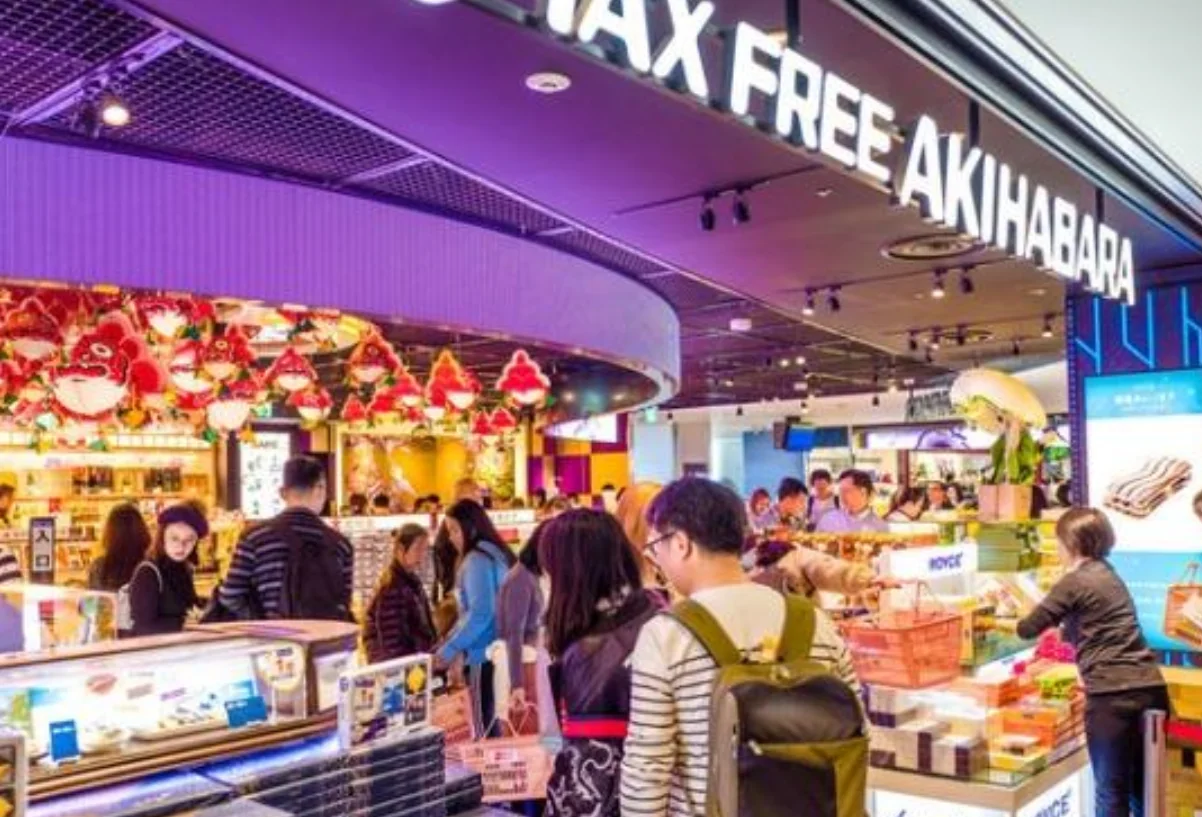
Three 2025 Narita debuts are worth remembering: Tokyo Banana's frozen banana chocolate cake, which stays soft for 11 hours at room temperature; BUTTER NO ITOKO's sweet potato and cinnamon butter wafers, T1 and T2 only; and Kameda's eel kabayaki kakinotane, exclusive to Fa-So-La at T2. Leave time for the tax refund and security — the airside shops sit towards the gates, and it is easy to overshop.
4. Transfers, overnight stays and passing the time
Two hours at Narita is a different experience from six.
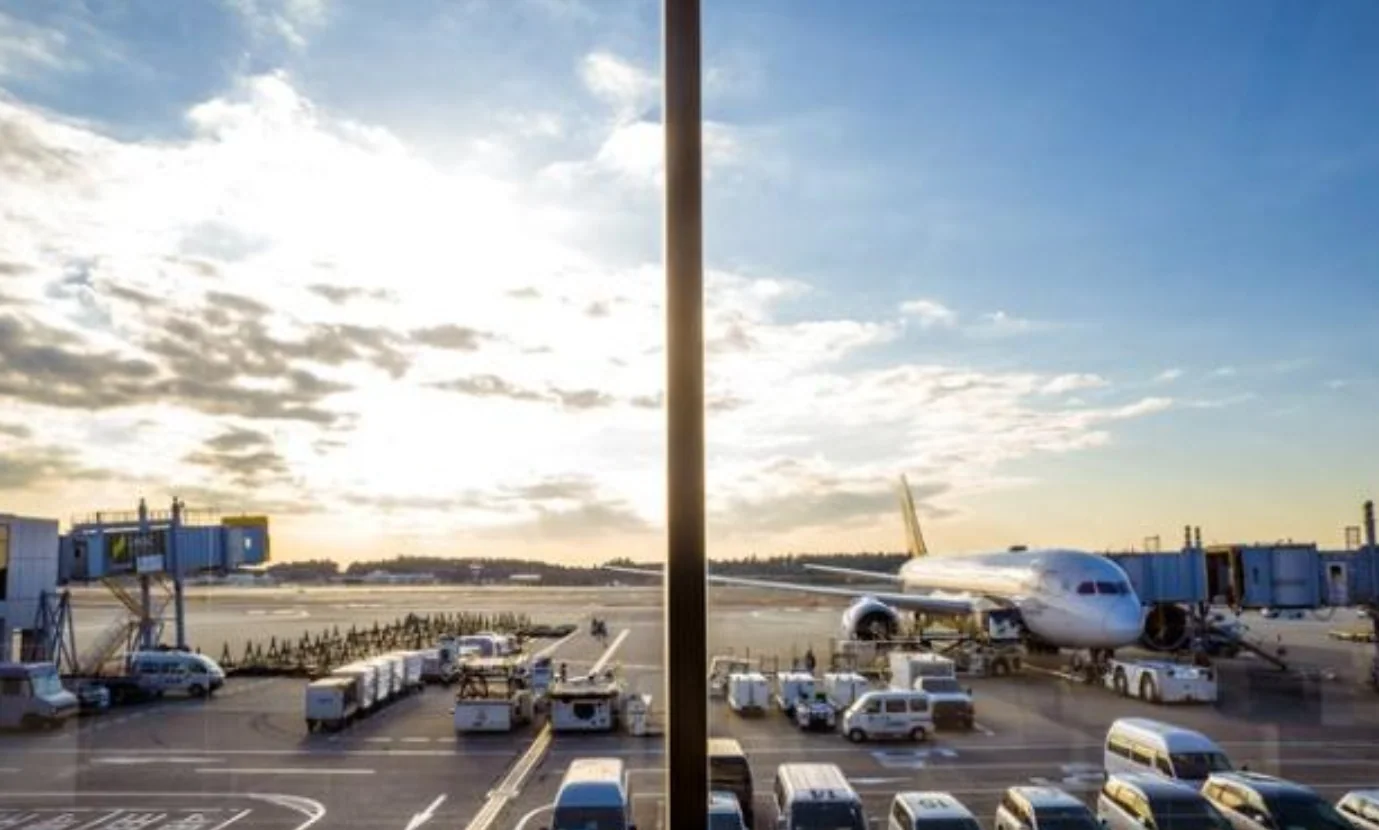
Two hours: the observation decks on T1 5F or T2 4F, for take-offs and landings and, on a good day, sunset, with a Starbucks alongside. It beats the gate.
Four hours: a browse through Fa-So-La at T2, a bowl of Ginza Kagari's chicken paitan ramen, then Traveler's Factory for airport-only stationery. You cannot move between landside and airside, so check your margin. Landside, T1 has a 24-hour McDonald's and the kaiten sushi Misaki, T2 a 24-hour Yoshinoya and Shinshu SOJIBOU's hand-made soba, T3 a 24-hour Matsuya and Sendai Rikyu's charcoal-grilled beef tongue. Airside, T1 has Ippudo and Sanpotei's teppan hamburg steak, T2 has Ginza Kagari and Dotonbori Kurita okonomiyaki, and T3 has caffe LAT.25° for beer and pasta.
Six hours or more: leave the airport. Naritasan Shinshoji is a comfortable half-day return; a meal in Tokyo and back is possible on the 36-minute Skyliner, but with two security queues six hours buys you one stop.
Overnight: T3 2F has 24-hour seating with power; T1 and T2 have showers at ¥1,050 per 30 minutes; T2's capsule hotel, 9h nine hours, starts at ¥4,900 and needs booking online. Landing on a red-eye between 22:00 and 05:30, take a late-night bus into Tokyo, pre-book a car, or sleep at the airport until the first train.
Transfers: confirm which terminal your onward flight uses. Within one building, follow the Transfer signs; between buildings, add the free shuttle (about 10 minutes) and a second security check to your margin. Three hours between flights is comfortable. Whether you need to enter Japan or re-check your bags depends on how the tickets are issued, so ask the airline.
5. On the way: one to four hours around the airport
With four hours or more between flights or buses, the country around Narita is worth a trip. All of these are in Chiba Prefecture and reachable by train or bus; the times are one way, and with the return you need half a day.
- Naritasan Shinshoji (about 30 minutes): the eel restaurant Kawafuku on the Omotesando approach, and the temple at the end of the street.
- Sawara (about 45 minutes): boat trips on the Onogawa and streets of soy-sauce warehouses.
- Sakura (about 50 minutes): the Chiba Prefectural Museum of Art and a castle town made for cycling.
- Choshi Inubosaki (about 90 minutes): Japan's easternmost lighthouse, sunrise over the Pacific and the INUBOH train.
6. Practical information and questions
From arrivals to the station: follow the Railway signs. Keisei and JR share the B1 station at each terminal — Narita Airport Station at T1, Narita Airport Terminal 2·3 Station at T2 — one floor below arrivals, with tickets and platforms within ten minutes. T3 has no station of its own: take the walkway or shuttle to T2.
Wi-Fi and luggage
- Wi-Fi: FreeWiFi-NARITA throughout, no registration.
- SIM and eSIM: vending machines and a SoftBank counter in the arrivals halls of T1–T3; eSIM by scanning a code, seven days and 20 GB from about ¥3,500.
- Coin lockers: arrivals halls of T1–T3, ¥300–800 a day, and full in peak season.
- Staffed storage: skis and cardboard boxes accepted, ¥800–2,000 a day.
- Delivery: Yamato and JAL ABC send bags to Tokyo hotels the same or next day, from about ¥1,900 for a 23 kg box; valuables and batteries are not accepted.
Common questions
- Fastest into town? The Skyliner, 36 minutes to Nippori.
- Public transport late at night? Late-night buses run until about 03:30; the last N'EX is around 21:30 and the last Skyliner around 23:00.
- Lost something? Call the lost property centre for your terminal: T1 0476-32-2105, T2 0476-34-5220, T3 0476-34-4195, staffed 24 hours, with Chinese-speaking help.
- Can I pay with Alipay or WeChat? Most duty-free drugstores and electronics shops take them; bus counters take cash or cards only.
- How early should I arrive? Three hours for international flights, another 30 minutes for LCCs; T3's security peaks are 07:00–09:00 and 19:00–22:00.
- T3 to T2? About 6 minutes on the 300-metre walkway or 3 minutes on the free shuttle; allow 13 minutes from the T3 departures hall to the ticket gates at T2 station.
- Narita or Haneda? Haneda is closer to town; Narita has more international routes, low-cost carriers and red-eyes. Pick by flight time and fare, not loyalty.
Related links
- On this site: Narita International Airport (NRT), Japan (JP)
- Wikipedia: Narita International Airport
- Baidu Baike: Narita Airport
Image source: Leyou Nihong. Fares, timetables and shop details are 2025 figures; check Keisei, JR, Narita Airport and the operators' own sites on the day you travel.
More articlesTravel notes
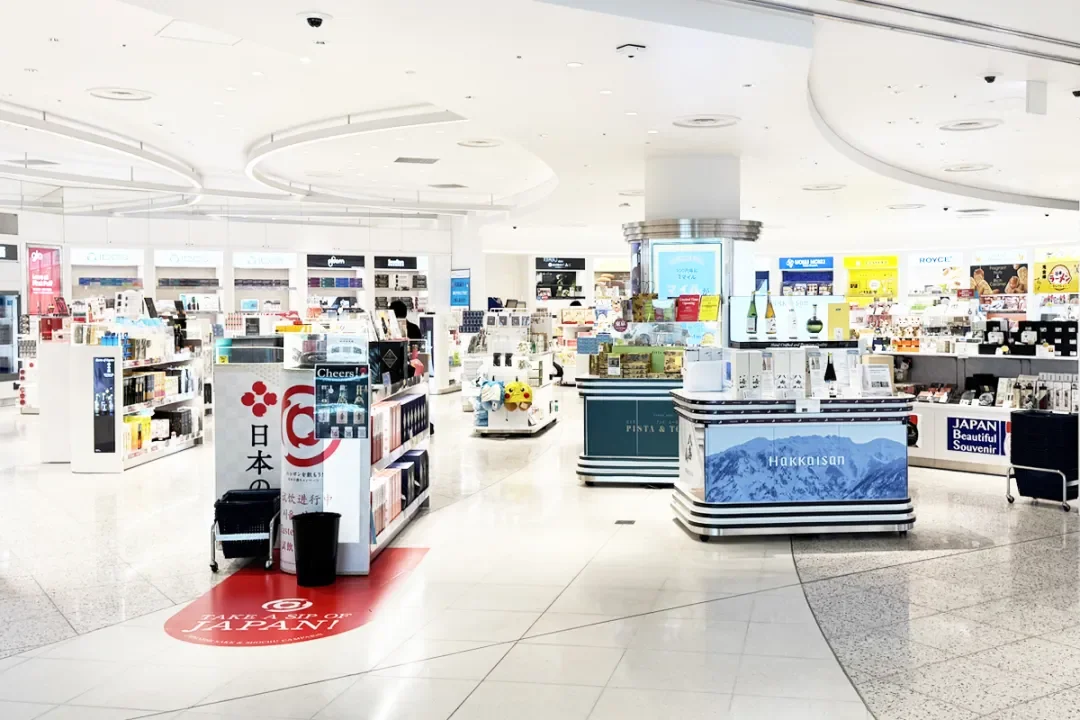
Duty-Free at Haneda Airport: T2 and T3 Shops, Brands and Transit Rules
A practical guide to duty-free shopping at Haneda Airport (HND): the T2 TIAT DUTY FREE SOUVENIR, the two T3 shops by gate 109, their hours and brands, ANA vouchers and online pre-order, plus duty-free versus tax-free, liquids on connections and what is worth buying at the airport rather than in town.5 min read
Getting from Haneda Airport into Tokyo: Monorail, Keikyu or Bus?
A practical guide to the Haneda Airport (HND) run into Tokyo: the Tokyo Monorail to Hamamatsucho, Keikyu trains to Shinagawa and through to Asakusa, airport buses to hotels and the wider Kanto region, taxis and late arrivals, with fares, transfer stations and a which-line-for-which-area table.6 min read