
São Paulo/Guarulhos International Airport Terminal Map
 Sao Paulo · Brazil· São Paulo/Guarulhos International Airport
São Paulo/Guarulhos International Airport (IATA: GRU, ICAO SBGR) is a large airport serving Sao Paulo, Brazil, with 3 terminals and 85 gates, about 25 km from central Sao Paulo.
São Paulo/Guarulhos International Airport (GRU) serves Sao Paulo, Brazil. It has 3 terminals with 85 gates in total and handles about 44 million passengers a year. The airport is about 25 km from the city centre. Ground transport into the city: bus, rail and taxi.
Download Airport MapsDownloads
Airport time information — GRU current timeAirport Time
Current time at GRU (America/Sao_Paulo) compared with your local time.
São Paulo/Guarulhos International Airport route map — direct destinationsRoute Map
89 direct destinations: map, operating airlines and distances.
Airport information & detailsAirport Details
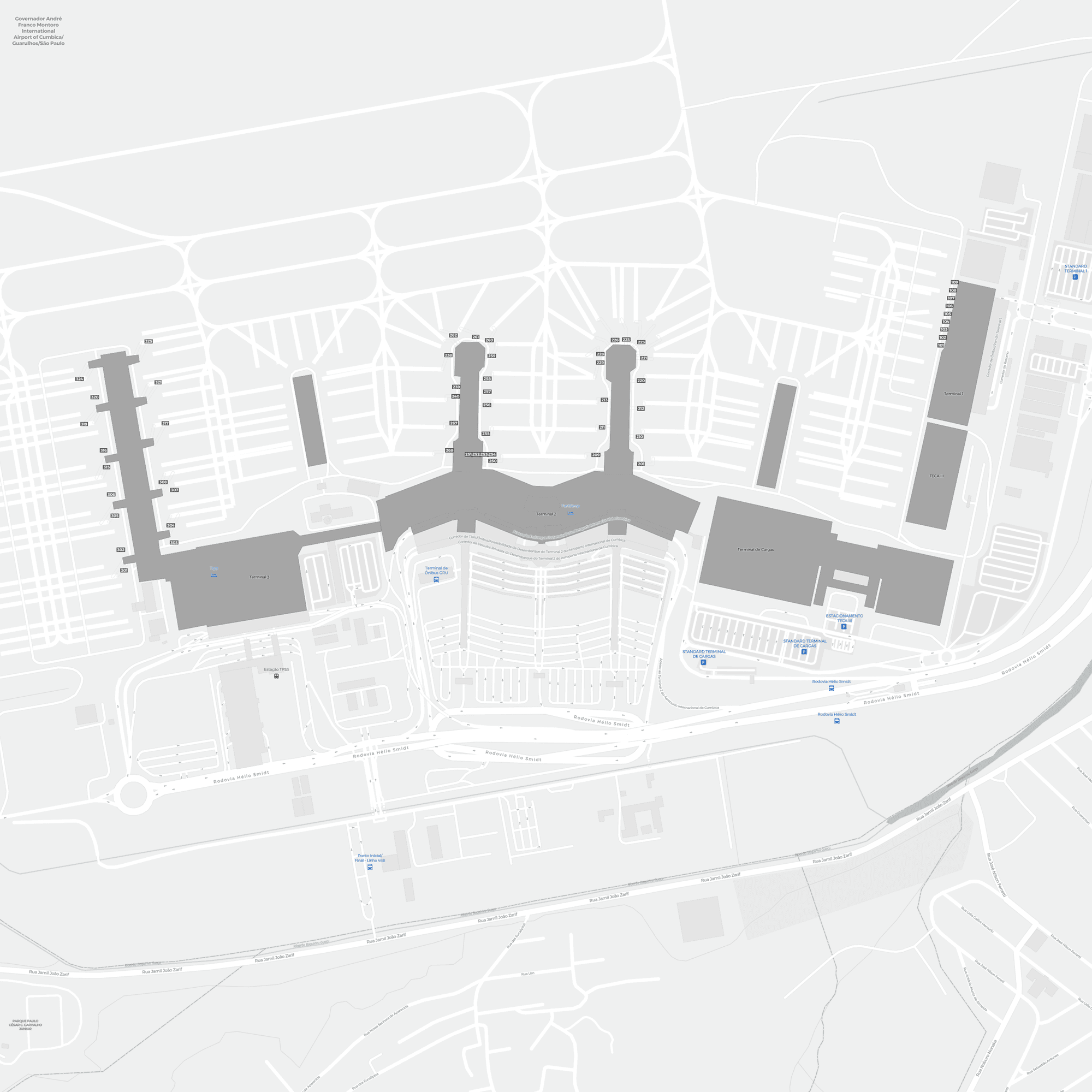
Interactive map — São Paulo/Guarulhos International Airport locationInteractive Map
View this airport on other map services:
São Paulo/Guarulhos International Airport terminal guideAirport Guide
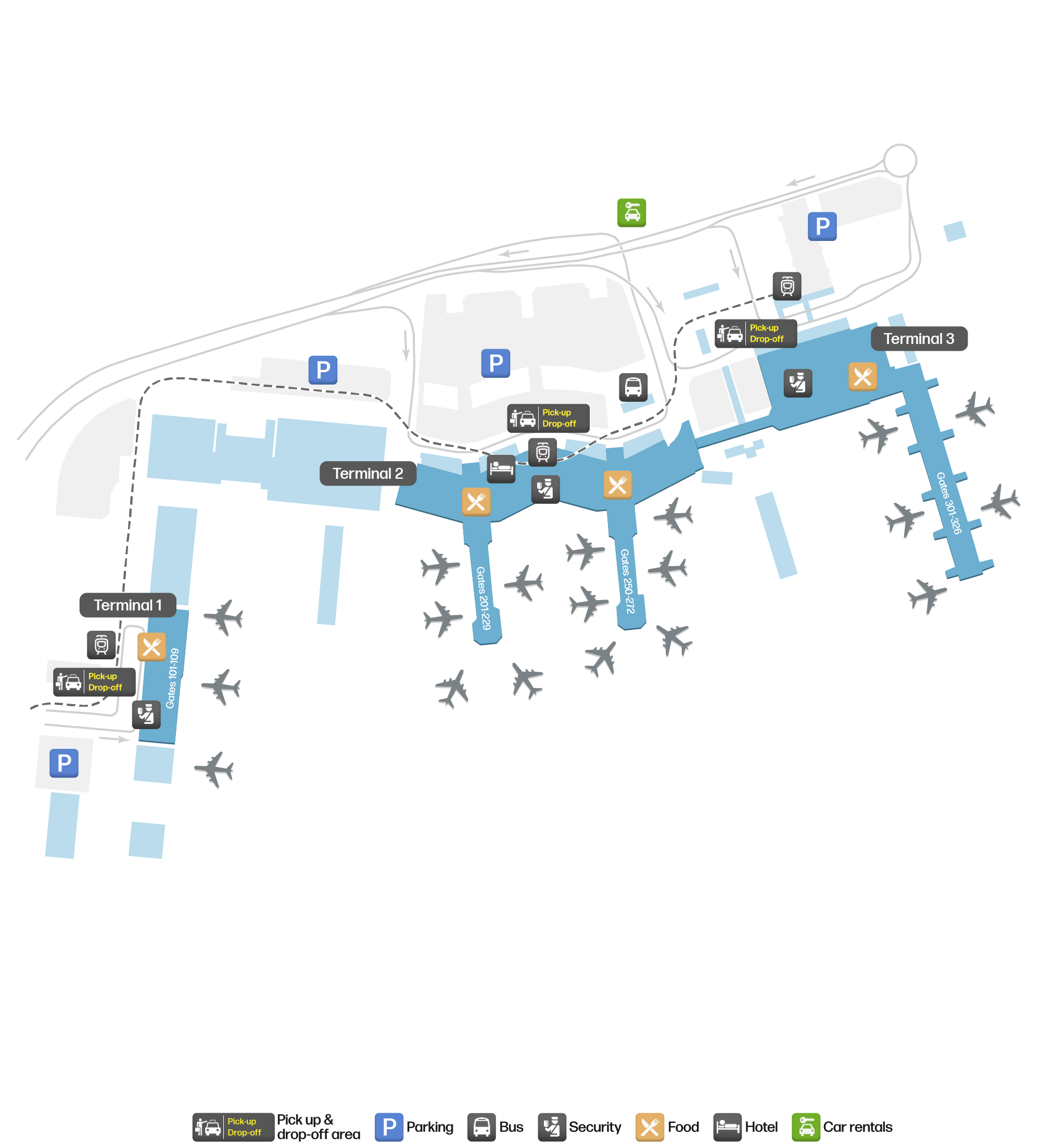
Guarulhos lies about 25 km from central São Paulo and handles around 47.2 million passengers a year (2025), the busiest airport in South America. Its layout is unusually friendly to travellers: the first digit of the gate number is the terminal number — see 301 and you know you are in T3, see 205 and you are in T2. The difficulty is not reading it, but the fact that T1 is not connected to T2/T3.
The three terminals
| Code | Name | Gate ranges | Main flights |
|---|---|---|---|
| T1 | Terminal 1 | 101–109 | Mostly domestic flights |
| T2 | Terminal 2 | 201–229 / 250–268 | Mixed domestic and international, LATAM's main base |
| T3 | Terminal 3 | 301–332 | International flights |
How to tell where you are: the first digit of the gate number is the terminal number — 1xx in T1, 2xx in T2, 3xx in T3.
- T2 and T3 are joined by a walking connection — about 10–15 minutes, indoors at both ends.
- T1 is a separate building — close to the railway station, and reaching T2/T3 means a free shuttle bus (roughly every 10–15 minutes during the day).
Our diagram draws T1 as a separate block and T2 and T3 as a linked pair precisely to mark that relationship — one building apart, two joined.
Transfers and connections
- Confirm the terminal from the gate number first: a connection inside T2 or inside T3 is the quickest.
- T2 and T3 can be linked on foot via the walking connection; allowing more than 30 minutes is safer.
- A connection involving T1 needs the shuttle wait added on, so allow more than 2.5 hours.
Routes and flights
| Aspect | Details |
|---|---|
| Routes | 47.19 million passengers in 2025 (+8.2%), reclaiming the top spot in Latin America; international traffic of 16.8 million was a record, with new long-haul routes to Doha, Los Angeles and Johannesburg |
| Flights | 47.19 million passengers in 2025, with monthly totals regularly above 3.5 million |
| Aircraft | LATAM Brasil is the base carrier, with T2 as its domestic and international hub; the fleet flies A320-family aircraft and 767 / 777 widebodies, while Gol and other Brazilian carriers operate a dense domestic network |
Getting into São Paulo
- Airport bus — direct to the city centre and the main hotel districts, with plenty of luggage space; the least stressful option.
- Commuter rail + metro — the airport has a railway station, but you first take a shuttle to reach it and then change again for the city; the lowest fare, with the most changes.
- Taxi / ride-hailing — about 25 km, 40 minutes without traffic; São Paulo's peaks are severely congested and the trip often takes twice as long.
- Ride-hailing — pick-up points are fixed and prices transparent, which makes it easier for a late-night arrival.
Practical tips
- São Paulo is South America's largest city, and the unpredictability of the roads matters far more than the distance itself; if you are catching a flight, allow time for peak traffic.
- The airport is carrying out a large expansion: a new international terminal and the rebuilding of T2 are going ahead in stages, so terminal arrangements may change — check your airline's latest guidance before you set off.
- Domestic flying in Brazil is extremely dense and domestic transfer traffic is heavy, so check-in and security queues can be long; arrive early.
Terminal guideTerminal Guide
Gate ranges, main airlines and facilities for each terminal at São Paulo/Guarulhos International Airport.