
Soekarno–Hatta International Airport Terminal Map
 Jakarta · Indonesia· Soekarno–Hatta International Airport
Soekarno–Hatta International Airport (IATA: CGK, ICAO WIII) is a large airport serving Jakarta, Indonesia, with 3 terminals and 70 gates, about 20 km from central Jakarta.
Soekarno–Hatta International Airport (CGK) serves Jakarta, Indonesia. It has 3 terminals with 70 gates in total and handles about 60 million passengers a year. The airport is about 20 km from the city centre. Ground transport into the city: rail, bus and taxi.
Download Airport MapsDownloads
Airport time information — CGK current timeAirport Time
Current time at CGK (Asia/Jakarta) compared with your local time.
Soekarno–Hatta International Airport route map — direct destinationsRoute Map
60 direct destinations: map, operating airlines and distances.
Airport information & detailsAirport Details
Interactive map — Soekarno–Hatta International Airport locationInteractive Map
View this airport on other map services:
Jakarta Soekarno-Hatta International Airport terminal guideAirport Guide
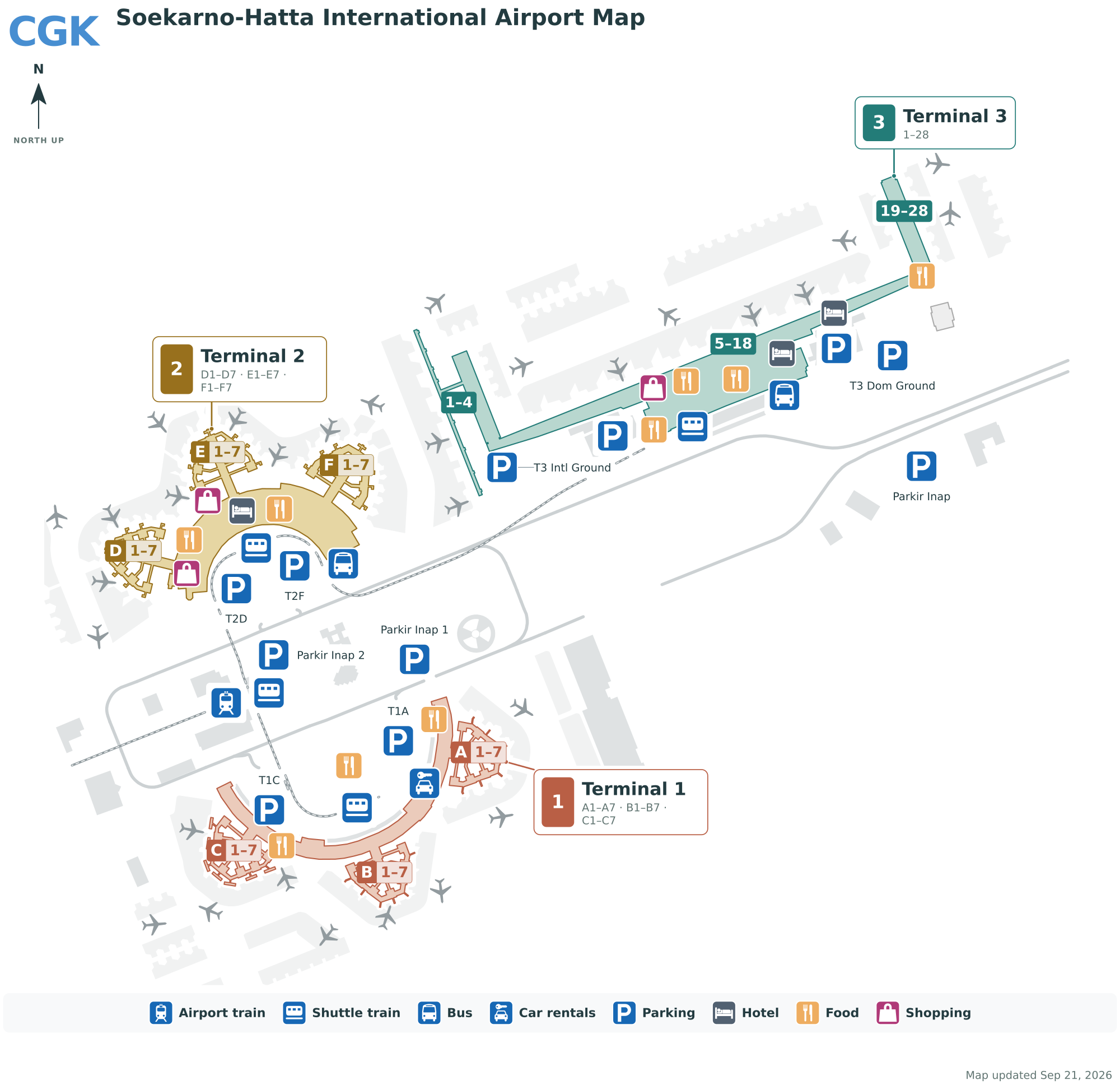
Soekarno-Hatta sits north-west of Jakarta, about 20 km from the city centre, and handles around 55 million passengers a year (2025) as Indonesia's gateway hub. Its three terminals stand apart from each other with no airside connection between them, tied together by a free skytrain known locally as the Kalayang — that is the first thing to understand about this airport.
The three terminals
| Code | Name | Main flights | Main users |
|---|---|---|---|
| T1 | Terminal 1 | Domestic | Mostly low-cost: Lion Air, Citilink and others |
| T2 | Terminal 2 | Domestic + international | Full-service carriers; domestic at 2D, international at 2E/2F |
| T3 | Terminal 3 | Mainly international | The newest and largest; the main building for Garuda and international airlines |
How to work out where you are going:
- Most international flights use T3, with some at T2; domestic flights are spread across T1, T2 and T3 by airline.
- The three buildings are not connected airside — moving between them means leaving the building and taking the Kalayang skytrain or a shuttle bus.
- The Kalayang is free, runs roughly 06:00–24:00 every few minutes, and is replaced by shuttle buses at night.
Our diagram draws the three buildings as a group joined by a single elevated track precisely to mark out that free skytrain.
Transfers and connections
- First confirm whether both flights use the same building — staying within one building saves the most time.
- For a connection between buildings, allow 60–90 minutes or more — you have to leave the building, wait for the train and clear security again.
- International to domestic is the common connection here, so count both security checks and the ride between buildings into your time.
Routes and flights
| Aspect | Points |
|---|---|
| Routes | Around 54.95 million passengers in 2025, the busiest airport in South-East Asia for domestic traffic; it serves cities across the Indonesian archipelago plus international points in South-East and East Asia, the Middle East and Australia |
| Flights | 229,249 aircraft movements in 2025 |
| Aircraft | Garuda Indonesia is the home-based full-service carrier, with around 99 serviceable aircraft in the group (end of 2025); main types are the Boeing 737, 777-300ER and Airbus A330; low-cost carriers Lion Air, Citilink and Indonesia AirAsia also operate heavily |
Getting into Jakarta
- Airport rail link (Railink) — the station sits between T1 and T2 and is reached by the Kalayang; about 45–60 minutes direct to BNI City in the city centre, every 30 minutes, and the best way to avoid the congestion on the ground.
- Airport buses — reach several hubs in the city, and cost the least.
- Taxi / ride-hailing — board at the designated points; Jakarta's congestion is famous the world over, and the morning and evening peaks can double your journey time.
Practical tips
- Jakarta is the archetype of the gridlocked city: take rail whenever you can — the airport rail link and the Kalayang are free or cheap and run to time.
- There is no walking connection between the three terminals, so do not estimate your time on the basis that it is only a few steps.
- Indonesia's domestic network is enormous, and travellers connecting from a domestic flight to an international one should pay particular attention to the terminal code (2D is domestic, 2E/2F is international).
Terminal guideTerminal Guide
Gate ranges, main airlines and facilities for each terminal at Soekarno–Hatta International Airport.