
Singapore Changi Airport Terminal Map
 Singapore · Singapore· Singapore Changi Airport
Singapore Changi Airport (IATA: SIN, ICAO WSSS) is a large airport serving Singapore, with 4 terminals and 101 gates, about 20 km from central Singapore.
Singapore Changi Airport (SIN) serves Singapore, Singapore. It has 4 terminals with 101 gates in total and handles about 69 million passengers a year. The airport is about 20 km from the city centre. Ground transport into the city: rail, bus and taxi.
Download Airport MapsDownloads
Airport time information — SIN current timeAirport Time
Current time at SIN (Asia/Singapore) compared with your local time.
Singapore Changi Airport route map — direct destinationsRoute Map
122 direct destinations: map, operating airlines and distances.
Airport information & detailsAirport Details
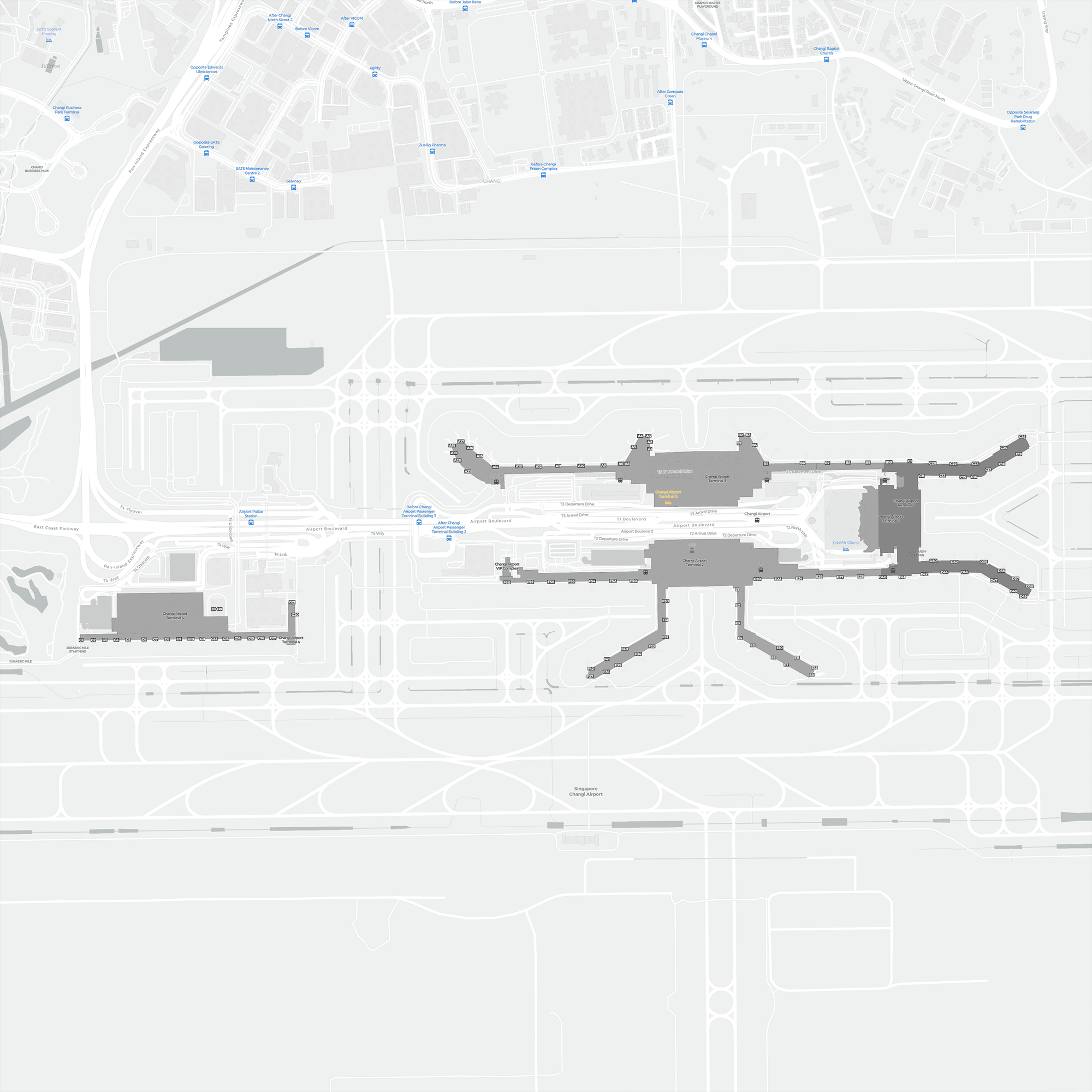
Interactive map — Singapore Changi Airport locationInteractive Map
View this airport on other map services:
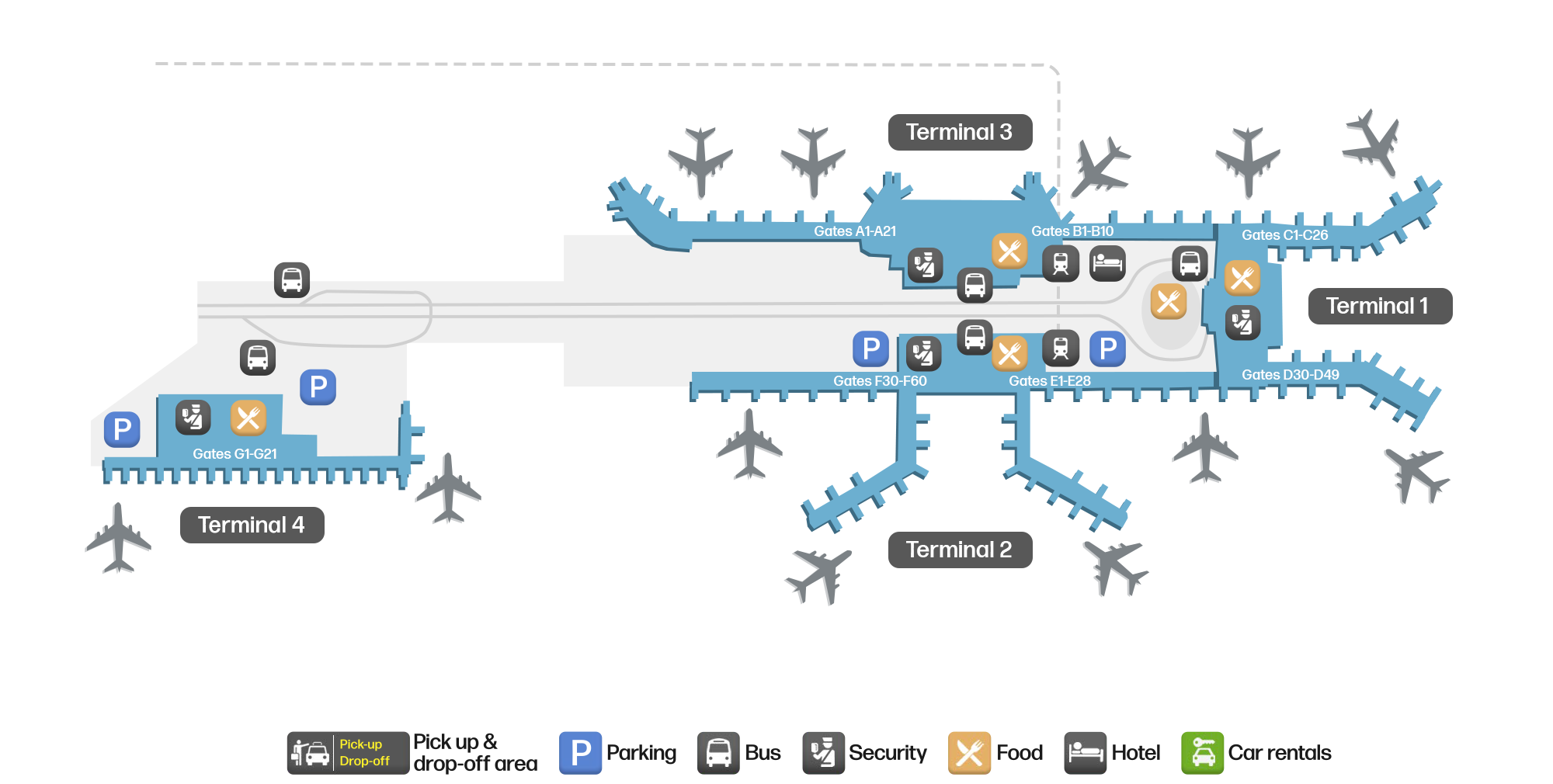
Singapore Changi Airport terminal guideAirport Guide
Changi has four terminals, handles around 70 million passengers a year and sits about 20 km from the city centre. Its gates are numbered by terminal zone, so reading the letter prefix tells you which building you need before you set off.
Terminals and their gate zones
| Code | Name | Gates | Gate count |
|---|---|---|---|
| T1 | Terminal 1 | A1–A20, C1–C5 | 25 |
| T2 | Terminal 2 | E1–E25, F1–F10 | 35 |
| T3 | Terminal 3 | A1–A20, B1–B10 | 30 |
| T4 | Terminal 4 | G1–G11 | 11 |
How the letters map to buildings:
- C, E, F and G each belong to exactly one terminal (C→T1, E/F→T2, G→T4).
- A and B appear in both T1 and T3 — the letter alone cannot tell you which terminal you need. Go by the terminal number printed on your boarding pass.
That is exactly why it is worth writing down: at Changi, read the terminal number first and the gate letter second. Doing it the other way round is how people end up at the wrong building.
Moving between terminals
- Skytrain — free inter-terminal shuttle, and the quickest way to change building.
- On foot — walkways also connect adjacent terminals and are often faster than waiting at peak times.
If your two flights are in different terminals, allow time for the change. A gate letter that jumps zones (E to G, say) means a building change plus a walk, which is the slowest kind of connection here.
Routes and flights
| Aspect | Detail |
|---|---|
| Routes | A record around 70 million passengers in 2025; about 100 airlines connect Singapore to more than 170 cities. Long-haul points reach as far as New York, London, San Francisco, Sydney and Frankfurt; the busiest regional routes are Kuala Lumpur, Bangkok, Jakarta and Denpasar. |
| Flights | Around 374,000 aircraft movements in 2025 (up about 2%), equal to some 7,300 flights a week — roughly 1,000 a day. |
| Aircraft | The main bases are Singapore Airlines (SQ) (Star Alliance; a ~140-aircraft widebody fleet of A350, A380, 777-300ER and 787-10) and its low-cost subsidiary Scoot (TR) (an all-787 fleet). |
Getting into the city
- MRT East West Line — from Changi Airport station straight into the city, and the cheapest option.
- Airport buses — night routes cover the city, useful for red-eye arrivals.
- Taxi — separate, well-signed pickup tiers; the easiest choice late at night.
- Skytrain — inter-terminal only; it does not go into the city.
Practical tips
- At only 20 km out, the MRT gets you downtown in around half an hour — you do not need to over-buffer the ground transfer.
- The terminals are a destination in themselves: with a long connection you can follow the signs into another terminal and come back to your gate.
- Arriving after the MRT stops for the night, take a taxi or a night bus route rather than trying to walk out of the airport.
Terminal guideTerminal Guide
Gate ranges, main airlines and facilities for each terminal at Singapore Changi Airport.